Intentions of the Holy Father for April

Ecology and Justice. That governments may foster the protection of creation and the just distribution of natural resources.
Hope for the Sick. That the Risen Lord may fill with hope the hearts of those who are being tested by pain and sickness.
Showing posts with label signs of the times. Show all posts

An Unlikely Alliance to Overthrow the West: More Signs of the Times

CNSNews.com has two pieces that struck me.

The first piece reports on comments made by Harry Knox, who serves on President Barack Obama’s Advisory Council on Faith-Based and Neighborhood Partnerships. In the National Prayer Hour during which the accompanying video is recorded, Knox calls evil (in this case, the distribution of contraception) good, and good (Pope Benedict XVI) evil (for opposing the distribution of those sinful little population control devices) (Isaiah 5:20).  Notably, this event is the American Prayer Hour, not intended to call upon God Almight for his help with some issue or another, but to affirm on their own "inclusive values" and to call on Uganda to stop being mean by doing things like outlawing sodomy.  The Pope's reason - aside from the religious - for disapproving of the use of contraception to fight the spread of HIV is that is just doesn't work.  Even though Pope Benedict XVI has, on this issue, the backing of findings of
researchers at notoriously flim-flam, conservative institutions like Harvard, Knox reasserts his claim that the Pope and the Church are hurting poor people in the name of Jesus.  Knox, unlike the Church, cares very much for (heterosexual and juvenile) HIV patients in Africa and Asia.  He does all sorts of things to help them, like run orphanages for HIV-infected children, has cooperated with all sorts of federal programs to prevent the spread of AIDS at home and abroad, has been conducting vigorous propaganda campaigns in Africa against risky behavior, and provide about 25% of the world's AIDS patients with their primary care.

Oh, wait.  My mistake.  It's the Catholic Church that does those things for AIDS patients.

The second piece reports on a Dutch legislator being prosecuted for "discrimination and incitement to hatred" for claiming that the Koran has been linked to extremist violence.  I know what you're thinking: what an outlandish claim.  I know.  Aside from the backwardness of prohibiting free speech, the Dutch prosecutor doesn't seem to think that the actual truth of the statements made should be relevant to their prosecution.  The whole bit makes me think of the final book in C. S. Lewis' The Chronicles of Narnia, in which some treacherous Narnians sell their people out to a foreign, despotic people from southern deserts, in the hope of personal gain.  The Dutch legislator being prosecuted has asked to call for his defense Mohammed Bouyeri, a "Dutchman" of Moroccan extraction convicted of shooting and stabbing to death Theo Van Gogh for making a documentary that claimed unpleasant things about Islam.  Bouyeri stuck a note to van Gogh's chest using the knife with which he murdered the filmmaker.  In the note, he also threatened to murder Dutch legislator Ayaan Hirsi Ali, a nationalized Somali woman who uses her new Dutch nationality and legislative voice to campaign against the abuse of women in peaceful Islamic countries like Iran and her native Somalia.  Surprisingly, the Dutch prosecutor and judges in the case is nervous about calling Bouyeri to the stand.


I am concluding that the powers that be hate Jesus Christ, the Catholic Church, and the West they built up so much that any enemy of His will suffice as an ally.  It does not matter to them what lies they tell or whom they invite to come be their new caliph.  This whole democracy thing is passe, anyway, right?  Time to progress to something better.

Signs of the Times

It is not terribly shocking to hear that Fr. Alberto Cutié has decided to defect from the Catholic Church, and go to one (the Episcopal - that is, Anglican-in-America) in which things will be more to his liking. For one, they don't mind his inability or lack of ongoing commitment to celibacy. Fair enough - they don't require or esteem celibacy in the first place. More intriguing is the fact that they don't mind that he is an oath-breaker. He made solemn promises of obedience and celibacy, and now has unilaterally dodged them both in one fell swoop. They don't suit him anymore. One would think that Fr. Cutié's new superior would at least want to be sure that he can stick to a vow, no?

Well, it's perhaps fitting, after all. After all, the Anglican Communion was founded when an oath-breaking king became tired of his promises regarding sexuality, and decided to put away his first wife for another. And another. And another. One wonders how many churches Fr. Cutié will put away to suit his evolving tastes before the whole thing is done. It's a little known fact that England and her kings were legal vassals (governmental subordinates) of the Pope until Henry VIII broke his forefathers' faith. In most of Europe, the Pope could take up special collections and so forth; in England, he could collect taxes and call for soldiers. Henry VIII would rather have things his own way, though, rather than honoring the promises of his fathers. Now that Fr. Cutié has broken with Rome, one must wonder if he will really let himself be governed by another master, or if he will be his own... if perhaps he is already his own master. That's the devil's motto, in Milton's Paradise Lost: "I will not serve." That and his television show frankly smack of a towering pride.

Meanwhile, our President has named an ambassador to the Holy See: Miguel Diaz. He is Catholic, in the way that the Sandinistas are. He is "pro-Life," in the way that Douglas Kmiec and the President are. He publishes on presses that call themselves Catholic but are either notorious for dissent, uncommitted to the teachings of the Church, or flat out deny the entirety of Christian revelation. Like Fr. Cutié and the President, he is young, good looking, smooth, and charismatic. He has a track record of supporting social justice issues for the poor and weak (except for, as one commentator has pointed out, the poorest and weakest, i.e., the unborn). He is suave and probably very convincing, and will probably be charged by the White House with getting the Vatican to believe that white is black and black is white, that good is evil, and evil good.

And against these slicksters, whom can Holy Church send forth, tattered and bruised by her own conduct as much as by that of her enemies? The likes of this man:

Now, don't get me wrong. Archbishop Favalora of Miami is likely a very competent administrator, strong shepherd, and loving father. He has enormous responsibilities of which, dear reader, you and I cannot even dream. I wouldn't criticize a bishop to save my life, I hope. I used to, but I'm done with that. It just helps out our enemies. And His Excellency's words regarding Fr. Cutié strike me as very well chosen. Still, looking at him and hearing his words will not be very convincing to most Americans - Catholic or otherwise - when the likes of Fr. Cutié or Prof. Diaz is sitting on the opposite side of the talk-show host. The Archbishop certainly has authority over both them (well, over Diaz only indirectly, since Diaz doesn't live in his diocese), and his reasoning is doubtless sounder than that of Cutié. All the same, I have a sickening feeling in my gut that many, many of the priest's fans, preferring to have their ears tickled, will choose him over Jesus' plump, wrinkly old vicar in Miami.

"For the time is coming when people will not endure sound teaching, but having itching ears they will accumulate for themselves teachers to suit their own likings, and will turn away from listening to the truth and wander into myths," 2 Tim 4:3-4.

A close friend of mine is being ordained a priest this weekend in Burlington, Vermont. Several more friends from my time in seminary will be ordained priests and (transitional) deacons in the next few weeks. They are young. Some are more charming and charismatic than others, but they are all very good men and that shines through. They believe in Jesus. They love and obey his Church. They defend life. I couldn't close without pointing out a few stars amid the dark night sky.

The Culture of Me

This from the Washington Post (http://www.washingtonpost.com/wp-dyn/content/article/2008/02/28/AR2008022803315.html?hpid=smartliving&sid=ST2008022901519)

Me
If It's All About You, You're in Trouble. Why a Sense of Entitlement Can Wreak Havoc on Happiness.

By Dan ZakWashington Post Staff Writer
Sunday, March 2, 2008; Page N01

Broad pronouncement of the week: We are entitled brats.

For immediate proof, turn on the television. Locate a reality show on Bravo or MTV. The "Real Housewives of Orange County" and their real children are halfway through a marathon of placating and whining. "The Hills" and "Newport Harbor" are stocked with people who expect to be treated with a disproportionate amount of respect, lest they erupt in a raging meltdown.
We watch these shows in horror, with a judgmental eye on their cast members, but how different are we from them? In real life, we want what we want and we want it now. No delay. No aggravation. No hassle, pain-free, our way, right away. We're a highly technical society in a land of plenty. We place a premium on efficiency and convenience. Tiny annoyances and inconveniences foul our moods and affect our behaviors. Why? And how can we get past these trivialities?

Consider this paradox: Things are becoming more instantaneous in an era when delays are rampant and increasing. There are faster flights and cars but more people in airplanes and on the roads.

What has happened, even though companies are improving service, is that "customer expectations are continuing to rise," says Roger Nunley, managing director of the Customer Care Institute in Atlanta. This can be attributed to "consumers doing business online, where they get instant gratification and quick turnarounds. That's quickly becoming the standard expectation."
Change in expectations is a generational thing, experts say. People who grew up during the Depression were happy to have a job and stuck with one for a lifetime. Many members of generations X and Y were raised in a different light. They expect a buffet of opportunities and are peeved when they don't materialize.

Narcissism and entitlement among college students have increased steadily since 1979, according to a study to be published this year in the Journal of Personality. Between that year and 2006, 16,000 college students were asked to pick between such paired statements as "I expect a great deal from other people" and "I like to do things for other people," and "I will never be satisfied until I get all that I deserve" and "I will take my satisfactions as they come."
The data are clear: The ascent of narcissism and entitlement is dramatic.

"What we really have is a culture that has increasingly emphasized feeling good about yourself and favoring the individual over the group," says the study's co-author, Jean Twenge, a professor of psychology at San Diego State University. "And that has happened across the board, culturally, and it's showing no signs of slowing down."

To complement her research, Twenge offers evidence from the field: "I have a 14-month-old daughter, and the clothing available to her has 'little princess,' or 'I'm the boss,' or 'spoiled rotten' written on it. This is what we're dressing our babies in."

Schools have programs designed to boost self-esteem. Parents say things like, "You shouldn't care what other people think of you." We're inundated with the notions of "feeling special," "believing in yourself" and "be anything you want to be." Twenge ponders all these messages in her book "Generation Me: Why Today's Young Americans Are More Confident, Assertive, Entitled -- and More Miserable Than Ever Before" (Free Press, 2006).

Quite a title, but doesn't it feel kind of right? Twenge also coins the term "iGeneration" ("i" as in both iPod and "me, me, me"), which includes those of us born in the general range of 1981 to 1999.

This goes beyond social conditioning and technology, though. Entitlement is something that's part of human narcissism. It's an ego thing that transcends generations. When something goes wrong for others, it's their fault. When something goes wrong for us, it's not ours; it's the fault of external forces. We project blame.

This projection often antagonizes a situation. Feeling entitled to something you aren't getting leads to frustration, which leads to bratty behavior and confrontation. Nearly 80 percent of Americans say rudeness -- particularly behind the wheel, on cellphones and in customer service -- should be regarded as a serious national problem, according to a study by the opinion research firm Public Agenda.

An airport is a petri dish for rude behavior: a bunch of people in close quarters under time constraints. Stress and impatience lay down the welcome mat for brattiness.
"You have people screaming at customer representatives at airports because it's snowing out -- as if they're entitled to have a sunny day," says professor W. Keith Campbell, who specializes in the study of narcissism at the University of Georgia. "That's where it gets out of hand. With entitlement, the issue is, yeah, there are certain times where we're entitled and other times we're not. The problem is when we have that meter wrong."

It's unreasonable to spend an hour on hold, in other words, but there are situations when basic entitlement turns into self-infatuation and blatant disrespect for others. All of this is tied to the feeling of not being satisfied, of thinking that some force is blocking the way to a goal we think we deserve.

"The question is, 'What the heck is enough?' " says writer and psychologist Carl Pickhardt, who specializes in parenting and child development in his private practice in Austin. "I see that all the time. A couple comes in for marriage counseling, and they ask me, 'Are we happy enough?' Somebody's at a job they like, but are they successful enough? People have to make that choice. We are a dissatisfaction market society. Advertising constantly creates the notion that whatever we have is not enough. We can declare independence of that."

But how? It's about realigning our expectations and then squelching the nagging voice in our minds that propels our discontent. Pennsylvania psychologist Pauline Wallin calls this voice our "inner brat," which is an evil twin to our "inner child." After years of counseling clients who routinely made mountains out of molehills, Wallin dived into the concept, named it and produced the book "Taming Your Inner Brat: A Guide for Transforming Self-Defeating Behavior" (Wildcat Canyon Press, 2004).

"We have enough big things to be upset about, and people are losing their minds over small things," she says. "Frustration leads to aggression. If you don't let yourself get frustrated in the first place, then you don't get so angry and you don't blow things out of proportion."
Stress also fuels bratty behavior. It makes us impatient and irritable from the get-go. Psychologist Ronald Nathan of Albany, N.Y., recommends practicing relaxation techniques when waiting for such things as the Metro, the doctor or tech support. This turns a disadvantage (the frustration of waiting) into an advantage (making good use of that time to relax).

"Whether you are tempted to interrupt someone or are trying to get around a slow car -- when you're under stress you tend to react rather than respond," says Nathan, who specializes in stress. "Look at what you're telling yourself about your world and how you are interpreting it. We sometimes interpret the world as a set of 'shoulds,' 'oughts,' 'have to's,' 'musts,' 'deserves.' Those are exaggerations. It's a very competitive world we live in, so we easily get frustrated."
Nathan has trademarked a technique for stress relief that has a time-release formula ( http://www.relaxfastforfree.com). It involves setting some kind of unobtrusive alarm -- the vibrate function on your cellphone, for example -- to remind you to take several minutes to do some deep belly breathing and loosen your muscles and limbs. After several months of conditioning yourself to do this at certain times of the day, this kind of reframing of the mind can become automatic.

Another habit to form is being grateful. Clinical experiments show that people who express gratitude in some form every day live more-content lives, and they record lower levels of narcissism and entitlement.

"On the drive home from work, it's a matter of turning the radio off and thinking about how wonderful your job is or, if your job sucks, how wonderful your family is or, if your family's in shambles, how good your health is," says psychology professor Mike McCullough, who studies gratitude at the University of Miami.

He helped conduct one experiment titled "Counting Blessings Versus Burdens," wherein one group kept a journal of their daily hassles for a period of time while another recorded the times they were grateful. The outcome may be obvious, but it is no less instructive: People who concentrated on hassles were generally miserable; the others were pleased and satisfied.
It comes down to perspective and expectations. Do you want empty highways, no lines, a promotion and limousine conveyance to your birthday party? Fine. But don't expect them. Focus on your reliable car, your good health, your job stability or the fact that you're in a position to celebrate a birthday at all.

"When you're feeling this sense of deprivation or entitlement, try to take the longer view," McCullough urges. "Ask yourself, 'Is it really true -- empirically true -- that you are entitled to something?' In most cases, people say no."

A Dawn in the East

Epiphany of Our Lord (Jan 6)


Phane, in Greek, means "torch." An "epiphanos" in ancient Greece was a torchlit procession or parade, as part of a religious or civic ceremony, or a popular demonstration. The idea carried by the word "epiphany" is a bright, blazing forth like fireworks in the night - it is not just a demonstration, but a manifestation; not just an appearance, but a revelation. It is a bold work in an otherwise gloomy time.
The Feast of the Epiphany commemorates specifically the visit of the magi to the Baby Jesus, but more generally all those acts by which the Father has revealed His great love for us. Yesterday at the National Shrine of the Immaculate Conception in Washington, D.C., the priest who preached at the 10:30 a.m. Mass had a very interesting metaphor for God's self-revelation to the world. He said the theme is light in the darkness of a world blanketed in sin, and we see this all the time - every day.
In the earliest hours of the day, the world is covered in darkness with only perhaps some starlight. With great difficulty, you might walk across a room or a field, but you must be careful or else you will stub a toe or turn an ankle. This situation is like the world before God's supernatural revelation, with only natural reason and the imprints God has left in nature to give us faint signs of his love and plan for us.
The first set of revelations, to the Jews, are like the full moonlight. By them, one can walk around with greater ease, even maybe in a dense forest. But it is still easy to get lost and more is needed to move with the fullest ease. Similarly, with the Jewish revelation, one can live a good life and know of God's great love for us. But to live the sort of life God has in mind for us is still not possible.

With the early events of Christ's life, the Annunciation to Mary, the birth of Christ, the visit of the wise men from the East, God's fullest revelation begins. The sun itself dawns. As our Lord teaches, the full light of day begins to shine. With His death, Resurrection, and Ascension, the sunlight of God's love for us is at full noon. Since the time Our Blessed Lord ascended from the earth, the sun has begun slowly to set.
It is not that God has abandoned us - we must remember that as times continue to get darker and darker. These things were foretold and promised. We should expect them. It is that God's love made so manifest is now again being obscured from our sight by the darkness of sin and hatred in the world, which are themselves as clear as the sunlight they try to block out. We do not see God or his love for us with our own eyes, as the Apostles did. We see by Faith.
Our Holy Faith tells us to be confident that the sun will dawn again, and this time in a blazing eternal day that will never end. The sun, when He returns, will never set again. It is for this that the Christmas season is meant to prepare us. It is for this that we hope.

Miguel Pro and Christ the King

This past Sunday was designated as Solemnity of Christ the King. Originally promulgated in the 1925 document Quas Primas by Pope Pius XI to occur on the last Sunday of October, the feast is now celebrated each year on the last Sunday of the liturgical year - the Sunday before the beginning of Advent.

Culturally, the feast is meant to fly in the face of all that we hold dear in democratic countries: self-determination, representation, policy by consensus. Pope Pius XI read the signs of the times and could smell the growing determination by world leaders not to be bound by traditional morality. While Communists overthrew Russia and the revolutionary government in Mexico became violently anti-Christian, even Christian Europe witnessed new trends and social programs opposed to good morals. It was clearer and clearer to the Holy Father that an assault against Jesus Christ himself was underway. Placing the feast at the end of the year is perfect. The readings taken from the Mass and the Liturgy of the Hours (especially those from the books of the Maccabees) for the end year all draw our attention to the Lordship of God. The readings do so in a stark way: example after example is given of worldly rulers claiming absolute dominion - even insisting that people violate the laws of God to prove their loyalty. In these cases, the readings dramatically highlight the necessity of martyrdom by those who love God.

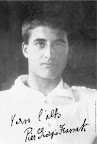
One modern example given to the Church on November 23 is that of Blessed Miguel Pro, S.J. The young Jesuit found his studies for the priesthood interrupted by the Mexican Revolution. His seminary was moved to Texas, and after a time there, he finished his studies in Belgium. By then, the persecution of the Catholic Church in Mexico was in full swing. Where the laws were enforced, priests were forbidden to wear special attire, renounce allegiance to the Church, cease performing sacraments, required to marry, and executed for refusal to any of those things. Priests were literally being shot in the street wherever they were found. Bl. Miguel volunteered to return to this environment because he suffered to see his countrymen go without the sacraments, with nobody to preach the Gospel to them, with nobody to remind them that God heard their cries and would not leave them alone forever.

After sneaking back into Mexico, Bl. Miguel evaded the authorities for a few years. Frequently he would slip right under their noses using the same sort of clever disguises that he and his siblings had used in their amateur theatre performaces as children. He even made so bold as to evangelize soldiers and police officers in places where "wanted posters" displayed his picture! By the time the young priest was apprehended in Mexico City, he was personally arranging the food and rent money for hundreds of families dispossessed for adhering to Holy Church, as well as offering Mass illegally numerous times weekly to crowds of people numbering into the hundreds. At last he was betrayed, like Christ, by one of those who benefited from his labors. Arrested with two of his younger brothers on the pretext of an assassination attempt, he refused the opportunity to disavow his priesthood, and was ordered to be shot by a firing squad in front of ambassadors and the press corps of the world's socialist and communist countries and organizations. So it was that, refusing a blindfold, Bl. Miguel stood before his murderers, facing them calmly, and forgave them aloud. Then, as the command to raise rifles was given, he threw wide his arms and shouted out "Viva Cristo Rey!"

Long Live Christ the King!

This pose is the one captured by photographers. Some of them, though socialists, were awed by his bravery, and within days holy cards had been made from the photographs and were circulating illegally. He was forbidden a public funeral, but the government was unable to act against the tens of thousands who showed up to escort the body to its burial site.

The question we have to ask ourselves, whatever our state in life, is whether Christ is king over us.

Do I avoid sin for fear of offending Him? Or do I make excuses?

Do I engage in thankless service in order to please Him? Do I only do the good things I like?

Do I rearrange my affairs to accord more completely with His desires?

Do I fear the opinion of other people, even strangers, more than I fear provoking God?

Am I willing to part with anything - ANYTHING - material possessions, habits, relationships - the moment it begans to interfere with my relationship with Jesus Christ?

In calling myself a Christian, "One of Christ's" I am implicitly answering the above questions. Do I answer them the same way in acting like Christ?


If Jesus Christ is not the Lord of my Life, the King of my Heart, then He is just a nice prop in my life that I take out sometimes, maybe once a week or so, to make me feel better about myself. We have cause to concern about this situation because Our Lord, the King of the Universe, himself said, Not every one who says to me, `Lord, Lord,' shall enter the kingdom of heaven, but he who does the will of my Father who is in heaven. On that day many will say to me, `Lord, Lord, did we not prophesy in your name, and cast out demons in your name, and do many mighty works in your name?' And then will I declare to them, `I never knew you; depart from me, you evildoers,' (Mt 7:21-23).

Again, it is fitting that the feast of Christ the King comes at the end of the year, because when all is said and done, Jesus Christ is Lord. On the Last Day, He will have the last word.