Intentions of the Holy Father for April

Ecology and Justice. That governments may foster the protection of creation and the just distribution of natural resources.
Hope for the Sick. That the Risen Lord may fill with hope the hearts of those who are being tested by pain and sickness.
Showing posts with label prayer. Show all posts

The Spirituality of the Fast

This post was going to start out about the spirituality of fasting, as you may have guessed from the title. I hadn't put down the first words yet when I realized how pompous it would be to sit down to such a topic, that has graced the pens of sages and saints from St. Matthew to St. John Paul II. With these men of deep prayer and learning, who labored and loved the Lord, having doubtless spent thousands of hours and days learning about this subject the hard way, anything I can say in an abstract vein will be glib. I might as well talk about the ardors of child rearing.

Instead, I will leave it alone and note that while I am fasting, I feel the deep hunger in my soul, that the rest of the time I cover up with all sorts of things trivial or terrible. Fasting is sacramental in this way, that it makes physically manifest a spiritual reality.

The days I fast are long, and tiring, and usually more peaceful than the days in which I do not. That seems odd, in a sense, because things like hunger are supposed to add tension to the nerves. Maybe an added element is that when I fast, I lay my fast at the feet of Our Lady as often as I can remember to do so. She who prays for us now and at the hour of our death cannot help but notice my hunger and assuage it somewhat with her love.

But Can I Be Peter?

The readings today (Third Sunday of Easter: Acts 5:27-32, 41-44; Ps 30; Rev 5:11-14; Jn 21:1-19) got me thinking on an old topic.  A few weeks ago, I asserted that I am Judas.  A friend blogger begged to differ.  LuceMichael commented:

I dunno Ryan, I'm going to have to disagree with you on this one. What Judas did was purely evil. Not just sinful, but truly and historically evil. Saying "I am Judas" is akin to reckoning ourselves as the contemporaries of Jesus who condemned Him to death, a view which VII rejects, btw.

More appropriate is a comparison to Peter, or the other apostles who abandoned Jesus in fear and denial. They sinned, turned away from doing the right thing, but in the end, were redeemed and in the case of Peter, who was exhorted by the Lord to "turn back and strengthen" the others, much good came from a flawed man. In fact, the papacy and Magisterium came from him, once he was humbled, contrite and forgiven.

There is always the philosophical and theological conundrum of whether Judas is in Hell. While none of us can say for sure, there is at least a strong likelihood that he *is* in Hell, having sold out the Lord, and taking his own life in despair of mercy.

Judas and Peter make an interesting contrast in their response to the own guilt in the passion. But most of we Christians are NOT Judas; most of us, though we sin carelessly, thoughtlessly, or maliciously and with intent, still do not come to the level of evil that Judas attained. With the grace of God, I will never completely deny Jesus. Through all my sins and faults, I know Him to be my Lord and Savior.

And He is Risen!
My major point was that my sins are the things that necessitate the death of the Messiah.  In a way, Judas was less culpable than I, perhaps, because he was more confused about who Jesus is.  I, on the other hand, know precisely who Jesus is, and yet sin and sin again.  We must be careful here, because the sin that landed Judas in hell, if that is where he is, was not treason against God, nor was it apostasy.  Those sins are forgivable (Jn 20:23).  St. Peter committed the same sins after all, though in a different way.  The sin of Judas was rejection of forgiveness, rejection of the Holy Spirit prompting him to repentence.  Judas thought that somebody like himself, someone so enormously important who had done a thing so enormously wrong, could never be forgiven.  And, in a sense, he was right.  Without repentence, there can be no forgiveness of sins (Mk 3:29; CCC 1864).

But St. Peter repented.

Her point is very well made.  Judas killed himself (Mt 27:5-8) but St. Peter repented.  In today's gospel reading, our Lord asks St. Peter three times if he loved Him as they strolled along the beach together, perhaps arms-over-shoulders.  The threefold act of love that St. Peter makes rehabilitates him after the threefold betrayal.  Note well that these acts of love, these acts of contrition, do not undo what Peter has done, but rather, they set him on a new path.  So it is with the penances that we perform after our confessions.  They actualize our repentence and put us on a new path  So how do we get to be like St. Peter, who did so many wonderful things for the Church, even dying for the sake of our blessed Lord?
 
We repent.

Face it.  We are probably not going to stop sinning any time soon - though make no mistake: in grace, it is possible, so strive for heavenly perfection.  Strive for sanctity!  But, observing our own failure, our own repeat failures, even our own egregious failures, we must not give up.  We must not go hang ourselves as Judas did, either literally or metaphorically.  Do not say of our holy religion, "This is a hard saying; who can listen to it?" (Jn 6:60) and then abandon it as those who could not stand the Eucharistic teaching of our blessed Lord (John 6:66).  Examine your conscience and pray for the grace of honesty.  So many people are afraid to confront their own sins, so they say, "Oh yeah, well the Church sucks because of X."  When we have reached our maximal efforts and failed yet again, perhaps we will then realize on a deep, deep level that it is not our own efforts that save us.  Most of us, Catholic, Protestant, Evangelical, Pentecostal, really believe deep down inside believe that we can save ourselves, that we must save ourselves, that we must prove ourselves to God.  That is all bosh.

Jesus Christ saves us.

"While we were yet sinners Christ died for us," (Rom 5:8).  He loves us even in the midst of sin.  And no matter how badly we sin, we have only to turn back, confess our sins to a priest, and receive the gift of a fresh start.  We must pray for the courage to face our sins head on, for the grace to be St. Peter.

The Resurrection: Fridays in Eastertide

So during this eight-days-in-one that we call the Easter octave, we've been reflecting about what the Resurrection of Jesus of Nazareth, the Christ, means.  We've looked at what the Apostles meant, and that the Church still means the same thing today.  We've looked at how the Resurrection manifests Jesus as Lord and God, with power over life and death - and how he plans to share his kingdom with us by giving us a new way of life.  We've looked at how that new way of life can begin now, and how it will lead us to an eternity of joy.

So what is the proper response of a Christian?  Let's look at Psalm 116, my favorite, for some suggestions.

I love the LORD, because he has heard
         my voice and my supplications.
Because he inclined his ear to me,
         therefore I will call on him as long as I live.
The snares of death encompassed me;
          the pangs of Sheol laid hold on me;
          I suffered distress and anguish.
Then I called on the name of the LORD:
          "O LORD, I beseech thee, save my life!"
Gracious is the LORD, and righteous;
          our God is merciful.
The LORD preserves the simple;
          when I was brought low, he saved me.
Return, O my soul, to your rest;
          for the LORD has dealt bountifully with you.
For thou hast delivered my soul from death,
          my eyes from tears,
          my feet from stumbling;
I walk before the LORD
          in the land of the living.
I kept my faith, even when I said,
          "I am greatly afflicted";
I said in my consternation,
          "Men are all a vain hope."
What shall I render to the LORD
          for all his bounty to me?
I will lift up the cup of salvation
          and call on the name of the LORD,
I will pay my vows to the LORD
          in the presence of all his people.
Precious in the sight of the LORD
          is the death of his saints.
O LORD, I am thy servant;
          I am thy servant, the son of thy handmaid.
         Thou hast loosed my bonds.
I will offer to thee the sacrifice of thanksgiving
          and call on the name of the LORD.
I will pay my vows to the LORD
          in the presence of all his people,
          in the courts of the house of the LORD,
          in your midst, O Jerusalem.
Praise the LORD!
The Psalmist is deeply grateful to the LORD for having saved him from the "snares of death," the "pangs of Sheol," and from anguish and distress.  When he was tearfully stumbling, consternated by the abandonment of human consolations, God "dealt bountifully" with him.  The Psalmist, as he often does, prefigures Christ with his prayers.  The Holy Spirit invites us to make the prayer our own, to pray like Jesus, and so the prayer is an invitation to the imitation of Christ.  Jesus was raised up from "the snares of death" by God.  What was Jesus' response to being raised from the dead?

He offered the Eucharist (Lk  24:30), a word that means "thanksgiving" in Greek, a ceremony that He made a sacrifice of His flesh and blood (1 Cor 11:23-5; Mt 26:26-8) by His sacrifice on the cross, a sacrifice that draws us into communion with Him, and thence to God, and thence to all the others in communion with God for an eternity of Joy (Jn 6:48-57).  The Eucharist is literally our participation in Jesus' sacrifice of thanksgiving.  It is how we thank God for what He has done for us.  Moreover, it is how God does for us what He has done for Jesus.

(hat tip to Veritas Vos Liberat)

"Whoa... wait a minute," you might be thinking.  "The Eucharist is how God saves me," you start, and then continue, "and it is how I thank God for saving me?"  Yup.  "But, I don't get it.  What does that mean?  What do I have to do?"  Nothing.  Just accept it gratefully.  Make it our weekly (daily?) act of thanksgiving to God, and we will have received what He would give us.  He doesn't want our actions - whatever you and or I can do, He can do better anyway.  He doesn't want our charity.  He doesn't want our money.  He doesn't want our apologetics or evangelization or even our prayers.  Doesn't need 'em.
God, infinitely perfect and blessed in himself, in a plan of sheer goodness freely created man to make him share in his own blessed life. For this reason, at every time and in every place, God draws close to man. He calls man to seek him, to know him, to love him with all his strength. He calls together all men, scattered and divided by sin, into the unity of his family, the Church. To accomplish this, when the fullness of time had come, God sent his Son as Redeemer and Savior. In his Son and through him, he invites men to become, in the Holy Spirit, his adopted children and thus heirs of his blessed life.
He just wants us.

The rest will follow.  So simple.  Die to yourself by going to confession.  A real deathblow happens there - the ego is given a tough kidney shot, at the very least.  Then go to Mass.  Pray silently along with the priest.  Enter into the prayers.  Enter into Christ.  Receive Him with an open heart to whatever He wants.  Give thanks and praise.  And then "do whatever He tells you," (Jn 2:5).

Friday is the day on which Catholics generally (at least in former times, though we are still asked to) give up meat, in honor of the day on which our Lord gave up His own flesh.  May I humbly suggest that, at least during the fifty days of Eastertide, we take up the sacrifice of thanksgiving by going to Mass an extra time, perhaps on Fridays, to sing the praises of God?

The Resurrection: Eyes on Jesus

Excerpts from the gospel reading for the day is one of the most excellent:

That very day, the first day of the week, two of Jesus’ disciples were going to a village seven miles from Jerusalem called Emmaus, and they were conversing about all the things that had occurred. And it happened that while they were conversing and debating, Jesus himself drew near and walked with them, but their eyes were prevented from recognizing him. He asked them, “What are you discussing as you walk along?”  They stopped, looking downcast.

One of them, named Cleopas, said to him in reply, “Are you the only visitor to Jerusalem who does not know of the things that have taken place there in these days?”

And he replied to them, “What sort of things?”

They said to him, “The things that happened to Jesus the Nazarene, who was a prophet mighty in deed and word before God and all the people, how our chief priests and rulers both handed him over to a sentence of death and crucified him.  But we were hoping that he would be the one to redeem Israel; and besides all this, it is now the third day since this took place.  Some women from our group, however, have astounded us: they were at the tomb early in the morning and did not find his Body; they came back and reported that they had indeed seen a vision of angels who announced that he was alive.  Then some of those with us went to the tomb and found things just as the women had described, but him they did not see.”

And he said to them, “Oh, how foolish you are! How slow of heart to believe all that the prophets spoke! Was it not necessary that the Christ should suffer these things and enter into his glory?”  Then beginning with Moses and all the prophets, he interpreted to them what referred to him in all the Scriptures.  As they approached the village to which they were going, he gave the impression that he was going on farther.

But they urged him, “Stay with us, for it is nearly evening and the day is almost over.”  So he went in to stay with them.  And it happened that, while he was with them at table, he took bread, said the blessing, broke it, and gave it to them.  With that their eyes were opened and they recognized him, but he vanished from their sight.  Then they said to each other, “Were not our hearts burning within us while he spoke to us on the way and opened the Scriptures to us?”  So they set out at once and returned to Jerusalem where they found gathered together the Eleven and those with them who were saying, “The Lord has truly been raised and has appeared to Simon!”  Then the two recounted what had taken place on the way and how he was made known to them in the breaking of the bread.

Luke 24:13-35

In his homily, Monsignor made a couple astounding points.  "[The disciples'] eyes were prevented from recognizing him," Monsignor conjectured, because they were "downcast."  The disciples were not looking for Jesus in those darkest days of human history; they were looking at the ground.  They thought that He was done and that they were abandoned.  We must not focus so much on ourselves and on our own problems that we miss Jesus even while He is there with us, teaching us, and setting our hearts aflame - if only we will look to Him and listen.


I would like to point out that the disciples actually recognized Jesus for who He is in "the breaking of the bread," the Eucharist.  Hearing the Word of God explained to them prepared them to receive the Word of God into their fellowship and into their very bodies.  I would also like to point out that the disciples conversed with Jesus, frankly expressing their troubles and their doubts to Him.  That honesty is part of sincere faith for those who have troubles and doubts.

If we bring our even our dashed dreams and deepest despair to Jesus, who knows what he might make of them?  Keep praying.  After you have said your peace, listen in prayer.  Speak with other disciples.  Read the scriptures.  Confess your sins, if needs be.  Visit the Eucharist at church, hear Mass, receive communion.  Don't give up on Jesus, and try not to be downcast, but fix your eyes on Him and look for Him.  He is risen!

(Lastly, here's a link to the Men of Emmaus, a Catholic fellowship for men based in Gaithersburg, Maryland, for those of you who might be looking for fellow disciples and who live in the area.)

If You Are Feeling Weighed Down

If you are Catholic, and trying to do it (i.e., be Catholic) well, and are paying attention, you probably feeling a little down about all the stuff going on right now.  I know I am.  I don't have anything really articulate to write.  The thing feels to me like a very dense storm cloud, fiercer than normal anti-Church nonsense.  It's very incongruous with the weather being so fine outside my window.  The cross is not ours to bear alone, though.  Please do not give up looking to Jesus, looking to heaven for help.

There should be some consolation in this: that our blessed Lord told us that we would be persecuted (Jn 15:20).  Now, don't get me wrong.  Getting called on sin - that's not persecution, it's a public service that we apparently need.  Being gleefully, ferociously stalked by self-appointed "watchdogs" who completely neglect their own house and who bay and howl for the House of God to be torn down to its foundations, head first - that is a little bit closer to what is meant by persecution.  At least, it gives us a watered-down taste of what our brothers and sisters in other countries face every day on a much more violent scale.  We should allow this animosity provoke us to prayer for our enemies and for our brethren whom they treat worse.
We should also take comfort in this prophecy of St. Peter, the first pope, who himself came against fierce opposition:
For the time has come for judgment to begin with the household of God; and if it begins with us, what will be the end of those who do not obey the gospel of God? (1 Pt 4:17)
If you find yourself fazed or perturbed, please remember these words of Teresa of Avila:
Let nothing perturb you,
nothing frighten you.
All things pass.
God does not change.
Patience achieves everything.
Whoever has God
lacks nothing.
God alone suffices.
 It's going to be OK.  Hold fast, pray, enter into the Triduum with your whole heart.  Remember Jesus.

The Brouhaha Over The Pope

I might be the last to have heard about these events, but it has lately come to my attention that the Holy Father is himself being accused of aiding and abetting child molestation, specifically by ordering the abandonment of the church criminal trial of a vicious child molesting priest in Wisconsin.  The New York Times' Laurie Goodstein "broke" the story, which in reality turns out to be little more than a well-orchestrated hoax, as Fr. Raymond J. DeSouza shows.  In fact, not only do the documents cited by Ms. Goodstein as evidence flatly contradict her assertions, but neither she nor any of the other papers or blogs to carry the story have ever contacted Fr. Thomas Brundage, ecclesiastical judge in the original case that was supposedly thrown out by then-Cardinal Ratzinger.  As the Anchoress points out, this sham is just the next in a string of annual hoaxes, fabrications, and exaggerations that by pure happenstance all come at Eastertide.


Sincere, devoted Catholics are more sickened than anyone else by the horrorific revelations of diabolical priestly sin and of the horrendous abdication of episcopal responsibility that have wracked the Church these last ten and twenty years.  But that's not what these fabricated accusations are about.  Nor are the legitimate stories, for the most part, being so vigorously reported because of a hunger and thirst for justice on the part of the media.  This brouhaha is about ideology.  That's why other organizations, a number of which are far more deeply saturated in this wickedness, are left unscathed by the media; it's why the media won't hesitate to run journalistic garbage as news.  Ideology?  Yes.  Sexual ideology - specifically, birth control, fornication, homosexuality, women's ordination, and so on.

We must pray for our Holy Father.  He has recently asked for prayers that he will not flee from ravening wolves who want only to shipwreck the Church.  This opportunity is one we must not miss to band together with each other and Christ, and to walk with this cross on our shoulder, together, to Calvary.

And The Ayes Have It!


One lesson that leaps out on the Feast of the Annunciation is obedience to God.  Mary's yes to God literally revolutionized the entire world and all of human history.  It rerouted us from the downward spiral of sin and slavery onto the upward path of redemption and grace.

But how can a single yes be so powerful?

A clue can be found by delving into what happens to be my favorite beatitude, if beatitudes are the sort of thing that can be ranked.  Blessed are the meek, for they shall inherit the earth (Mt 5:1) provides deep inside once we understand what is meant by meekness.  Meekness is not door-mat-ishness.  Meekness is the acceptance of reality.  Now, that doesn't sound too hard, but when we consider how much time, energy, money, thought, and emotion are invested into iPods, movies, shopping sprees, expensive vacations, distracting hobbies and enterntainment, and worse, darker things like addictions, we can quickly see that a lot of people prefer to avoid reality.  When we look at the power politics in a place like Washington, D.C., the micromanagement in our own office, or the violent behavior that often dominates in places like the Beltway, we can quickly see that a lot of people prefer to control reality.  The meek person, far from passively giving in to adverse forces, evaluates reality, understands what is possible to him without sinning against God or his neighbors, and then works within those parameters.  The meek person realizes that not only he or she, but also reality, is real too.  The meek person realizes that God is God, and that he is not.  Reality is real, and lying, cheating, or stealing won't make it go away.

This message can be really hard.  Some people feel very deeply that they have been jipped by life, and all of us have some hard knocks, from time to time, that tempt us to lash out against them, against somebody in our life, or against God.  The meek person, trusting in God's providence, rolls with the punches.

The virtue of meekness makes me think of a favorite movie of mine, Slumdog Millionaire. If you haven't seen it, you should.  Two of the movie's main characters are brothers.  One spends his life in tremendous violence, always grasping for a better life.  The other sets his heart on love, accepts circumstances as they come without letting them deter him, and refuses either to do wrong or accept discouragement along the way.  The characters are not Christians, but they come very close to a perfect illustration of the polar opposition between the one who does whatever it takes to get what he wants, and the one who accepts reality as the framework for living life.  If to the latter way of life we add humble trust in God's will and fatherly providence for us, we have the Christian virtue of meekness, the virtue that wins us the whole world.

If we, moved by grace, can be open to God's will and say, "Yes," whatever may come, we will be amazed by what follows.  Since we are not immaculately conceived, we'll typically have years or decades of spiritual grime clogging our heart.  But even this first yes will begin to move things along, open things up, turn things around.  God will begin, perhaps slowly, but certainly surely, to move in our life.  He will not suddenly transplant us to a rose garden of a life - that wouldn't be real.  But as long as we keep saying, "Yes," to Him, He will keep giving us more and more of the raw stuff that joy is made of - love, peace, service, friendship, virtue, a clean conscience, and a sound relationship with Him.  He will give us all the things that we can never seize for ourselves or control like masters.

A great way to say, "Yes," to God, to accept the reality of our own sinfulness and to proclaim the reality of God's amazing justice and mercy, is to go to confession.  Especially during these last days of Lent, and especially if you haven't been in a few months or years, consider going.
Take, Lord, and receive all my liberty, my memory, understanding, and will.
All that I have and am You have given to me,
And I surrender it now to be governed entirely by Your will.
Your grace and Your love: these are wealth enough for me.
Grant me these, Lord, and that shall be enough for me.
Amen.
The Suscipe Prayer of St. Ignatius Loyola

Dear Young People II

Dear young people, do not be content with anything less than the highest ideals!  Do not let yourselves be dispirited by those who are disillusioned with life and have grown deaf to the deepest and most authentic desires of the heart.  The time has come to re-propose wholeheartedly to everyone this high standard of ordinary Christian living.  Refuse to sell your dreams cheaply.  Watch out for the dangerous ways that lead to passing joys and satisfaction.  Deepen your relationship with God through prayer.  Prayer spreads Divine energy.  It makes us live in a new way and gives rise to a revolutionary evangelical style.

St. Agnes of Bohemia

This life of St. Agnes of Bohemia, whose memorial is today, is taken from AmericanCatholic.org:

Agnes was the daughter of Queen Constance and King Ottokar I of Bohemia. At the age of three, she was betrothed to the Duke of Silesia, who died three years later. As she grew up, she decided she wanted to enter the religious life.

After declining marriages to King Henry VII of Germany and Henry III of England, Agnes was faced with a proposal from Frederick II, the Holy Roman Emperor. She appealed to Pope Gregory IX for help. The pope was persuasive; Frederick magnanimously said that he could not be offended if Agnes preferred the King of Heaven to him.

After Agnes built a hospital for the poor and a residence for the friars, she financed the construction of a Poor Clare monastery in Prague. In 1236, she and seven other noblewomen entered this monastery. Saint Clare sent five sisters from San Damiano to join them, and wrote Agnes four letters advising her on the beauty of her vocation and her duties as abbess.

Agnes became known for prayer, obedience and mortification. Papal pressure forced her to accept her election as abbess; nevertheless, the title she preferred was "senior sister." Her position did not prevent her from cooking for the other sisters and mending the clothes of lepers. The sisters found her kind but very strict regarding the observance of poverty; she declined her royal brother’s offer to set up an endowment for the monastery.

Devotion to Agnes arose soon after her death on March 6, 1282. She was canonized in 1989.
Agnes was the daughter of Queen Constance and King Ottokar I of Bohemia. At the age of three, she was betrothed to the Duke of Silesia, who died three years later. As she grew up, she decided she wanted to enter the religious life.

After declining marriages to King Henry VII of Germany and Henry III of England, Agnes was faced with a proposal from Frederick II, the Holy Roman Emperor. She appealed to Pope Gregory IX for help. The pope was persuasive; Frederick magnanimously said that he could not be offended if Agnes preferred the King of Heaven to him.

After Agnes built a hospital for the poor and a residence for the friars, she financed the construction of a Poor Clare monastery in Prague. In 1236, she and seven other noblewomen entered this monastery. Saint Clare sent five sisters from San Damiano to join them, and wrote Agnes four letters advising her on the beauty of her vocation and her duties as abbess.

Agnes became known for prayer, obedience and mortification. Papal pressure forced her to accept her election as abbess; nevertheless, the title she preferred was "senior sister." Her position did not prevent her from cooking for the other sisters and mending the clothes of lepers. The sisters found her kind but very strict regarding the observance of poverty; she declined her royal brother’s offer to set up an endowment for the monastery.

Devotion to Agnes arose soon after her death on March 6, 1282. She was canonized in 1989.

Did you catch that? Seven hundred and seven years (707!) from the time she died until Holy Father John Paul II canonized her. Talk about patience! St. Agnes of Bohemia strikes me as a great saint for Lent. She spent much of her life in the secular world doing good for Jesus. She entered a convent that she founded, did not seek prominent position or honors, was a gentle servant, but uncompromising in her devotion to Jesus. This Lent, let's continue to burrow into the interior monastery that God wants us to build in our heart. Let's deepen our devotion to prayer, detachment, and service to the poor.

St. Agnes, Poor Princess of Bohemia, pray for us.

Patrick Madrid on the Quakes

On his blog, Patrick Madrid writes:

First, the devastating quake in Haiti 45 days ago, and now this one in Chile. My guess is that more of these disasters will strike more frequently. I hope not, but that's a hunch. Sooner or later, one of these BIG quakes will strike within the U.S. — Los Angeles? St. Louis? Chicago? San Francisco? New York? It's just a matter of time, the scientists have been telling us.

Two things we should do:

1) Always be ready to meet the Lord by staying close to him in prayer and the sacraments, especially frequent confession. This is a no-brainer, but it's amazing how many people, including Catholics, never give the four last things any thought: Death, Judgment, Heaven, and Hell;

and

2) If you haven't already, start making practical preparations in your own home so that, if find yourself in a quake-stricken area, you and your family can fare better and be in a position to help those around you. Lay in a supply (even if just a small one) of extra water, foods that will keep without refrigeration, medicines like Ibuprofen, a hand-crank radio (no batteries needed), etc. Make a plan with your family, especially your kids, so that they will know where to meet up. You know, those kinds of basic preparations.

We should pray to God that these disasters spur us to greater charity, and to deepen our Lenten devotion, in a sense: to remember that we will die, and that we know neither the day nor the hour.

Office of Readings: Friday after Ash Wednesday

The highest good is prayer and conversation with God, because it means that we are in God’s company and in union with him. When light enters our bodily eyes our eyesight is sharpened; when a soul is intent on God, God’s inextinguishable light shines into it and makes it bright and clear. I am talking, of course, of prayer that comes from the heart and not from routine: not the prayer that is assigned to particular days or particular moments in time, but the prayer that happens continuously by day and by night.

Indeed the soul should not only turn to God at times of explicit prayer. Whatever we are engaged in, whether it is care for the poor, or some other duty, or some act of generosity, we should remember God and long for God. The love of God will be as salt is to food, making our actions into a perfect dish to set before the Lord of all things. Then it is right that we should receive the fruits of our labours, overflowing onto us through all eternity, if we have been offering them to him throughout our lives.
Prayer is the light of the soul, true knowledge of God, a mediator between God and men. Prayer lifts the soul into the heavens where it hugs God in an indescribable embrace. The soul seeks the milk of God like a baby crying for the breast. It fulfils its own vows and receives in exchange gifts better than anything that can be seen or imagined.

Prayer is a go-between linking us to God. It gives joy to the soul and calms its emotions. I warn you, though: do not imagine that prayer is simply words. Prayer is the desire for God, an indescribable devotion, not given by man but brought about by God’s grace. As St Paul says: For when we cannot choose words in order to pray properly, the Spirit himself intercedes on our behalf in a way that could never be put into words.
If God gives to someone the gift of such prayer, it is a gift of imperishable riches, a heavenly food that satisfies the spirit. Whoever tastes that food catches fire and his soul burns for ever with desire for the Lord. 

To begin on this path, start by adorning your house with modesty and humility. Make it shine brightly with the light of justice. Decorate it with the gold leaf of good works, with the jewels of faithfulness and greatness of heart. Finally, to make the house perfect, raise a gable above it all, a gable of prayer. Thus you will have prepared a pure and sparkling house for the Lord. Receive the Lord into this royal and splendid dwelling — in other words: receive, by his grace, his image into the temple of your soul.

A Homily by Psuedo-Chrysostom

Meditation for Lent


In translation (courtesy of Catholic.org):

Hearken, O Lord,
and have mercy,
for we have sinned against Thee.
Crying, we raise our eyes to Thee, Sovereign King,
Redeemer of all.
Listen, Christ, to the pleas of the supplicant sinners.

Hearken, O Lord,
and have mercy,
for we have sinned against Thee.
Thou art at the Right Hand of God the Father,
the Keystone,
the Way of salvation and Gate of Heaven,
cleanse the stains of our sins.

Hearken, O Lord,
and have mercy,
for we have sinned against Thee.
O God, we beseech Thy majesty to hear our groans;
to forgive our sins.

Hearken, O Lord,
and have mercy,
for we have sinned against Thee.
We confess to Thee our consented sins;
we declare our hidden sins with contrite heart;
in Thy mercy, O Redeemer, forgive them.

Hearken, O Lord,
and have mercy,
for we have sinned against Thee.
Thou wert captured, being innocent;
brought about without resistance,
condemned by impious men with false witnesses.
O Christ keep safe those whom Thou hast redeemed.

Hearken, O Lord,
and have mercy,
for we have sinned against Thee.

While We Are Snowbound

We in the Washington, D.C. area might use this opportunity of being stuck in the house to remember those who are stuck in the big house: prisoners. Whether prisoners of war, criminal prisoners, or the falsely imprisoned. We might pray that they, as well as ourselves, use their time of restricted movement to spiritual profit.

Willing to Ask

More from Jean Lafrance's Give Me a Living Word:

You are willing to ask, but you want to have alternative solutions in case your supplication does not "work".  That is precisely why your supplication does not have this desperate power which overturns mountains and casts them into the sea.  You withhold an alternative solution and you do not yield yourself totally to this prayer of petition.
I would add to Fr. Lafrance's words that we often also lack, in addition to abandonment to God's solution to our problem, abandonment to God's plan, which might include our problem.  Of course, both deficits are merely instances of the same attitude that says, "Do my will," rather than, "Father, not my will, but yours," (Lk 22:42).

What Does It Mean to Be a Spiritual Child?

Today, as on most Saturdays, my mother and I pick up my baby sister Keelin, about whom I've written before, and take her for a car ride. Keelin looks forward to these rides, and on the odd occasion when they cannot happen, she is disquieted. She does not understand. She wants her car ride. And it is worse if, for some reason, either of us has to go by her group home on such an occasion for some business. Today I had to drop off some articles for her. I took some pains to avoid having her see me, because the weather is very inclement, and in such situations the briefer one's time on the road, the better. I spoke with her aide quietly, never going into the house. As I took my leave, I saw Keelin in the background, standing on her tippy toes and craning her neck to see over the aide from a distance. I do not know if she identified me with my hood on, by I know that she knows the time of the week and whom she expects to arrive for her. What she probably does not understand is what snow and low visibility have to do with her car ride.

It is also so between us and God. We know what we want and are expecting, and we know them to be good things: successful career; family happiness; freedom of movement; good health; a rhythm of diversion, leisure, and fruitful labor; and so on. What we do not understand are the reasons for which God withholds these things from us, or at least permits them to be withheld.

It is at these times when we can internally rebel against God, even if we continue to go through all the motions of a religious commitment to Him; or we can pray for the grace to accept that our Father knows what we need and is giving it to us, even when it feels like a very bitter pill to swallow.

This is faith: knowing that God has a plan for our good, even when we cannot see it.

i am a little church(no great cathedral)


i am a little church(no great cathedral)
far from the splendor and squalor of hurrying cities
-i do not worry if briefer days grow briefest,
i am not sorry when sun and rain make april

my life is the life of the reaper and the sower;
my prayers are prayers of earth's own clumsily striving
(finding and losing and laughing and crying)children
whose any sadness or joy is my grief or my gladness

around me surges a miracle of unceasing
birth and glory and death and resurrection:
over my sleeping self float flaming symbols
of hope,and i wake to a perfect patience of mountains

i am a little church(far from the frantic
world with its rapture and anguish)at peace with nature
-i do not worry if longer nights grow longest;
i am not sorry when silence becomes singing

winter by spring,i lift my diminutive spire to
merciful Him Whose only now is forever:
standing erect in the deathless truth of His presence
(welcoming humbly His light and proudly His darkness)
Another beautiful piece of postmodern poetry by the late e. e. cummings.

Keep Your Eyes Open

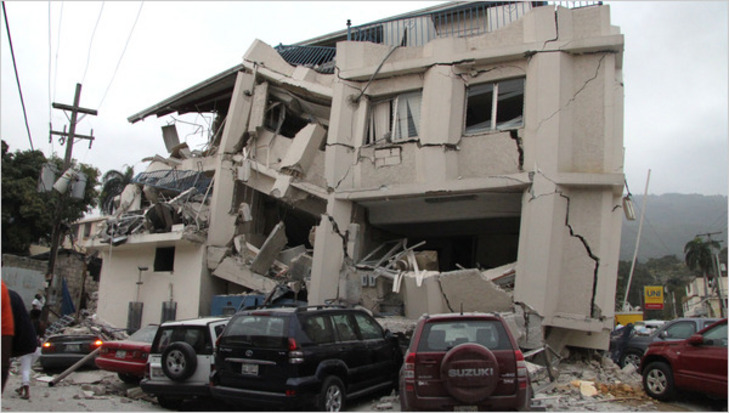
You may not have heard, but Haiti was struck today by an earthquake measuring 7.0 on the Richter scale.  That's the same as the earthquake that beat San Francisco down in 1986.  Only Haiti is poor, very poor, and hasn't got a very stable government, and hasn't got a broad tax base.  The quake hit very close to the capital, Port-Au-Prince, so many houses and hospitals designed to withstand storms, but not shaking, have collapsed into piles of rubble.  Catholic Relief Services is estimating that thousands will be found only after they are dead.


The people there are going to need some help getting themselves back up on their feet again. Keep a look out for ways to help. I recommend Catholic Relief Services (which has, as far as I know, had nothing like the scandals attached to the CCHD lately) or Food for the Poor.  Don't forget to pray for the Haitians, while you are at it.

The Slaughter of the Innocents Goes On...


Today, Monday 28 December 2009, is the feast of the Holy Innocents, those children slaughtered by Herod (Mt 2:16) in his demented plot to destroy the Christ Child, thereby winning the notorious distinction of being the first manifestation of anti-Christ in history.  The Church recognizes his little victims as something like martyrs, even donning red on their feast day in honor of their blood.  They did not voluntarily give their lives rather than deny Christ, yet their innocence poured out still bears witness to His.

In our times, anti-Christ has been powerfully active in many modern regimes.  The Nazis and the Soviets were both explicitly anti-Christian.  They were defeated, but we must not lull ourselves into thinking that anti-Christ was, or even that his plan was delayed.  The Evil One is crafty beyond our reckoning.  I believe that part of his plan was to discredit evil itself - he has done this by psychologizing sins into mere neuroses on the one hand, and by making us think that a plan or idea cannot be evil unless it is proposed by a short man with a funny mustachio and a German accent.  We are mistaken if we believe either of those two lies.  Sin is sin, and we are all guilty of it.  Some sins are small, and others are immense.  We must use our meager powers and whatever grace God gives us to resist it all.  We cannot compromise with it, and must realize that the Enemy always tries to sell us sin by bundling it with genuine goods, because only a lunatic would pick sin otherwise.  So intimacy and pleasure, both good, are used to sell adultery; adventure and profit, both good, are used to convince people to burgle or rob.

Now health care is being used to push abortion.  Make no mistake - unless the law specifically forbids the funding of abortion, it will be slipped in as one more entitlement.  If the developers of the health care proposals under consideration did not want abortions to be funded directly or with subsidies, they would include prohibitive provisions in their bills.  And I can think of no better way - nor can Uncle Sam - to encourage something, other than to pay for it.
Please pray for Bart Stupak (D-MI) and the group he is rousing to resist this atrocity, this holocaust to Moloch. Rumor has it that he and his group are already being brought under tremendous pressure from the highest levels.

Fellow Americans, we are capable of helping each other out without paying to kill each other's babies.  America, we can do better than abortion!

Stones Crying Out

One of my favorite lines from the Scriptures is found in the Gospel of St. Luke, who recounts an interaction between Jesus and some Pharisees. Jesus processes into Jerusalem fresh from raising Lazarus (Jn 11), both followed and preceded by thousands of excited admirers (Jn 12:17; Mk 11:9), who are cheering "Hosanna," which means something like "God save..." or "Long live...", as in, "Long live the King!" The word hosanna is actually related to the proper name Yeshua, Jesus' name in his mother tongue. Trust me on this one. Now, as people are cheering, "God save the one who comes in the Name of the Lord," a reference to the messiah, the pharisees become perturbed (Mt 21:15; Jn 12:19). The Pharisees ask Jesus to tell the crowds to stop calling him King (Lk 19:39).

Here's what Jesus says to answer them:  I tell you, if these were silent, the very stones would cry out, (Lk 19:40).  That's it.  That's one of my favorite lines.  Think about it - even the paving stones under their feet are yearn, bursting forth with the news that God has come to his people, that God has returned to holy Jerusalem, that God is going to reclaim his holy people.  Even the stones!

This idea doesn't originate with Jesus though, except inasmuch as he is God and everything originates with him.  Read the first few verses of Psalm 19:

To the choirmaster. A Psalm of David.
The heavens are telling the glory of God;
   and the firmament proclaims his handiwork.
Day to day pours forth speech,
    and night to night declares knowledge.
There is no speech, nor are there words;
   their voice is not heard;

Yet their voice goes out through all the earth,
    and their words to the end of the world.
    In them he has set a tent for the sun,
Which comes forth like a bridegroom leaving his chamber,
    and like a strong man runs its course with joy... (Ps 19:1-5).
Jean Corbon, who is said to have shadow-written the fourth part of the Catechism of the Catholic Church, which deals with prayer, wrote a book called The Wellspring of Worship.  I highly recommend it for anyone who wants to understand what is the heart of liturgy.  By "liturgy" I am not indicating any migration to an Eastern Rite.  Still less am I getting hippified and refusing to use the word "Mass," which is the correct English-language word designation for what we Catholics are required to attend on Sundays and other obligatory holy days.  Liturgy is a broader term whose translation is often botched as "work of the people."  The Greek term, and its Latin loan word, both meant "public work," which is different.  Works of the people include things like potluck dinners, spontaneous singalongs, and quilting bees.  There are obviously people in the Church who want the Holy Sacrifice to fall into this category and so continue to promote this incorrect translation.  A "public work" is different.  In ancient Greece or Rome, liturgia would have described such things as arenas like the Colosseum, a new sewer system, or a nice fountain.  Modern things like the Washington Monument, Fed-Ex Field, or your local public school serve as modern equivalents.  Then as now, the state built such things, and so did very wealthy, private benefactors.  They were gifts to the people, and very often built by the people, and in those senses were "public works"; but they most certainly were not the brainstorms of people on the street, or for that matter, people in the pew.  So it is with the Mass.  The Mass is a gift to the people and not from the people.  It originates in Jesus Christ's sacrifice of the cross because we need it, and not because he needs it.  And the Mass is one instance of liturgy.

The Church has been entrusted with at least six other liturgies: one for each sacrament.  The different liturgical churches within the Catholic Church each have their own liturgy, their own way of carrying out the seven sacraments.  Liturgy is a sort of scripted, cyclical ritual given by God in order to orient us toward God.  It is liturgy in this sense that Corbon examines in his book.  I will attempt to summarize his central thesis in a single sentence: God has created all of creation to share in his joyous, loving glory, which pulsates throughout creation, drawing all creation back toward God; and God has designed creation specifically to bring as many people as possible back to himself.  He might say that all creation is a sort of living, breathing, God-worshiping organism.  we humans enter into the reorientation of self toward God that is worship by entering into the liturgy that is the universe, particularly the sacramental life of the Church, which Jesus has instituted for that purpose. (OK, I cheated by using a semicolon. It's a big book, with lots of points to make...)

I wish I could paraphrase Corbon better, but I haven't got my copy of his book handy.  I gave it away in a moment of blind affection.  Ah, well.  It's on my Amazon wishlist.  Lol.  I mention all of this now because I came across the YouTube video below on the Anchoress's blog.  If what I wrote above seems kind of abstract, watch the six minute beauty below.  Heck, even if you got what I wrote above, which given my penchant for Ryanese strikes me as a bit unlikely, watch the video.


Do you see what I mean now? EVERYTHING: my car wreck a week or so ago that taught me a little obedience to the divine will, the snow that swamped DC this past weekend and made us rest and stay at home, baptisms and transubstantiations, animals in the zoo, sunny days on mountaintop meadows, all of it... it was all created by God because he loves us and wants to teach us to love Him in return. As we learn to enter into it, to discern his will, act charitably and as good stewards, respond with gratitude, we do in fact draw closer to him. Everything is meant to build this reality into us, and especially the sacraments are meant to do so in a way that nothing else can. Jesus, the Gracious God Made Flesh, became flesh precisely so that grace can operate in fleshly things. He would not have heaven and earth, the spiritual and the material, separated forever. In his nativity, God becomes a native of planet earth so that we can become strangers and exiles here, with a new citizenship in heaven.

It's just amazing what he did that day two thousand years ago in Bethlehem. Creation is still reeling with the ripples of God diving into his own creation, to change us from the inside, to teach us to praise his Father in every circumstance.

Hosanna!  Blessed is he who comes in the Name of the LORD.  Hosanna!