Intentions of the Holy Father for April

Ecology and Justice. That governments may foster the protection of creation and the just distribution of natural resources.
Hope for the Sick. That the Risen Lord may fill with hope the hearts of those who are being tested by pain and sickness.
Showing posts with label popes. Show all posts

If You Are Feeling Weighed Down

If you are Catholic, and trying to do it (i.e., be Catholic) well, and are paying attention, you probably feeling a little down about all the stuff going on right now.  I know I am.  I don't have anything really articulate to write.  The thing feels to me like a very dense storm cloud, fiercer than normal anti-Church nonsense.  It's very incongruous with the weather being so fine outside my window.  The cross is not ours to bear alone, though.  Please do not give up looking to Jesus, looking to heaven for help.

There should be some consolation in this: that our blessed Lord told us that we would be persecuted (Jn 15:20).  Now, don't get me wrong.  Getting called on sin - that's not persecution, it's a public service that we apparently need.  Being gleefully, ferociously stalked by self-appointed "watchdogs" who completely neglect their own house and who bay and howl for the House of God to be torn down to its foundations, head first - that is a little bit closer to what is meant by persecution.  At least, it gives us a watered-down taste of what our brothers and sisters in other countries face every day on a much more violent scale.  We should allow this animosity provoke us to prayer for our enemies and for our brethren whom they treat worse.
We should also take comfort in this prophecy of St. Peter, the first pope, who himself came against fierce opposition:
For the time has come for judgment to begin with the household of God; and if it begins with us, what will be the end of those who do not obey the gospel of God? (1 Pt 4:17)
If you find yourself fazed or perturbed, please remember these words of Teresa of Avila:
Let nothing perturb you,
nothing frighten you.
All things pass.
God does not change.
Patience achieves everything.
Whoever has God
lacks nothing.
God alone suffices.
 It's going to be OK.  Hold fast, pray, enter into the Triduum with your whole heart.  Remember Jesus.

The Brouhaha Over The Pope

I might be the last to have heard about these events, but it has lately come to my attention that the Holy Father is himself being accused of aiding and abetting child molestation, specifically by ordering the abandonment of the church criminal trial of a vicious child molesting priest in Wisconsin.  The New York Times' Laurie Goodstein "broke" the story, which in reality turns out to be little more than a well-orchestrated hoax, as Fr. Raymond J. DeSouza shows.  In fact, not only do the documents cited by Ms. Goodstein as evidence flatly contradict her assertions, but neither she nor any of the other papers or blogs to carry the story have ever contacted Fr. Thomas Brundage, ecclesiastical judge in the original case that was supposedly thrown out by then-Cardinal Ratzinger.  As the Anchoress points out, this sham is just the next in a string of annual hoaxes, fabrications, and exaggerations that by pure happenstance all come at Eastertide.


Sincere, devoted Catholics are more sickened than anyone else by the horrorific revelations of diabolical priestly sin and of the horrendous abdication of episcopal responsibility that have wracked the Church these last ten and twenty years.  But that's not what these fabricated accusations are about.  Nor are the legitimate stories, for the most part, being so vigorously reported because of a hunger and thirst for justice on the part of the media.  This brouhaha is about ideology.  That's why other organizations, a number of which are far more deeply saturated in this wickedness, are left unscathed by the media; it's why the media won't hesitate to run journalistic garbage as news.  Ideology?  Yes.  Sexual ideology - specifically, birth control, fornication, homosexuality, women's ordination, and so on.

We must pray for our Holy Father.  He has recently asked for prayers that he will not flee from ravening wolves who want only to shipwreck the Church.  This opportunity is one we must not miss to band together with each other and Christ, and to walk with this cross on our shoulder, together, to Calvary.

Dear Young People II

Dear young people, do not be content with anything less than the highest ideals!  Do not let yourselves be dispirited by those who are disillusioned with life and have grown deaf to the deepest and most authentic desires of the heart.  The time has come to re-propose wholeheartedly to everyone this high standard of ordinary Christian living.  Refuse to sell your dreams cheaply.  Watch out for the dangerous ways that lead to passing joys and satisfaction.  Deepen your relationship with God through prayer.  Prayer spreads Divine energy.  It makes us live in a new way and gives rise to a revolutionary evangelical style.

Dear Young People

Here is an excerpt from a simple speech of the late Holy Father, John Paul II of venerable memory. I love this one:

Dear young people, many false teachers point out dangerous ways that lead to fleeting joys and satisfactions. Today expressions of our culture are mired in superficiality... Refuse to sell your dreams too cheaply! Dream, but in freedom! Plan, but in truth!

The Lord is also asking you: "Will you also go away?" Answer with the Apostle Peter: "Lord, to whom shall we go? You have the words of eternal life" (Jn 6,68). God alone is the infinite horizon of your life. The more you know him, the more you will find out that only he is love and an inexhaustible source of joy.

But to enter and remain in contact with God it is indispensable to establish a deep relationship with him in prayer. When it is genuine, prayer spreads divine energy in every context and at every moment of life. It makes us live in a new way. Is it not prayer that made Francis a new man and Clare a source of light?
I love that speech to the second international meeting of "Young People to Assisi". You can read the whole, brief thing by clicking here. The quotation from St. John's gospel is among my favorite. It's a great one for prayer when I am tired of following Jesus sometimes, or feel like giving him an ultimatum to do things my way. "Jesus, you better... or else I'll walk!" So many times the words of Peter have drifted back into my heart and mind at those points. "Fine. I guess I'm still yours, thick or thin."

At this time of the year, we do especially well to reinvest ourselves in Jesus, who is the source and summit of authentic human happiness, and to ask him with renewed fervor to reinvest Himself in us.  Come, Lord Jesus!

Something Interesting I Just Found Out


While reading a bit about the Solemn Feast of Christ the King, I came across this Methodist website and this Calvinist (Presbyterian?) one.  I was startled to say the least, but these appearances serve as an anecdotal confirmation of something I heard a year or so ago.

About a year ago, Archbishop Wuerl spoke at the Catholic University of America about the Synod of Bishops he had just attended.  The purpose of the synod was to discuss the role of the Sacred Scriptures in the life of the Church and to put together its findings and views in a brief to the Holy Father for his consideration, and ultimately for his use in the development in an exhortation to the whole Church.  The Synod was a great mix, he said.  Its voting members were of course only bishops, but collaborating experts and guests included any number of others, even non-Catholics.  In Archbishop Wuerl's working group there was the publisher of a Bible society of particular importance in the English-speaking world.  The publisher was a conservativish mainline-evangelical.  He said to the rest of the working group, "You Catholics have a major problem regarding the rest of the world."  At that, they all perked up.  I speculate that some were thinking, "Who is this joker?  Does he know where he is?"  The publisher continued, "Your problem is that you don't understand your relationship to the rest of the Christian churches.  We might be 'separated brethren', but we still look to you constantly... we can't help it, we always have, even when we'd prefer not to."  The Protestant world, even with regard to its highest earthly good - the Bible - rebelled against the Church, has constantly kept one eye on her, and nowadays finds herself looking over the Church's shoulder frequently, to see what the Church is "reading," as it were.

So in 1925, Pope Pius XI declares that henceforth, the last Sunday in Ordinary Time (then simply called "after Pentecost"), the Sunday before Advent, will be kept as the Solemn Feast of Christ the King.  The declaration was a response to the rise of Fascism in Italy in the early 1920s.  It remained as a challenge to National Socialism (Nazism) in Germany in the 1930s, and it remains as a challenge to secularism in the last days of the second millennium and the first days of the new one.  Mussolini might be Il Duce ("the Leader") and Hitler might be Der Fuhrer ("the Leader"), but Christ is King!

And interestingly enough, mainline Protestant churches started celebrating it as well, sometime between 1925 and the 1980s, as they adopted the Revised Common Lectionary, their cycle of readings based on the order of our (Catholic) lectionary.  So in this matter, on some level or levels, the Protestant world has looked to the Catholic again.  Let's see if, by our reverent devotion to our King, and our insistence upon his Lordship, we can set a good example.

The Popes' Guardian Angel

A friend of mine just made me aware of the existence and life of Camillo Cibin, papal bodyguard extraordinaire.  The man is pretty amazing.  Here is a link to the London Telegraph's biography of the man called the "Pope's Guardian Angel," because of his role in catching one would-be assassin and in thwarting a much less well known assassination attempt that happened one year later to the day.


Mr. Cibin died on October 25, at the age of 84, four years after retiring from 59 (!) years of personal, physical service as papal bodyguard.  Far from being funny, into his late seventies the man - quick, burly, and strong - was known to toss people back over the barricades they had leapt in order to get closer to the Pope.  The article is short, easy read about this man who was chief of security at the Second Vatican Council and personal bodyguard to at least three popes.

Wer Glaubt


"He who believes is never alone,"
Pope Benedict XVI, Regensburg, Sept. 12, 2006
Click the pic to read the story.

More on the Concert

The concert was great.  Here are some random, unorganized recollections and reflections.


U2 did a good mix of old and new.  That is very much their style: classic because unchanging on some substratum, but yet always keeping up with the times, and never mindlessly following them.

I would have liked to hear "Angel of Harlem" but am happy to exchange that experience for what I did get: Bono sang a medley in honor of Eunice Kennedy Shriver, a hero of mine, that started off with the first verse of "Amazing Grace," sang reverently and beautifully.  The whole audience joined in.  So much for America not being a Christian nation.  The medley transitioned into "Beautiful Day," causing the audience to explode and join in.  He sang other songs in tribute to the following people, perhaps among others I missed, and in no particular order:

  • Bishop Desmond Tutu;
  • President George W. Bush (no joke - in gratitude for Pres. Bush's previously unsung but heroic efforts against malaria in Africa - people were stunned into silence by this tribute, but they loved the song, so it was OK); and
  • Aung San Suu Kyi of Burma.
Bono was not explicit with his own Christian faith, not in the sense of preaching at the audience - it wasn't a revival and faith witness - but he was really unabashed about it his Christian beliefs and spiritual anchoring.  That was cool.  Cardinal McCarrick was in attendance and got one of the first shout-outs.  Rumor has it that Bono and the Cardinal are fans of each other and have met on a number of occasions.  The late Holy Father John Paul II also had such a relationship, more visible, with the Rock Star.  That relationship went so far as to include gift exchanging, as if Bono were a head of state.

Last night at the concert, when Bono introduced the band, he gave each of the band members titles: Secretary of Defense, etc., making Larry Mullens, Jr. into the leader of the opposition party, for example, and announcing himself as majority leader of the Nation-State of U2.  He ended his introductions by speaking a bit about how much he likes Washington, D.C., Maryland, and Virginia, having visited the region a number of times aside from his concert tours.  Naturally, the crowds enjoyed these compliments.  He also praised America, and thanks Americans for "the idea of America."  That's very Chestertonian of him.  G. K. Chesterton wrote in What I Saw in America something to the extent that "whereas other countries are bloodlines, America is an idea," the idea of democracy and plurality in harmony - what Holy Father Benedict has called America's healthy secular ideal - in opposition to the atheistic secularism in Europe, and gaining ground even here under the cover of the older kind of civic life that called itself secular once.

They sang all the staples in their canon, some that you might not expect, like "Vertigo", some of the stuff from All That You Can't Leave Behind ("Beautiful Day" was for Eunice; thinking of her makes me choke up sometimes; God rest her well), and a couple songs from their new album.  I especially enjoyed hearing "Moment of Surrender" played.

The graphic and special effects were out of this world.  Just amazing.

Each of us...

"Each of us is willed, each of us is loved, each of us is necessary,"
Pope Benedict XVI.

Caritas in Veritate

It's a funny little thing that the Holy Father did with the title of the encyclical that he released today. The title is Caritas in veritate. It means "love in truth," (not, by the way, "love truly" as the English may be construed; in Latin, that would be different). Now, even though the encyclical JUST CAME OUT, there is already all sorts of commentary being printed about it. How can these people have read it? Perhaps they have advance copies, dear reader, but I haven't. And I haven't read a word of it yet. But I have noticed one thing that none of the commentators have mentioned.

The title's wrong. It's backwards. The Holy Father is, I presume, quoting the scripture verse:

"Rather, speaking the truth in love, we are to grow up in every way into him who is the head, into Christ, from whom the whole body, joined and knit together by every joint with which it is supplied, when each part is working properly, makes bodily growth and upbuilds itself in love," (Eph 4:15-16).

Well, I also presume that the Holy Father knows what he is doing, and so he has done it deliberately. But why? That's a good question. Let's read the encyclical (by clicking here) and find out.

I'm Getting Good...

I wrote a response to a blog article on the Washington Post's online religion page. A lot of the blogs' responses are controlled by the blog owners, a reasonable measure to prevent spammer nastiness that nearly destroyed the blogs. For one reason or another, depending on the blog owner, I am sure, most of my responses never go through. Hmmm... But I am getting better. Rather than go apoplectic at my time wasted, or just sigh in resignation, I have saved my piece and am reproducing it below. (I know, heaven forbid I just do something useful!)

First, a click here to read the reasonably well considered, original post by Fr. Thomas Reese, S.J. to which I respond:

(my response follows)


I am intrigued by this thoughtful article, Fr. Reese. At first you lean into a mistake, labeling the Holy Father "left of most Americans including President Obama." This mistake is huge. The Holy Father himself, while addressing the U.N. in New York, asked them to move beyond worn-out categories of left and right. But then, as the article progresses, you indicate an awareness that the Pontiff isn't so easy to pin down.

Trammatic does a good job of summarizing how this indeciperability plays out in American politics:

"I am a practicing Catholic and find no comfort in either political party. I have either respect for life on the right or the preferential option for the poor on the left, but no place with both. On some issues I'm more conservative than most; on others more liberal. This is evident in near-down-the-middle split of the Catholic voting block."

It is because Christ was neither a liberal nor a conservative, but God. Trammatic is on to something in saying that the encyclical will be worthless here in America. That's because even most 'religious' Christians put politics before Christ, and then try to fit him into one party or the other. The only way to make Jesus Christ, the Infinite Alpha and Omega, the Great I-Am, fit into one political party or another is a grizzly process of amputation: not of his heart or mind or ideas or actions, but of ours.

That's why Americans don't, fundamentally, "get" the Church. Whatever she does, people think she is pandering for the opposite political party. She is at once a leftist for caring about migrant workers and a right-wing nut for caring about unborn children and the aged.

In reality, the Holy Father is not going to call for the world to move 'leftward' politically or economically, any more than any other pontiff has. He is going to ask the world to move inwardly, to examine its conscience, and change its way of thinking and living. He is going to call us to something entirely different than swinging back and forth on some right-left pendulum. He is going to call us to Christ.

Piety, rightly understood, is the key to understanding why the Church's "rightist" and "leftist" concerns aren't actually contradictory. Piety is the virtue and gift by which one recognizes God's fatherhood over oneself and over others as well. Consequently, we recognize our fraternity under that same Father, and His loving will that we love each other. This in turn leads to pity (in the best sense of the world), in which we show tender mercy to those who have fallen beneath us in some way, beneath our true dignity as human beings. Piety, then, inspires not only reverence toward God, but love of neighbor. Conversion, the deepening of our relationship to God as His children, will consequently and necessarily change our attitude toward each other. This does not mean socialism - a political centralization of decisions regarding economic matters - but social conscience. We become aware that our actions - whether choices in the businesses we patronize or candidates for whom we vote - affect other people who are as beloved to our Father as are we. In gratitude for His love, we share it.

Personal conversion is not on the opposite end of some tension or spectrum from social action. Quite to the contrary. In fact, any personal conversion that does not change how we regard and behave toward others is a sham. And any social action uninformed by a deep interior reflection, self-evaluation, and conversion toward God's loving will, is bound to be hollow and domineering.

This stuff isn't difficult. It will be interesting to see whether American Catholics get it, though, and whether we are able to share it effectively with our neighbors.

Ryan Haber
Kensington, Maryland

Necks Stretched Out

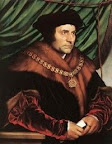
Today is the second anniversary of my blog. Also, and more importantly, it is the feast of Ss. John Fisher and Thomas More. Two years ago, I started off my blog with these reflections about those two men and the moral life. For the last two years those two men, especially St. Thomas, have played a heftier role in my devotional life, or at least become more important as role models. Below are some more thoughts I've thunk in the last two years.

When all the bishops of England yielded to the demand of King Henry VIII, John, the Bishop of Rochester refused. The King insisted that they break their ties with the Bishop of Rome and declare Him to be their spiritual sovereign. They soothed their consciences by convincing themselves that they weren't changing their religion, but only some political stances. The Pope, after all, was also the Prince of the Papal States and a political figure as well as religious. But St. John saw clearly that either the Church and her religion were constituted by Christ, or not. If not, then why bother with any of it? If so, then how dare one change it? And that the Pope was the leader of the Church, he could see no way around. In our own times many voices, even inside the Church, call for political compromises that offend the Law of God. Let us never yield.

St. Thomas More was executed by the King for even more diabolical reasons. The Church of England having broken from the universal Church founded by Christ, its new head proceeded to allow himself to divorce his wife and marry another (and another, and another, and another...) while she yet lived. St. Thomas didn't publicly oppose the thing. But then, he didn't have to: silence from one of the most celebrated commentators of the age was deafening. St. Thomas only seems to have wished to be allowed to resign his office (since he could not support the King's actions) and live out his days in peace and quiet. But the King wanted Thomas' blessing, because Thomas had been the senior judge of the Kingdom, and famously upright and honest. St. Thomas could not give his blessing to a sin. Badgered and beleaguered by the King, his country, and even his family, St. Thomas still refused. The whole world, except for the smothered voice of distant Rome, opposed St. Thomas. But the King's Good Servant refused to cooperate with sin regardless of how many thousands did. Let us never cooperate with evil.

For their troubles, St. John Fisher was executed today, 22 June, in 1535. St. Thomas More was executed a couple weeks later, on 6 July of the same year.

Ss. John Fisher and Thomas More, pray for us.

Pius XII, Vindicated (Again)

If Pius XII was such a Nazi sympathizer, as has become popular "common knowledge", why were they trying to kill him? Click here for more.

Happy Birthday, Humanae

Humanae Vitae, Pope Paul VI's 1968 encyclical on the regulation of births, had the 40th anniversary of its release today. Here are some excerpts and a link to the document:

1. The most serious duty of transmitting human life, for which married persons are the free and responsible collaborators of God the Creator, has always been a source of great joys to them, even if sometimes accompanied by not a few difficulties and by distress.

At all times the fulfillment of this duty has posed grave problems to the conscience of married persons, but, with the recent evolution of society, changes have taken place that give rise to new questions which the Church could not ignore, having to do with a matter which so closely touches upon the life and happiness of men.

2. The changes which have taken place are in fact noteworthy and of varied kinds. In the first place, there is the rapid demographic development. Fear is shown by many that world population is growing more rapidly than the available resources, with growing distress to many families and developing countries, so that the temptation for authorities to counter this danger with radical measures is great. Moreover, working and lodging conditions, as well as increased exigencies both in the economic field and in that of education, often make the proper education of a larger number of children difficult today. A change is also seen both in the manner of considering the person of woman and her place in society, and in the value to be attributed to conjugal love in marriage, and also in the appreciation to be made of the meaning of conjugal acts in relation to that love.

Finally and above all, man has made stupendous progress in the domination and rational organization of the forces of nature, such that he tends to extend this domination to his own total being: to the body, to psychical life, to social life and even to the laws which regulate the transmission of life...

17. Upright men can even better convince themselves of the solid grounds on which the teaching of the Church in this field is based, if they care to reflect upon the consequences of methods of artificial birth control. Let them consider, first of all, how wide and easy a road would thus be opened up towards conjugal infidelity and the general lowering of morality. Not much experience is needed in order to know human weakness, and to understand that men -- especially the young, who are so vulnerable on this point -- have need of encouragement to be faithful to the moral law, so that they must not be offered some easy means of eluding its observance. It is also to be feared that the man, growing used to the employment of anti-conceptive practices, may finally lose respect for the woman and, no longer caring for her physical and psychological equilibrium, may come to the point of considering her as a mere instrument of selfish enjoyment, and no longer as his respected and beloved companion.

Let it be considered also that a dangerous weapon would thus be placed in the hands of those public authorities who take no heed of moral exigencies. Who could blame a government for applying to the solution of the problems of the community those means acknowledged to be licit for married couples in the solution of a family problem? Who will stop rulers from favoring, from even imposing upon their peoples, if they were to consider it necessary, the method of contraception which they judge to be most efficacious? In such a way men, wishing to avoid individual, family, or social difficulties encountered in the observance of the divine law, would reach the point of placing at the mercy of the intervention of public authorities the most personal and most reserved sector of conjugal intimacy.

Consequently, if the mission of generating life is not to be exposed to the arbitrary will of men, one must necessarily recognize insurmountable limits to the possibility of man's domination over his own body and its functions; limits which no man, whether a private individual or one invested with authority, may licitly surpass. And such limits cannot be determined otherwise than by the respect due to the integrity of the human organism and its functions, according to the principles recalled earlier, and also according to the correct understanding of the "principle of totality" illustrated by our predecessor Pope Pius XII...


18. It can be foreseen that this teaching will perhaps not be easily received by all: Too numerous are those voices -- amplified by the modern means of propaganda -- which are contrary to the voice of the Church. To tell the truth, the Church is not surprised to be made, like her divine Founder, a "sign of contradiction", yet she does not because of this cease to proclaim with humble firmness the entire moral law, both natural and evangelical. Of such laws the Church was not the author, nor consequently can she be their arbiter; she is only their depositary and their interpreter, without ever being able to declare to be licit that which is not so by reason of its intimate and unchangeable opposition to the true good of man.

In defending conjugal morals in their integral wholeness, the Church knows that she contributes towards the establishment of a truly human civilization; she engages man not to abdicate from his own responsibility in order to rely on technical means; by that very fact she defends the dignity of man and wife. Faithful to both the teaching and the example of the Savior, she shows herself to be the sincere and disinterested friend of men, whom she wishes to help, even during their earthly sojourn, "to share as sons in the life of the living God, the Father of all men."

Thank you, Holy Father Paul. Sorry we didn't listen. Please pray we finally learn.

Read the entire encyclical at http://www.papalencyclicals.net/Paul06/p6humana.htm.

Question from the Late JPII


"But I ask you, is it better to be resigned to a life

without ideals, or rather to seek truth, goodness, justice,

working for a world that reflects the beauty of God,

even at the cost of facing the trials it may involve?"


- Servant of God, John Paul II (pp 1978-2005)

World Day of Prayer for China

Last year in his letter of 27 May 2007, Holy Father Benedict asked all Christians to pray for Church in China on 24 May 2008, which is the feast of Mary, Help of Christians. The day commemorates the return of the Pope Pius VII to Rome after being abducted, held prisoner, and tortured by Napoleon.

The day was suitable because of the captivity in which so much of the Church in China is kept by its government.

After the recent catastrophes there, and the Church's attempt to respond vigorously, it seems all the more imperative that we pray not only for the Church there, but for the whole nation.

Mary, Help of Christians, pray for us.

The Pope and His People


Whatever most Americans were thinking, I cannot say. My suspicion is that the major media outlets were as far from the average American's heartbeat as they usually are. But I noted a few things that really struck me and those with whom I personally shared the beautiful experience of the Holy Father's visit to our nation's capital.

First, I wasn't at all excited, or even interested a few months ago. It was off in the "distant future" along with next Christmas and my scheduled dental work. Things to do, for better or worse, don't make an impression on me until they are very close at hand, because so many other things line themselves up in my schedule between now and then. A few weeks out, some of us noted that we were starting to buzz about the Holy Father. The night before, laying in bed with an alarm set to 4:45 a.m., it was almost impossible to sleep. I was too excited. "Why on earth should one foreign dignitary's visit provoke so much excitement, especially in a city so jaded and accustomed to foreign dignitaries?" That's the kind of question asked frequently in the media during the lead-up to the visit. Why, indeed. If the Holy Father were merely a foreign dignitary, the excitement would be inexplicable.

Second, the media kept harping on the recent poll by the Pew Foundation as evidence that the Church in America is sagging, and thence deduced that the Holy Father had planned his trip to bouy our spirits. Quite possibly so, but that is not the picture anyone in attendance at the Papal Mass saw. What we saw was a stadium filled to maximum capacity such as it never likely will be again (not while the Nationals play there, in any event) with people cheering and screaming like very few rockstars ever experience. The gathered community had a great number of immigrants, to be sure - as the Catholic Church in America always has had. Secularists say that the Bishops welcome immigrants to fill their pews; we might as easily say that secularists resent immigrants because immigrants upset their status quo. Forty-six thousand cheering, happy people very content to ignore all the "expert advice" and gloomy predictions of the mass media must be disturbing for them. No wonder so many outlets looked for so many other angles on the story. That said, a number of media outlets did a very nice job covering the event.

Third, while the Holy Father came to preach a message of hope and to encourage us Catholics to live it in our country, it seemed like he was as inspired as were we. It was deeply moving to see how much the Holy Father enjoyed being with us, his spiritual children. He even pulled a John Paul II by going into the crowds during the Recessional at the close of the Papal Mass. It was moving to see how moved he was by Placido Domingo's beautiful rendition of Panis Angelicus. One gets the feeling that he not only loves us as an obligation, but actually likes us, enjoys us, and wants to be with us. His deep humility and shy personality came through, but he overwhelmed himself with his own joy on several occasions, throwing open his arms, even cheering. When the late Holy Father John Paul the Great died, I commented to a buddy, "I feel like an orphan now," to which he responded, "I think we all do, Ryan." Now seeing the affection of the Roman Pontiff for his subjects, it feels right to think of him as a father.


Holy Father, we love you! Thanks for coming!

Miguel Pro and Christ the King

This past Sunday was designated as Solemnity of Christ the King. Originally promulgated in the 1925 document Quas Primas by Pope Pius XI to occur on the last Sunday of October, the feast is now celebrated each year on the last Sunday of the liturgical year - the Sunday before the beginning of Advent.

Culturally, the feast is meant to fly in the face of all that we hold dear in democratic countries: self-determination, representation, policy by consensus. Pope Pius XI read the signs of the times and could smell the growing determination by world leaders not to be bound by traditional morality. While Communists overthrew Russia and the revolutionary government in Mexico became violently anti-Christian, even Christian Europe witnessed new trends and social programs opposed to good morals. It was clearer and clearer to the Holy Father that an assault against Jesus Christ himself was underway. Placing the feast at the end of the year is perfect. The readings taken from the Mass and the Liturgy of the Hours (especially those from the books of the Maccabees) for the end year all draw our attention to the Lordship of God. The readings do so in a stark way: example after example is given of worldly rulers claiming absolute dominion - even insisting that people violate the laws of God to prove their loyalty. In these cases, the readings dramatically highlight the necessity of martyrdom by those who love God.

One modern example given to the Church on November 23 is that of Blessed Miguel Pro, S.J. The young Jesuit found his studies for the priesthood interrupted by the Mexican Revolution. His seminary was moved to Texas, and after a time there, he finished his studies in Belgium. By then, the persecution of the Catholic Church in Mexico was in full swing. Where the laws were enforced, priests were forbidden to wear special attire, renounce allegiance to the Church, cease performing sacraments, required to marry, and executed for refusal to any of those things. Priests were literally being shot in the street wherever they were found. Bl. Miguel volunteered to return to this environment because he suffered to see his countrymen go without the sacraments, with nobody to preach the Gospel to them, with nobody to remind them that God heard their cries and would not leave them alone forever.

After sneaking back into Mexico, Bl. Miguel evaded the authorities for a few years. Frequently he would slip right under their noses using the same sort of clever disguises that he and his siblings had used in their amateur theatre performaces as children. He even made so bold as to evangelize soldiers and police officers in places where "wanted posters" displayed his picture! By the time the young priest was apprehended in Mexico City, he was personally arranging the food and rent money for hundreds of families dispossessed for adhering to Holy Church, as well as offering Mass illegally numerous times weekly to crowds of people numbering into the hundreds. At last he was betrayed, like Christ, by one of those who benefited from his labors. Arrested with two of his younger brothers on the pretext of an assassination attempt, he refused the opportunity to disavow his priesthood, and was ordered to be shot by a firing squad in front of ambassadors and the press corps of the world's socialist and communist countries and organizations. So it was that, refusing a blindfold, Bl. Miguel stood before his murderers, facing them calmly, and forgave them aloud. Then, as the command to raise rifles was given, he threw wide his arms and shouted out "Viva Cristo Rey!"

Long Live Christ the King!

This pose is the one captured by photographers. Some of them, though socialists, were awed by his bravery, and within days holy cards had been made from the photographs and were circulating illegally. He was forbidden a public funeral, but the government was unable to act against the tens of thousands who showed up to escort the body to its burial site.

The question we have to ask ourselves, whatever our state in life, is whether Christ is king over us.

Do I avoid sin for fear of offending Him? Or do I make excuses?

Do I engage in thankless service in order to please Him? Do I only do the good things I like?

Do I rearrange my affairs to accord more completely with His desires?

Do I fear the opinion of other people, even strangers, more than I fear provoking God?

Am I willing to part with anything - ANYTHING - material possessions, habits, relationships - the moment it begans to interfere with my relationship with Jesus Christ?

In calling myself a Christian, "One of Christ's" I am implicitly answering the above questions. Do I answer them the same way in acting like Christ?


If Jesus Christ is not the Lord of my Life, the King of my Heart, then He is just a nice prop in my life that I take out sometimes, maybe once a week or so, to make me feel better about myself. We have cause to concern about this situation because Our Lord, the King of the Universe, himself said, Not every one who says to me, `Lord, Lord,' shall enter the kingdom of heaven, but he who does the will of my Father who is in heaven. On that day many will say to me, `Lord, Lord, did we not prophesy in your name, and cast out demons in your name, and do many mighty works in your name?' And then will I declare to them, `I never knew you; depart from me, you evildoers,' (Mt 7:21-23).

Again, it is fitting that the feast of Christ the King comes at the end of the year, because when all is said and done, Jesus Christ is Lord. On the Last Day, He will have the last word.


Pope Encourages Youth to Evangelize Hometowns

VATICAN CITY, OCT. 7, 2007 (Zenit.org).- Benedict XVI encouraged young people to be missionaries on the streets and in the neighborhoods of their own cities.At the end of the recital of the midday Angelus today, the Pope greeted 500 young missionaries who, from Sept. 28 to Oct. 7, participated in the 4th mission of Rome called Jesus at the Center. "I congratulate you, dear friends, because you have brought the proclamation of God’s love to the streets and to some hospitals and schools of the city," said the Pontiff. "The missionary experience is part of Christian formation and it is important for adolescents and young people to be able to live it personally," he added. The Holy Father concluded, "Continue to witness to the Gospel every day and commit yourselves generously in the next missionary initiatives in the Diocese of Rome."