Intentions of the Holy Father for April

Ecology and Justice. That governments may foster the protection of creation and the just distribution of natural resources.
Hope for the Sick. That the Risen Lord may fill with hope the hearts of those who are being tested by pain and sickness.
Showing posts with label generosity. Show all posts

Keep Your Eyes Open

You may not have heard, but Haiti was struck today by an earthquake measuring 7.0 on the Richter scale.  That's the same as the earthquake that beat San Francisco down in 1986.  Only Haiti is poor, very poor, and hasn't got a very stable government, and hasn't got a broad tax base.  The quake hit very close to the capital, Port-Au-Prince, so many houses and hospitals designed to withstand storms, but not shaking, have collapsed into piles of rubble.  Catholic Relief Services is estimating that thousands will be found only after they are dead.


The people there are going to need some help getting themselves back up on their feet again. Keep a look out for ways to help. I recommend Catholic Relief Services (which has, as far as I know, had nothing like the scandals attached to the CCHD lately) or Food for the Poor.  Don't forget to pray for the Haitians, while you are at it.

Priestly Solidarity with the Poor

I cannot tell you how happy it made me to read that the priests of the French diocese of Lyon have decided to donate a month's wage to a fund established to help those crushed under by the economic troubles we face. What an awesome witness. For your convenience, I've inserted it below:

Unexpected Gifts

This morning my roommate/marathon-partner, Tom, who is a pilot, took me up on a Cesna for breakfast in York, PA. He's building his flight time and takes these trips regularly. It was a very, very fun time.

After returning home, I drove to visit a friend and his wife for lunch and to help him to prepare to give a lecture at a conference in Peru, speaking Spanish. He doesn't really speak Spanish, but working from his own text translated by the conference organizers, I believe he'll do just fine. It was cool to be able to help him prepare because among the attendees will be a large number of devout families, priests, and a few bishops and cardinals.

When I returned home from lunch and helping my friend prepare for his lecture, I saw an Amazon box sitting on the front step. "Ooooh! Amazon," I thought. I love Amazon deliveries. Even though I am the principal recipient of them at our house, and even though I myself place the orders, deliveries always make me feel special - and I know I am not alone in this, people. But then I grew glum, thinking, "I didn't order anything from Amazon. Shoot, it must be for one of my roommates." I turned it over and read the label, and whaddya know, it was for me, and the return address was that of a friend from my parish. I was too surprised to register. Opening the box, I saw it was a book, Commentary on New Testament Use of the Old Testament. This particular book has been atop my Amazon wishlist since it came out in 2007 and will be a terribly useful reference for biblical scholars for years to come. And this friend bought it for me spontaneously, just because, because he is a kind and generous man - manifested in my mind numerous times long before this, especially with his commitment to the youth of our parish.

I love debts of gratitude. Debts of gratitude are different from debts of account because they are not calculated in dollars and cents and they are not paid back. Rather, they are paid forward, to borrow a nice phrase. They might even be paid forward to the person to whom we feel grateful. But they aren't paid as a matter of obligation, but as a matter of love. A gift freely given inspires in a healthy recipient a free response, in some direction. The repayment or the forward-payment of debts of gratitude is not intended to clear the debt, but to perpetuate it and deepen it, to draw more people into it. There is no tit-for-tat, but rather a response of grace for grace, free gift for free gift, and neither size nor shape are measured against each other. Instead, heart meets heart. Before long, a number of people feel a great desire to give not only their things, but really parts of themselves, as it were, to their neighbors and friends. Instead of lending and repaying money, we invest ourselves and are blessed by others. Gratitude inspires a sort of calculation that is exactly the opposite of either capitalism or socialism. Gratitude builds an economy of love.

There is nothing like gratitude to build those two beautiful forms of charity: piety and friendship. It is really important to do kind and generous things for others. If done selflessly, such deeds are magnanimous and share in the most magnanimous charity ever, that of our Lord for us. It is also really important to let others do kind and generous things for us when they are so moved. The graceful reception of such kindness not only humbles our pride, but may build up the giver's sense of sharing in divine grace, which can only lead to more grace. When we refuse gifts, while there is sometimes a genuine and legitimate desire to avoid unnecessary entanglements, there is also often a refusal to be humbled. What a sad condition!

Lol, all this is to say thanks to those men who blessed me today. I'll put personal notes in the mail. Except to you, Tom. I live with you. That would be dumb. How 'bout I buy you a milkshake after our next run?

Rest in Peace, Eunice

Eunice Kennedy Shriver died on Tuesday, and today will be buried from St. Francis Xavier, Hyannis, Massachusetts. Her legacy was immensely important to me personally – she strove to help the world see the strengths of persons with disabilities, rather than as a series of shortcomings or challenges. Her efforts were largely in response to the condition of her sister Rosemary, who seems perhaps to have been mildly mentally retarded or ill until a failed lobotomy, secretly ordered by her father, reduced her to utter incapacity. Eunice and her brother Ted Kennedy were both present when their sister Rosemary passed away in 2005.

Until recently, Eunice and Ted have had very different approaches, though. One cannot doubt that both loved their sister as best they knew how. That is natural. But Eunice was convinced that every single human life was a good thing, no matter what else. She personally advocated with president after president, starting with her brother. Even though she was a card-carrying Democrat, she was an outspoken supporter of the pro-Life cause within and outside of the Democratic Party. Ted, on the other hand, along with much of the political members of the Kennedy clan, has been a strong advocate for abortion. Abortion says nothing if it doesn’t say, “Some lives aren’t worth living.”


Persons with severe disabilities challenge our easy status quo. Normally, each of us is self-sufficient. We each can take care of ourselves, and occasionally help each other out as need arises. But a person with a severe difficulty, especially a mental one, needs constant help. Oftentimes they need help for the most basic functions of life. That means we around them must pitch in, get outside of ourselves, and learn to be patient, and gentle, and do extra work. Unlike “the rest of us,” it is not possible merely to coexist with the handicapped. They need too much. That is why we will either learn to love them or we will decide to kill them.

This morning, listening to NPR on the way to work, I heard some Democrat pundits fending off accusations by those hostile to their plans for healthcare reform. They brought up the accusation that they or their approach would kill all the people with Down syndrome. “Ha! Come on!” was about all they could say. Of course they don’t support killing all who have Down syndrome. They just support extensive neo-natal testing. Oh, but wait, they also support abortion on demand, and especially in difficult situations. And of course they support, many of them at least, government funding for abortions. Hmm… one wonders why there are so many fewer people being born with Down syndrome now than in the past.

But let’s get back to Ted and Eunice. Ted’s approach is the politically expedient one (for now), and it is also the more pleasant one, that is, the one that allows social pleasantries to do most of the work. After the abortion (say, of a child with Down syndrome), social pleasantries can go into full gear. It wasn’t a child, but a choice. There was no abortion (such an ugly word), but merely the premature termination of a pregnancy. The child who never existed didn’t have a perfectly livable condition with which millions of people worldwide live happily; rather, there was a severe defect. The doctor and family did not conspire to murder for the sake of convenience a child entrusted to their care by God Almighty, but rather, they sent home to Good and Gentle Jesus a precious little one who otherwise would have struggled greatly. Do you see, dear reader, how the game is played? False words cover over the truth, and one can try to look at oneself in the mirror again.

That’s not how Eunice’s approach works, though. In Eunice’s approach, a child is born into difficult circumstances. Sometimes the circumstances are extrinsic to the child – like poverty, or an ill mother or missing father. Sometimes the circumstances are part of who the child is – like mental disability or a permanent medical problem. The child’s life is filled with frequent or even constant hardship. Those close to the little boy or girl must learn to sacrifice in new and intense, profound ways: sleep is lost, money is spent on extensive necessities rather than on yearned-for luxuries, vacations are altered or sacrificed, hopes and dreams are modified or abandoned (that’s the hardest part). It is too much for one person, so the family, friends, neighbors, and local leaders all have to pitch in together. Cooperation makes an overwhelming set of challenges manageable. New virtues are acquired that were never before needed, or are developed when before they would have been slight: patience, tenderness, discipline, flexibility. Heroic effort is needed for basic steps. Those around the child eventually learn to be amazed and joyful at very little bits of progress – oh, how a person with handicaps struggles for such little gains. I remember my amazement to discover that my own handicapped sister had learned to tie her shoes. That she was fifteen years old wasn’t my interest, but only, “Hey, Ma! Look what she can do! Did you see that? Did you already know she could do that? Holy cow! That’s great, Keelin! Good job!” In Eunice’s plan, we learn self-sacrifice, cooperation, affection. We learn love. And as the child grows and prospers modestly, or not, we learn to see a rhythm in reality, a meaning in the muddle. We learn to see how one event happened before another, though we would not have so arranged things, and that the arrangement that actually happened was, in fact, arranged. We come to see that there is a plan in the universe, and a Planner. Ultimately, in the life of a child with disabilities, we come to see the face of God.


But it’s not romantic, and it’s not easy. There is a lot of blood, sweat, and tears to be shed along the way, or else everyone would do it. We need grace – the life, strength, joy of God shared with us from on high – or else we will go the path of least resistance. We will go the way the pagan world, the world without God, has always gone. The Jewish prophets were the first to object to the murder of the weak and marginalized. They were the first to insist that personal comfort and domination by the fittest were not in accord with God’s will, with deepest reality. Christians have taken up that objection, that insistence – though some of us have been seduced into murder by pleasant words. If we do not learn to pray, to return to God, to seek His help, we will end by killing those who interfere with our plan for happiness. We will go Ted’s way.

Now, on a closing note, I’d like to be fair to Ted. It is easy for a good heart to be seduced. Moreover, he now has brain cancer, and wasn’t even able to attend his sister Eunice’s funeral Mass. His cancer has certainly incapacitated him. He was there for Rosemary, after all. Maybe his struggle with cancer and the prayers of his sisters in heaven will help him to come to know the love of God in a more profoundly penetrating way than he has before.

Eunice, thank you for all you did. Yours was a monumental life. Now you are with your Rosie and can know her as God has always known her. Please pray for us who still journey here below.

P.s.: Today Eunice's family issued a powerful statement that well summarizes a powerful life. She visited Rosemary regularly. She advocated persistently for political and social measures to improve opportunities for those with handicaps to enjoy their full human potential. She strongly challenged consciences and gently coaxed contestants. She built the Special Olympics from a backyard affair (literally) to a global showcase of talent in which each individual is fostered and cheered on. Until the last years of her life, she and her husband, Sargent, hosted a summer camp for children with and without disabilities at their home in Rockville, Maryland, so that the children could grow with each other.

"Inspired by her love of God, her devotion to her family, and her relentless belief in the dignity and worth of every human life, she worked without ceasing - searching, pushing, demanding, hoping for change. She was a living prayer, a living advocate, a living center of power. She set out to change the world and to change us, and she did that and more. She founded the movement that became Special Olympics, the largest movement for acceptance and inclusion for people with intellectual disabilities in the history of the world. Her work transformed the lives of hundreds of millions of people across the globe, and they in turn are her living legacy."


P.p.s.: Another thing strikes me about Mrs. Kennedy Shriver. In every single photograph of her that I can find, she is smiling. It seems as though her path, though it be harder, is happier.

Click here for the biography on her website.

Casting Out Among Outcasts

Today's readings at Mass (Lv 13:1-2, 44-46, Ps 32:1-2, 5, 11, 1 Cor 10:31-11:1, Mk 1:40-45) have a very simple theme in common: outcasts and how we treat them. The first reading prescribes the ritual treatment of leprosy during a time in which a connection between disease and sin was presumed. For fear of disease and sin, the leper is to remain outside the wandering Israelites' camp, outside the oasis of civilization in a harsh world, until such time as their leprosy is cleared up. While the connection is not certain, it is not stupid, either. As evidence consider that many, but not all, who have cirrhosis of the liver have it from drinking too much. And just as some diseases are catching, so we can learn sins from each other as well. In the Gospel reading, St. Mark recounts our Lord's own trouble with leprosy. He did not catch the disease, but because he healed people with it, he came into such demand that he could not go into towns but had to stay outside in the wilderness. In an unexpected way, he took the consequences of the lepers' disease upon himself. This acceptance of their disease prefigures his acceptance of the sins of all humanity. It specifically prefigures his crucifixion on a barren hill outside Jerusalem.

"There are a lot of people in our world who are hurting," we were reminded by the recorded voice of the Archbishop this morning at every parish in the archdiocese. Some of these people are hurting because of sin, theirs or others'. Some of them are hurting because of dumb bad luck, as much as such a thing exists. Most people are hurting at least a little from both, and some people are hurting tremendously from both. And where there is one, especially the dumb-bad-luck, leprosy kind, we still instinctively assume that the other kind exists as well - that the person has sinned and brought it upon themselves. Homeless people must be either lazy or crazy, we assume - and oh, how our tightening economic straits might soon prove us wrong on this point! We don't want to "judge" HIV/AIDS patients, sure, but we don't want to touch them either, do we? How must that feel, to be looked at ten thousand times in a day, always with a frown, or a smirk, or with averted eyes - and never to be touched, or held, or kissed?

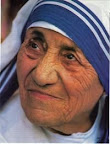
Jesus made no such assumptions, though. He simply went among them and did what He could (which was a lot!) to heal them when they came to Him. And He still does. We in the Church, incorporated by holy baptism into His mystical body and nourished on His Body and Blood, ought to do likewise. It takes some practice, to be sure, because our base instinct is to spend our time and energy on ourselves and to shrink from marred skin and open sores, both physical and spiritual. But remember our Lord's instructions to the fishermen who had thus far caught nothing: "Cast into the deep," (Lk 5:4). Those fishing instructions were nonsensical by the world's standards, but pulled in a catch that could only be seen as a manifestation of the power of God. Generosity of spirit, together with a gift of time and energy, both grounded in prayer and the sacraments, can do amazing, amazing things. If you'd like to see an example of this power of love, I recommend a visit with the Missionaries of Charity. In there houses people presumed about to die have been healed more by love than by medicine. The order founded by Mother Teresa to cast out into the deep, among the poorest of the poor, to those who are avoided by "civilized" folk. The Missionaries have a some houses here in DC: a hospice for poor people on Otis St NE and a soup kitchen and women's shelter on Wheeler Rd SE; and over 500 homes in 133 countries around the world.

The Church will continue to wake up and reclaim Her proper place in the world - priest, prophet, and king - only as much as we, Her children, do so. But what does it mean for the baptized person to be a priest, prophet, and king? I think I'll make that the subject of my next three posts.

A Couple of Notes

Today is the feast of St. John Damascene. Last year on this date, I wrote a piece about him, and rather than repeat myself, I will just provide a link to it. Click HERE.

For now, I will just share a brief thought I had this morning after Communion.

What a blessed people are we Christians, who may break our nightly fast by feeding on the flesh of God himself! What an amazing mystery.

"For what nation is there so great, who hath God so nigh unto them, as the LORD our God is in all things that we call upon him for?" (Deut 4:7, KJV).

"You shall eat in plenty and be satisfied, and praise the name of the LORD your God, who has dealt wondrously with you. And my people shall never again be put to shame," (Joel 2:26, RSV).

"He has not dealt thus with any other nation," (Ps 147:20).

Martinmas

Bishop (Nov 11)

That's today. In merry olde England, they used to refer to the major feast days by the person or occasion whose Mass was celebrated that day: Michaelmas (on the Feast of St. Michael the Archangel, now of all the Archangels), Candlemas (on Feast of the Presentation), Whitmas, Christmas, and so on. Today is the feast of St. Martin of Tours, in France, and it is a special day to me. The parish where I was raised is dedicated to him and under his patronage. A year or so ago, I read a biography of him written by a very interesting Frenchwoman.

Regine Pernoud, the biographer, was a professor of medieval history who lived from 1909 to 1998. She was elected to the Academie Francaise, quite an honor - maybe the highest for a French intellectual. She was not religious, as far as I can tell, until she began to write the lives of saints - first Joan of Arc, then Martin of Tours, and maybe others. Her biographies betray her conversion though, because while maintaining a rigorous standard of scholarship and thought, they have none of the dismissive anti-Catholicism that biases so much academic study of medieval history. She doesn't accept all the miracle accounts just because they are miracle accounts, but nor does she reject them just because they are miracle accounts. Some she accepts as well documented, and others she notes as nice stories, perhaps even true. A very sober, faithful, and ultimately pious approach. But I digress.

Martin was born in 316 in Hungary and as a young man was pressed into the Roman army's officer corps as a young man for the simple reason that his father had been an officer, and a new law required him to replace his father when his father retired. So Martin's early dreams of life in a monastery were dashed. He didn't abandon his Christian way of life though, not for a minute. Everyone around him marvelled at the care he took of his slaves, at how he tended them when they were ill, how he prayed during the night when he thought nobody was looking. There was even an incident when, on a cold day, he split his cloak, his precious centurion's cloak, and gave half it to a naked beggar on the road. This must have shocked his cohort not only for its practical implications (now both saint and beggar would be poorly clad!) but for its symbolic implications - the various implements of the legion were held sacred by the legionnaires. But that the Christian legionnaire held other things sacred, it was clear to all.

After departing from military service (perhaps simply by going AWOL after a decade or two), and settling in the western part of central France, Martin found himself ordained a priest. He tried to live quietly in the countryside, but there was so much need around him - material and spiritual especially. As the Roman Empire decayed, its deteriorating infrastructure left many abandoned of basic necessities. While the Gospel spread rapidly in the cities, out in the heath (countryside, hence the word "heathen"; "pagus" is the same thing in Latin, "a country district," hence the word "pagan") the Gospel spread more slowly and was easily mixed with local rites and gods. As he went from middle age to later years, his hopes of retirement to a monastery or better, a hermitage, were yet again dashed - Martin was elected bishop by the priests of his diocese.

As bishop, Martin wasted little time scolding lazy priests - he did their work for them until, shamefaced, they reclaimed their duties. He travelled throughout the diocese, throughout France and Germany, really, praying with his flock, preaching to them, administering the sacraments, defending them from local despots, and leading them to Christ. Miracle after miracle was attributed to him, and threats against his life by jealous clergy and irritated civil authorities were all thwarted. He is one of the few saints said to have raised the dead back to life. What marvelled people most was that, even as he entered his eightieth year he never stopped pouring himself out for his people.

The evidence of a person's greatness has to be found in the impact they make in the lives of others. At a certain point, words are no longer needed because the evidence is abundant. From Hungary to France there are thousands of churches and chapels named for the would-be hermit. Their number is bested only by the number of such places dedicated to the Blessed Virgin herself. He is one of very few saints that has an entire liturgy from Matins to Compline, with a Mass to boot, written in his honor, celebrated today. Martin is a very common name in France, Germany, Hungary, and elsewhere. Pernoud was able to write her biography using several sources written contemporaneously with his life, or shortly thereafter, including one source who was a childhood-friend-turned-admirer of the Bishop of Tours. My parish celebrates its patron each year with a parish dinner dance, and more importantly, by collecting from parishioners hundreds of winter coats to be distributed to the poor of our pagus... I mean, county. The important thing to note, and to replicate, about Holy Martin's generosity is that it was not out of his abundance. Remember how our Blessed Lord appraised the poor widow's generosity?

"Truly I tell you, this poor widow has put in more than all of them; for they all contributed out of their abundance, but she out of her poverty put her whole livelihood," (Lk 21:3-4).

This saint, who cut his only cloak in two, is one who should inspire us to dig deeper, trusting in our heavenly Father to provide all that we need, and looking to Him for that Providence, and being a means of His Providence for others.

Holy Martin of Tours, pray for us.

A Prayer


Lord Jesus Christ, who gave Your life for us, unworthy sinners, grant, we pray, that we be configured daily to Your selfless, joyful generosity, and so by imitating Your grace, combat our sins. Amen.

Happy Birthday, Humanae

Humanae Vitae, Pope Paul VI's 1968 encyclical on the regulation of births, had the 40th anniversary of its release today. Here are some excerpts and a link to the document:

1. The most serious duty of transmitting human life, for which married persons are the free and responsible collaborators of God the Creator, has always been a source of great joys to them, even if sometimes accompanied by not a few difficulties and by distress.

At all times the fulfillment of this duty has posed grave problems to the conscience of married persons, but, with the recent evolution of society, changes have taken place that give rise to new questions which the Church could not ignore, having to do with a matter which so closely touches upon the life and happiness of men.

2. The changes which have taken place are in fact noteworthy and of varied kinds. In the first place, there is the rapid demographic development. Fear is shown by many that world population is growing more rapidly than the available resources, with growing distress to many families and developing countries, so that the temptation for authorities to counter this danger with radical measures is great. Moreover, working and lodging conditions, as well as increased exigencies both in the economic field and in that of education, often make the proper education of a larger number of children difficult today. A change is also seen both in the manner of considering the person of woman and her place in society, and in the value to be attributed to conjugal love in marriage, and also in the appreciation to be made of the meaning of conjugal acts in relation to that love.

Finally and above all, man has made stupendous progress in the domination and rational organization of the forces of nature, such that he tends to extend this domination to his own total being: to the body, to psychical life, to social life and even to the laws which regulate the transmission of life...

17. Upright men can even better convince themselves of the solid grounds on which the teaching of the Church in this field is based, if they care to reflect upon the consequences of methods of artificial birth control. Let them consider, first of all, how wide and easy a road would thus be opened up towards conjugal infidelity and the general lowering of morality. Not much experience is needed in order to know human weakness, and to understand that men -- especially the young, who are so vulnerable on this point -- have need of encouragement to be faithful to the moral law, so that they must not be offered some easy means of eluding its observance. It is also to be feared that the man, growing used to the employment of anti-conceptive practices, may finally lose respect for the woman and, no longer caring for her physical and psychological equilibrium, may come to the point of considering her as a mere instrument of selfish enjoyment, and no longer as his respected and beloved companion.

Let it be considered also that a dangerous weapon would thus be placed in the hands of those public authorities who take no heed of moral exigencies. Who could blame a government for applying to the solution of the problems of the community those means acknowledged to be licit for married couples in the solution of a family problem? Who will stop rulers from favoring, from even imposing upon their peoples, if they were to consider it necessary, the method of contraception which they judge to be most efficacious? In such a way men, wishing to avoid individual, family, or social difficulties encountered in the observance of the divine law, would reach the point of placing at the mercy of the intervention of public authorities the most personal and most reserved sector of conjugal intimacy.

Consequently, if the mission of generating life is not to be exposed to the arbitrary will of men, one must necessarily recognize insurmountable limits to the possibility of man's domination over his own body and its functions; limits which no man, whether a private individual or one invested with authority, may licitly surpass. And such limits cannot be determined otherwise than by the respect due to the integrity of the human organism and its functions, according to the principles recalled earlier, and also according to the correct understanding of the "principle of totality" illustrated by our predecessor Pope Pius XII...


18. It can be foreseen that this teaching will perhaps not be easily received by all: Too numerous are those voices -- amplified by the modern means of propaganda -- which are contrary to the voice of the Church. To tell the truth, the Church is not surprised to be made, like her divine Founder, a "sign of contradiction", yet she does not because of this cease to proclaim with humble firmness the entire moral law, both natural and evangelical. Of such laws the Church was not the author, nor consequently can she be their arbiter; she is only their depositary and their interpreter, without ever being able to declare to be licit that which is not so by reason of its intimate and unchangeable opposition to the true good of man.

In defending conjugal morals in their integral wholeness, the Church knows that she contributes towards the establishment of a truly human civilization; she engages man not to abdicate from his own responsibility in order to rely on technical means; by that very fact she defends the dignity of man and wife. Faithful to both the teaching and the example of the Savior, she shows herself to be the sincere and disinterested friend of men, whom she wishes to help, even during their earthly sojourn, "to share as sons in the life of the living God, the Father of all men."

Thank you, Holy Father Paul. Sorry we didn't listen. Please pray we finally learn.

Read the entire encyclical at http://www.papalencyclicals.net/Paul06/p6humana.htm.

Easy All The Way

Today's readings (Thurs after VII Sun of Ord II; Jas 5:1-6; Ps 49; Mk 9:41-50) are not pleasant ones.

First, James excoriates the rich indifferent: "Come now, you rich, weep and wail over your impending miseries. Your wealth has rotted away, your clothes have become moth-eaten, your gold and silver have corroded, and that corrosion will be a testimony against you; it will devour your flesh like a fire." Their crime was that they "lived on earth in luxury and pleasure," gaining their wealth from the backs of laborers whose cries for justice have "reached the ears of the Lord of hosts." Thus they "have stored up treasure for the last days," as if gold could bribe God, as if money would appease the Maker of Heaven and Earth.

In the Gospel reading, our Lord gives us hard advice: if something of us causes us to sin, then we are to get rid of it, even going so far as to rip out an eye or cut off a hand, if it becomes for us an occasion of sin. People often say that our Lord is being metaphorical or hyperbolic on this point. He is not, and makes it clear by saying that it is better to lose a body part than to risk damnation. We can disagree only if we overvalue our possessions (even body parts) and do not understand how horrible hell is. Think about it: if we found we were holding in our backpacks a bottle of deadly poison gas, we would be very careful to distance ourselves from it. If such care is taken to protect the body, then why not the soul?

The message gains an added dimension if we recall the martyrdom of the widow and her seven sons, recounted in the Second Book of Maccabees (2 Mac 7). In that story, each of the sons willingly parts with hand, tongue, scalp, feet, or more, rather than betray the laws of God. The first brother expresses the hope of resurrection at the end of time. The second brother, disregarding his maimed limbs during his martyrdom adds: "It was from Heaven that I received these; for the sake of his laws I disdain them; from him I hope to receive them again," (2 Mac 7:11).

If we are really serious about avoiding sin then we must be willing to sacrifice the things that lead us into sin: wealth, comfort, friendships, love of self - all good things in their own right, can become inordinate and lead us away from God into disregard for our neighbor, greed, addictions, sexual immorality, and worse. We must take measures against these occasions for sin. Parting with wealth to avoid disregard for the poor; ridding ourselves of comforts to avoid sluggishness; parting with friends to avoid being tempted by them - none of these should be beyond our thinking, beyond our willingness. Whatever we cling to, even at the price of our relationship with God, will certainly drag us down to hell. Whatever we sacrifice for the love of God, we have good reason to hope will be restored to us in a glorified way at the resurrection. We have to be willing to go all the way for Jesus.

Easy now - don't go apoplectic! Usually, intermediate steps are possible between our current sinful state and a total disposal of all worldly goods. We need not break off all ties, or give away all wealth, at once. Rather, we should prudently examine ourselves. We should ask if it possible to avoid the occasion to sin by taking steps in the relationship, or parting with a chunk (but not all) of the wealth.

If a particular friend encourages me to use narcotics, might I meet with him only in safe situations? If that works, so much the better - I might end by being a good example to him. But if I think that by falling into sin with him I will somehow be a good example, or lead him out of it, I am only fooling myself. Better to cut him off than to go to hell with him. It is not my job to save others' souls, and pride alone can convince. Jesus will take care of him - perhaps seeing his good friends leaving is just the medicine needed. I cannot know. I can only do my sincere best to avoid sin at all costs, and that I must do.

Likewise, it may be that by developing a habit of tithing, I learn generosity as a virtue and begin to give to all who ask, as our Lord commands (Mt 5:42). In such cases, perhaps it is wise to keep a stock of wealth, especially if the firm intention is to invest it ethically and wisely to multiply its usefulness to God's purposes. But if I find myself obeying the commandment to tithe and then feeling self-satisfied and disregarding the vital needs of my poor brethren - well, better just to get rid of the wealth, flush it down the toilet even, so that I will be unable to help them, than to hold onto it and refuse to help them.

Prudence is the virtue of knowing what is most valuable and the best way to gain it. Heaven is more more valuable than a fat wad of cash, cool friends, or even two working eyeballs. The prudent thing is to be willing to go all the way for Jesus, to whatever sacrifice is needed (He did!), and to do it one solid step at a time.

Jesus, Judas, and the Poor

Today's readings (Monday after Palm Sunday; Isa 42:1-7; Ps 27; Jn 12:1-11) are powerful ones. The Gospel passage bears repeating before discussion:

"Six days before Passover Jesus came to Bethany, where Lazarus was, whom Jesus had raised from the dead. They gave a dinner for him there, and Martha served, while Lazarus was one of those reclining at table with him. Mary took a liter of costly perfumed oil made from genuine aromatic nard and anointed the feet of Jesus and dried them with her hair; the house was filled with the fragrance of the oil. Then Judas the Iscariot, one of his disciples, and the one who would betray him, said, "Why was this oil not sold for three hundred days’ wages and given to the poor?" He said this not because he cared about the poor but because he was a thief and held the money bag and used to steal the contributions. So Jesus said, “Leave her alone. Let her keep this for the day of my burial. You always have the poor with you, but you do not always have me.” The large crowd of the Jews found out that he was there and came, not only because of him, but also to see Lazarus, whom he had raised from the dead. And the chief priests plotted to kill Lazarus too, because many of the Jews were turning away and believing in Jesus because of him."

A lot of disaffected or disillusioned Catholics cite the splendor of some parish churches, or St. Peter's in Rome, the very exemplar of architectural splendor, as their reason for being unhappy with the Church. They will even make the same recrimination made in today's gospel reading, "Why was this... not sold... and given to the poor?"

It is worth noting, first of all, that this objection was Judas Iscariot's. It was he who betrayed our Lord and they are lying to themselves just as Judas did. Mary of Bethany, out of devotion to our Lord, poured out a year's wages - an enormous sum for anyone - what was almost certainly the bulk of her wealth, perhaps even her dowry and chance at marriage - upon the feet of the One who had saved her. Judas by contrast, devoted not one bit to our Lord but only to himself, was accustomed to taking for himself what had been given to him in trust for service to God.

The gifts that God has invested in us - time, talent, and treasure - we are meant to hold in trust until He comes to reclaim them. More than that, we are called to invest them to great profit in His service. The greatest investment we can make on God's behalf is to give them to those in greatest need, to those for whom He has a special affection - His poor little children. Christian stewarship is the way of life that recognize that what we have been given is not primarily for ourselves, but for those around us. The gifts we have we are given to share, in the words of a popular hymn. When we fail to exercise Christian stewardship, we act as Judas, taking for ourselves what was given to us in trust for service to God.

Judas did not understand what Jesus was about. He understood Jesus as a some sort of political or military leader, and seems to have become increasingly disturbed that Jesus was not doing a very good job of capitalizing on His immense popularity. Many modern Christians also do not understand what Jesus was about. They see him as some sort of figure head, or leader of a movement that has come to "solve" poverty or overturn a wicked economic system.

Judas did not understand that the Kingdom that Jesus had come to establish, a Kingdom that truly is ordained to overturn all the kingdoms of the world, would not be just another kingdom along the same lines - but a whole different sort of thing. Rather than governing by force of arms, it would govern by the suasion of love. Rather than murdering its enemies, it would heal and reconcile them. Rather than being founded upon the blood of its enemies, it would be built on the blood of its Founder. Judas wanted Jesus to seize power, and Jesus wanted only to give His life. Jesus understood something (well, a number of things) that Judas did not: God's inexaustible generosity. The Good News of this new kind of Kingdom isn't that we're going to invent a new politico-economic way of doing things. The Good News is that Jesus Christ is Lord, and that he has power over kings and corruption, and even over death itself.

Mary of Bethany, whose brother Jesus raised from the dead, understood that as well. She poured out her best upon the One who would pour out His best. She gave everything to Him who would give everything, who had been giving everything since the outset of His public ministry. Her gesture of pouring perfume reveals the depth of conversion that Jesus had poured into her heart. Judas, with his objection, did not reveal the generosity of its heart, but its miserliness. People who object along Judas' lines - well, let's say that I for one have never met one that tithed, or probably even gave more than a dollar or two a week at the offertory. Someone who has learned to sacrifice in order to give will have a generous heart and an easy conscience on the matter, and no objection to giving more not only to the poor, but to our Lord and His house of worship as well.

"But," many people say nowadays, "all those fine golden chalices in churches - wouldn't Jesus be happier with humble vestments and such?" This objection represents a misunderstanding of history and culture and the heart, and it is a thin cover for the same ungenerosity. If Jesus, a humble worker, used a ceramic mug for the Passover supper, you can be certain it was because He had nothing better. It would be incomprensible to a 1st century Jew as it was to a Jew 500 years earlier and as it is to a Jew now to use one's second best, let alone one's worst, in the worship of Almighty God. Any Jew would use his very best for the Passover, and like as not would have special equipment just for it. And Jesus, cared for as He was by so many doting widows, likely enough had much finer than baked mud to use for worshiping His Father.

We cushy Americans with our fancy vacations, sports cars, and video games - more wealth amassed in one nation than ever before in the history of the world - can certainly manage better for God than a ceramic mug. The whole point of Jesus living such a simply life was that He was God and gave up everything to be with us. Those of us who have given up very little give even less when we can spare nothing better than a pewter jug for the worship of Almighty God. It is not the same gesture as Mary's, or as Jesus', not at all. Such gestures do not honor and exalt but rather parody God's great humility; they do not show our appreciation for His sacrifice but our lack of gratitude for it. If the best we could do was a simple table, threadbare vestments, and a tin cup - well, that would be more than enough for God. And in places where that is the best that can be done - concentration camps, lands where Christians are persecuted, warzones - God is glad that it is done. But people in those dark places are the ones who most hunger for lavish churches and spledid symbols for God. It is only in our comfortable and selfish generation that we cannot spare a bit of gold for God.

If we will not make our best efforts for God, then we will make ourselves into Judas. For a generous heart there is no contradiction between pouring perfume on Jesus' feet and giving three hundred days' wages to the poor.