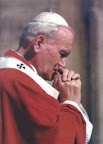
Intentions of the Holy Father for April

Ecology and Justice. That governments may foster the protection of creation and the just distribution of natural resources.
Hope for the Sick. That the Risen Lord may fill with hope the hearts of those who are being tested by pain and sickness.
Showing posts with label joy. Show all posts

Better Late than Never

The following is a shorter version of yesterday's Laetare Sunday homily: Authentic Christian Joy

We celebrate Laetare Sunday as a day of rejoicing in the midst of Lent. The Church gives us this oasis in the midst of our Lenten journey to remind us to keep our eyes focused on the goal of Easter. Our goal is the joy of the Resurrection. Authentic Christian joy is counter cultural; it goes against what the loudest segments of our culture tell us we should be searching for. The Parable of the Prodigal Son is a great illustration of the difference between authentic Christian joy and the cheap substitute that our culture often feeds us.

The Prodigal Son is searching for happiness and joy. He just doesn't know how to go about finding it. He makes three major mistakes that eventually lead him to the pig pen. The first one is that he separates himself from the family in search of freedom. Freedom is great, he just has the wrong idea of it. He sees it as a getting rid of restrictions so he can do what he wants. Freedom for the Prodigal Son means setting himself up as his own moral authority. What he doesn't understand is that freedom separated from objective truth leads to slavery. He'll get there eventually.

The second major problem with his search for joy is that he is greedy and possessive. "Give me my share of the inheritance," he demands. In the Prodigal Son's mind, the more he has, the happier he'll be. Does that message sound familiar?

His third major problem is that his ultimate goal is pleasure. Pleasures are great, and our culture offers us an innumerable amount of them, but if we set them up as the thing to be sought after, we'll be miserable. First of all, pleasure is fleeting, and secondly, it tends to consume us and our energies. Sure enough, the Prodigal Son's search for pleasures absolutely consumes him and all his possessions. Welcome to the pig sty.

What happens next is a work of pure grace. The words of the Gospel are powerful: "he came to his senses." This is where is journey toward true joy begins. The same is true for each one of us. We find joy when we see reality as it really is. C.S. Lewis said our challenge throughout life is to see what's really real. The Prodigal Son's about to find out what's really real.

Whereas freedom meant separating himself from the family and becoming his own moral authority, the Prodigal Son now finds that true freedom is in the family and living by the rules of the household. But it's more than that. True freedom consists in surrendering himself to the Father: "Treat me as one of your hired hands." St. Paul makes this point explicitly when he said, "Be slaves of Jesus Christ." The paradox is that when we give ourselves completely to God, we become freer than we could ever imagine.

Whereas he thought possessions would make him happy, now he finds that the love of the Father makes him truly happy. When he lived his life of dissipation, people loved him because of what he had; now as he returns to the Father with absolutely nothing, he realizes he's loved for who he is. When we understand this point, we'll be able to be truly detached from possessions, whether we have many or few. The only thing that really matters is the love of the Father.

Whereas he thought that the goal of life was pleasure and that pleasure meant joy, now he understands that the joy of reincorporation into the love of the Father demolishes that notion. He is swallowed up in the love of that Father--the cloak, the ring, the fatted calf, the party with all the household (come on big brother!). Our true joy consists in relishing in that same love of God for us in the midst of the community that is the Church.

Just as the final joyous state of the Prodigal Son is dependent upon his reconciliation with the Father, so our joy is as well. The Church offers us the chance to receive sacramental reconciliation, especially in this season of Lent. I think you'll find that your joy is associated with how seriously you take this offer.

How Religious Communities Heal Hearts

Anchoress, thanks for this video from the Boston Globe.


It got me thinking. That's always dangerous. A beautiful couplet of books, The Man on the Donkey, Pt. 1 and Pt. 2, by H. F. M. Prescott, show a similar dynamic.  The pair of books unfold and draw together the lives of disparate historical and fictional characters living in the time of Henry VIII.  In them, a battered and abused girl is sent to a convent so that she will no longer burden her older sister by existing.  Previously, the convent had been portrayed as worldly and petty in its aspirations: life was filled, apparently, with bickering over rugs and boasting over which sister had the most gold pins to hold her veil upon her head.  As the abused girls moves into the convent, the reader begins to see another side.  In this world vastly kinder than the one into which she was born, the girl begins to blossom as a person, having encountered simple, untangled and unmanipulative love for the first time.  I myself was startled by the ease with which the author, without ever re-representing or changing the personality of the convent, shows it first from one perspective, and then from another: worldly than it ought to be, but a haven of sanctity compared to the world.

During my time in seminary I saw something of the same dynamic.  Many of the men, myself included, thought the place very much more worldly than it ought to be.  Yet visitors were always and uniformly amazed by its quiet warmth, friendliness, hospitality, and the ease with which a heart lapses into prayer in that place.  We did not live in a place of lollipops and sunshine, and there weren't love-bombs, either... which is probably a good thing.  But there was a place where genuine love could gradually, organically grow and bring about real healing and a real kind of new life in the men that arrived there.  I saw it happen.  I recall one man who was very poorly socialized, a bore and boor, and very quickly found himself nearly isolated in that house of 150 Christian men because of it.  I suspect it was not the first time people had a hard time saying, "Well, that's just So-and-so.  You know how he is," because for most people, even good people, at some point, enough is enough.

But I also think of a friend of mine, a man who lived across the hall from me - well liked and popular because intelligent, athletic, easy-going, responsible, and kind.  This man told me that he was not going to just watch So-and-so crumble and fall away.  He couldn't bring himself to think, "Good riddance."  I also know that the petty unkindness and gossip against the unpleasant man became so bad that a very popular, well-respected, and high-ranking faculty member addressed So-and-so's class in his absence.  He told them that the faculty were aware of So-and-so's problems and issues.  There was no need to keep pointing them out to the faculty or to each other.  It was best just to be a friend to So-and-so, and to pray for him.  At first, I thought it unprofessional or even reckless of the faculty member to address the class so openly about what would probably be considered their classmate's personnel matter.  At least, that's what it would be considered in the world.  But there, in that house of God, it was a personal matter - and personal matters sometimes require far more delicacy than personnel matters, and sometimes far less.


Lastly, I think about how I watched, saw with my own eyes, the growth of So-and-so.  An irritating mannerism fell away.  A new friend was made.  Someone invited So-and-so to join in.  Another perplexing behavior was moderated.  So-and-so made another friend.  People stopped saying things harshly about So-and-so behind his back.  More people were willing to invite him to more things.  It became clear that he wasn't so stupid as people thought at first, even if a bit more uncouth than they liked.  People went from defending him on principle to defending him on the basis of his actual strengths.  It turned out he was athletic enough that, his abrasive characteristics diminishing, people didn't mind - no, actually wanted him on their team.  He started to enjoy his studies.  More prayers were offered up for So-and-so, doubtless, than anyone on earth will ever know.  For that matter, So-and-so went from being known for the amount of time he spent in front of the community television to being a man noted for the discipline of his prayer.  A man who looked like he wouldn't last the first year because he was so aggravating has since progressed well on the way to being a good and holy priest, certainly of great use to the People of God.  In that seminary, that house where seedlings are transplanted like stalks of rice, that man came alive in a new way.

So it is with the Church as a whole.  In the rock tumbler of our shared life in the Spirit, we are first to grind down sharp edges, then polish natural virtues, and at last glow like gems of holiness.  It is not a romantic thing, but a gritty thing.  Well, it is romantic in the sense of being adventurous, but not in the sense of being smooth or suave.  Temptations do not flee the life of holiness, but flock to it like moths.  We in the Church are called to live in a way different than that found in the world outside.
For as in one body we have many members, and all the members do not have the same function, so we, though many, are one body in Christ, and individually members one of another. Having gifts that differ according to the grace given to us, let us use them: if prophecy, in proportion to our faith; if service, in our serving; he who teaches, in his teaching; he who exhorts, in his exhortation; he who contributes, in liberality; he who gives aid, with zeal; he who does acts of mercy, with cheerfulness.

Let love be genuine; hate what is evil, hold fast to what is good; love one another with brotherly affection; outdo one another in showing honor. Never flag in zeal, be aglow with the Spirit, serve the Lord. Rejoice in your hope, be patient in tribulation, be constant in prayer. Contribute to the needs of the saints, practice hospitality. Bless those who persecute you; bless and do not curse them. Rejoice with those who rejoice, weep with those who weep. Live in harmony with one another; do not be haughty, but associate with the lowly; never be conceited. Repay no one evil for evil, but take thought for what is noble in the sight of all. If possible, so far as it depends upon you, live peaceably with all. Beloved, never avenge yourselves, but leave it to the wrath of God; for it is written, "Vengeance is mine, I will repay, says the Lord." No, "if your enemy is hungry, feed him; if he is thirsty, give him drink; for by so doing you will heap burning coals upon his head." Do not be overcome by evil, but overcome evil with good, (Romans 12:4-21).
We will not always do it very well, but our company should be a place where people will encounter the healing touch of Christ made present in His people, in His priests, in His word and sacraments.  It might not happen all at once, and it certainly will not happen without bumps and bruises along the way... but the more we rely on Jesus to make it happen, the more surely we will see progress before our very eyes - the more we will see souls open and blossom in a way the world can barely conceive, let alone imitate.

For that matter, a Christian family is supposed to be very much the same sort of thing as a Christian church.

i am a little church(no great cathedral)


i am a little church(no great cathedral)
far from the splendor and squalor of hurrying cities
-i do not worry if briefer days grow briefest,
i am not sorry when sun and rain make april

my life is the life of the reaper and the sower;
my prayers are prayers of earth's own clumsily striving
(finding and losing and laughing and crying)children
whose any sadness or joy is my grief or my gladness

around me surges a miracle of unceasing
birth and glory and death and resurrection:
over my sleeping self float flaming symbols
of hope,and i wake to a perfect patience of mountains

i am a little church(far from the frantic
world with its rapture and anguish)at peace with nature
-i do not worry if longer nights grow longest;
i am not sorry when silence becomes singing

winter by spring,i lift my diminutive spire to
merciful Him Whose only now is forever:
standing erect in the deathless truth of His presence
(welcoming humbly His light and proudly His darkness)
Another beautiful piece of postmodern poetry by the late e. e. cummings.

Haiti and God's Providence

There's been a lot of nonsense lately about Haiti - everything from remarks about it being divine retribution, to attempted pleasantries about it all being for the best.

Something I've been focusing a lot on lately, for personal reasons and because of more public affairs, is the authentic meaning of joy and hope.

St. Therese of Lisieux asked in a letter how it was that Jesus, without ever being deprived of the joy of the beatific vision, could yet experience such utter emptiness and abandonment on the cross. She answered herself that she did not know, but only knew that it was possible because she herself was experiencing it during her own painfully fatal conflict with tuberculosis. Joy, for a Christian, isn't mere happiness any more than love is mere warm feelings toward another. Joy is the knowledge of the presence of God's Kingdom, the knowledge of His will at work - even when it is hidden-and-not-yet-present.

The cheapness of religious cant isn't that it's false to say that God's Providence includes even the catastrophic suffering of innocents. If God's Providence doesn't include suffering and death, then it's worthless. It isn't false to say, "God has a plan, and this, eventually will be drawn into the good." But also isn't the point, and it is cheap to say to someone who is in the throes of suffering, unless you are darn sure they are prepared to hear it.

The cheapness of religious cant is that it subsumes one reality - that of pain, suffering, and death - into another one: the victory of God. It tries to make the sorrow "go away," and not for a commitment to truth or to the person suffering, but simply out fear of the discomfort of facing the truth of the person suffering.

When we are suffering, it is good to remind ourselves of God's Providence, and that He is as displeased with the pain we are experiencing as we are, and to ask ourselves, and Him, honestly, what role this might play in His plan for our lives. When others are suffering, it is probably better just to listen presently at whatever length, help them practically in ways they might need or request, let them ask their own questions in their own time, and let our presence in persona Christi serve as an unspoken answer.

What Happened Yesterday Going to Mass

Yesterday, I got a minor reminder of something of what Deacon Dave preached about, and posted yesterday at this blog.

I drove to St. XYZ parish for its 12:10 p.m. Mass.  It was convenient to where I was working yesterday.  I got there, and a note on the door politely stated that the 7:00 a.m. and 12:10 p.m. Masses of the day would not be said.  I presume it was because of Martin Luther King Jr. Day.  It is a federal holiday and so federal workers, who populate my area plentifully, as well as students and teachers, had the day off.  "Priests apparently, too," I remarked to myself as I went into the church to pray for a bit, since I was there anyway.  There were twenty or thirty people inside, apparently also unforewarned about the cancellation - and apparently workers on their lunch break, as usual.  I became irritated.  Irritation turned to anger, resentment.  I tried hard to pray.  The best I could muster was to growl at God about workshy bureaucrats and priests.  None of this reflects well on me, I am afraid.


But then a moment of grace intervened.  I didn't detect it at first.  It simply arose as a quiet thought, "Well, I might have gotten my butt out of bed for the early Mass at my own parish, or even the morning Mass, and still been to work on time - or close enough to it."  Since I was there anyway, I tried to remember the words to a prayer of spiritual communion.  I couldn't, so instead I just prayed, "Jesus, just yesterday you came to me in love.  Please extend into today the union you gave me yesterday.  Help me to love like you.  I want to trust that whatever happens, it is your will.  Help me to trust you.  Amen."  As I walked outside after praying a couple decades of the rosary, another thought came to me.  "The priest might actually be very industrious.  I don't know.  He might very well need today off from his usual duties."  The sun was warm on my face during our little Spring Break in January.  I was grateful for having slept well on my soft bed in my warm house the night before, and for having a bit of work for the time being.  Resentment and anger faded away.

Taking responsibility for one's own actions, giving others the benefit of the doubt, and gratitude are good people-person skills.  They are also good attitudes.  They are also something of the natural virtue upon which supernatural sanctity is built.

I went back to the office where I was working and was able to make a valuable contribution to the firm.  That's something to take a bit of pride in, something to sleep well on.  I joined my dad and his wife for dinner and we had a pleasant time.  My evening tutoring session went well.  The day has ended nicely.  The bitter poison of anger, that might have slowly and imperceptibly tainted the rest of my day, was drawn out by an action of grace, to which I opened myself by a determination to pray, which was given to me by an action of grace, to which I opened myself by deciding to make use of the sacraments if I could, which was given to me by an action of grace...

So yesterday I saw the co-mingling of grace and my own efforts - and saw a bit of water turned into wine.  Let's look for little reminders of grace, and in our actions, try to be for other people little reminders of grace.

My Gaudete

Today is the third Sunday of Advent, named on the Church calendar, as many Sundays are, for the first word of either the Epistle or the Gospel of the day, according to the lectionary before the liturgical reform. I believe that most of these readings now make up the Sunday readings for year A of the lectionary cycle. The epistle reading for today (Phil 4:4-7) begins, "Rejoice in the Lord always." The command form used in Latin to mean "rejoice" is gaudete. Hence, Gaudete Sunday. It is upon this Sunday of Advent that a little of the gloomy blue
is drained from the priest's vestments, leaving them rose in color ("It's not pink!" they're often heard to say).

And it was upon this Sunday, at about 2 p.m. I found myself unexpectedly standing in the rain along 16th St. NW, a heavily trafficked corridor, next to the-wreck-that-had-been-my-car-only-minutes-before. It was cold, and I was dressed nicely for a community service activity to which I had been running late, at which I would now be unable to attend, waiting for a tow truck and a ride from my roommate. It was only seconds after the car accident that my brain whirred, "I don't have full-time work. I don't have much savings left. My car is totaled. How can this be? Why me?" When I saw that the other driver was uninjured (as was I) but that her car had only some scratches and cracks in the bumper, my sense of the world's mocking unfairness only increased. But now, fifteen or twenty minutes after the accident, as the rain drizzled on my forehead, I realized, "This has all happened for a reason." In that moment of a grace, I felt a thorn or splinter remove from my heart, and the self-pity evaporated. The self-pity and the fear were alleviated. One moment they were there, and at the next they were not. Instead, a confidence of the all-encompassing providence of God's will began to penetrate into my heart.

Then a confirmation came to me from God. Actually, she drove up. She was an Ethiopian woman, and she rolled down her window and said me, "Are you alright?" When I nodded, she burst into a smile that chased away the clouds in my heart and made me smile as she cried, "Praise Jesus! I am so glad that you are well! See, it is a miracle, and for some purpose. Do you have anyone coming?" I told her my roommate was coming. She smiled and said, "It is for something. Do not forget that Jesus still has you!" And she drove off.

If I did not get the message, another Ethiopian woman drove up. I'm not kidding here. The odds seem slim, but it makes me wonder if the services of an Ethiopian church were letting out. She rolled down her window and told me that she liked my bumper stickers. Ending abortion is a passion of hers, she said, and that I should not worry about distractions and turmoil the devil will send to me. "You are well and God will bless you. Trust Him! Do you need to use my cell phone?" I thanked her and declined the favor, telling her that my roommate was on the way and so was a tow truck. She smiled and wished me well.  I noted that her car as well as the first Ethiopian lady's both had dents in them from collisions.  They had experienced my little trauma, and quite probably far worse.  But how they smiled!


After the tow truck took brought my car back to my home, and my roommate brought me back in his car, he and I went to Mass together. The priest punctuated a theme that my roommate and I had been discussing just a day or two earlier. Christian Joy is not a giddy thing, or a naive thing. It is not an emotion any more than love, he said, but it is an anchoring virtue, a continual knowledge or memory of the presence of God in our lives and in the events of our lives. Joy makes the deaths of loved ones tolerable, and weddings not merely happy, but hopeful and passionate. It makes births beautiful and injuries feel passing. Joy maintains an equilibrium, and without negating anything, accentuates the good in how we perceive everything. It does not dispel the troubles around us, but keeps them from penetrating too deeply into us. It keeps God in the back of our mind and disposes us to respond to Him in the events of our lives, rather than to our own emotional responses. We Christians make a grave mistake if we confuse joy with an emotion. If we think we are sinning by being sad, somehow disobeying the command to rejoice; or that we are "in grace" or consolation when things are pleasant, then we shall never see the face of God because we will have already forsworn the Cross without even noticing. Because joy is a knowledge and a decision, it is also a virtue, one that we can pray for and practice.  Joy is a virtue obviously connected to the virtues of faith and hope.

So though I felt sad at my loss, and still feel a bit of trepidation at the possible outcomes of my situation, my heart keeps gravitating, almost on its own, but really under the impulse of grace and the discipline of training, toward gratitude and trust. I am grateful that I have family and friends who care about me, limbs that are healthy and strong, a mind that is sharp, and possibilities unfolding before me, albeit slowly and in their own time. I am grateful that nobody was injured, rather than upset that my car will probably be totaled for a pittance. I am grateful for the gift of faith to see God's love even in darkness and in rain. I am grateful not to feel overwhelmed, but supported and protected.  And I have not given up waiting to see how Jesus is acting in my life.  I hope that you, dear reader, have not either.

This Gaudete Sunday, some key lessons were driven home to me, if you'll forgive the pun. Some other food for thought has been churning around in my head. I also have reason to believe from past experience that this day will turn out to have been a significant and good one when I reflect back upon it.

Good for the soul...

Ice cream, à la mode.


My Life Is Average

A friend of mine just told me about this site called My Life Is Average.  Open contributions from anyone who cares to contribute provide a steady stream of pleasant and cheerful anecdotes, like the ones quoted below:

Today, I was driving behind my boyfriend when he suddenly pulls over. I do the same and am utterly bewildered as he runs out of his car and pulls me out of mine. He then grabs my hand and we take off running.. and jumping into a giant pile of leaves he saw on the side of the road. I do believe I will be keeping him around. MLIA.
and:
Today, I was eating my dinosaur themed fruit snacks. There were only a few left, and poured them out into my hand. I find half of a red dinosaur, and a T-Rex with red on its teeth. Best bag of fruit snacks ever. MLIA.

I am convinced that even more than daily miracles, God offers us daily chuckles, if we will open our eyes to see them.  C. S. Lewis wrote that he was confident that affection is responsible for nine tenths of basic human happiness.  Being able to chuckle once or twice an hour probably goes a long way to basic happiness, too.

A Thought During a Long Run

During my distance run with my roommate tonight, I had a thought at some point. But I'll share that in a minute.  At the start, we offered our run for different intentions.  In the last miles, we started offering particular miles for different people and different intentions. That helps me, and perhaps him, to stay tough during my runs. Running is largely mental, and so is toughness. People whose first contribution to a conversation about long-distance running is, "I could never do that," probably won't. But they could, even in a wheelchair. During the Marine Corps Marathon last year one of the things that inspired me most and made me most emotional during the run was to see how men in racing wheelchairs, and without functioning legs, could keep up with the runners. Some of them were born without legs. Some of them lost their legs in the war. They tended to get passed on the uphills, but man, did they compensate on the way down! And ten dollars says that not one of them spent the race saying, "I could never do that."

So here's the though that occurred to me: "Toughness and gentleness are not at odds with each other, but in fact are complementary virtues." When we say someone is tough, we usually mean that he or she can take a beating, can get knocked around, and still get back up. "Tough" is a very different thing than "violent," or "aggressive," or "harsh," and its contrary opposite is not gentleness, I think, but weakness or cowardice. "Tough" might be a modern word for something like "having perseverance," or "having fortitude."

Now, someone who is tough knows how to take a knock and not get knocked down, or at least how to get back up. A tough person knows what it is to suffer in the way that a coward does not. A coward goes to any length in order to avoid suffering, perhaps because of fear that it will break him, or perhaps out of simple decadent complacency in comfort. This evasion of suffering can obviously lead very quickly into all sorts of sins. The coward refuses to suffer, never learns of what mettle he's made, never knows triumph, what the Bible calls glory, what we are all made for - perhaps because he cannot conceive even the hope of glory. When we reject weakness and suffering, we will begin to reject it, resent it, in others as well.


On the other hand, the tough person knows what it is to suffer. He has quite likely suffered amply, suffered in a way that a coward preempts by saying, "I could never do that." It is no coincidence that children come to birth before they come to the point of hurting their mothers' hearts. The woman's soul is prepared for suffering by the suffering her body has already learned to endure. This capacity can make them seem amazingly hard to a soul more repelled by pain. "How can she kick her own daughter out of the house, just for doing drugs, or bringing strange boys home overnight?" The tougher person knows that there is a good out there, worth attaining, and greater in goodness than the intervening suffering is in badness. So the tougher soul hardens itself to push through pain and suffering, and wins the prize. (Think of Rom 5:3 or 8:18.)

Precisely because these tougher souls, women in pangs and men in racing wheelchairs, know what it is to suffer, I believe they have a greater capacity to accept it in others. They may not choose to do so, but I think they have a greater capacity to be genuinely patient with others' weakness, suffering, and sorrow. They certainly have a greater ability to help others endure their own difficulties. In an unexpected way, the spiritually tough person is much better at being spiritually gentle. And precisely because our bodies and souls are so thoroughly interconnected, a lesson we learn in one can help us to live better in the other.

So many modern "solutions" to problems come from a rejection of suffering. "I could never carry my child to term, having it remind me of the man that raped me," and others, accustomed to similar thinking, ignore the child's humanity and innocence and concede abortion in cases of rape. It's easier. Less suffering. I-could-never thinking. "But grandma is so old and weak, and tired, surely this disease will torture her to death if we do not put her out of her pain," and others, accustomed to similar thinking, ignore the fact that rather than comforting and loving her, they will only do the work of the disease. It's easier. Less suffering. I-could-never thinking.

The insanity is here: the coward who betrays his comrades to avoid being shot in battle might very well be shot after the battle, and if he isn't, will probably wish he had been, so great will be his interior agony, his self-loathing, his division. For it is a plain truth that we are either at war with sin or at war with ourselves. We can never be at peace with sin because peace is contrary to the nature of sin. The part of our soul that wants goodness will then wage war against the part of our soul that has made a pact with sin, agreed to rationalize and protect it. And the agony of a house divided, of a war within one's soul, of doing evil and hating evil at the same time, is far worse than simply dying. But we often select it because it seems easier, more pleasant, better, especially in the short term. But in the long term, it is a worse sort of death. It is disintegration of the self, the death that does not die, and in the very end, it is hell. Likewise, after the glamor of sin has lost its luster, the couple that have divorced rather than dig into their problems are rarely happier, even if their daily lives seem more manageable. The father who has rejected his homosexually-inclined son "as a matter of scriptural principle," is not at peace.  Nor is the mother who tells the same son that such abnormalities are normal, in order to be nice.  They have successfully split Solomon's baby in two by choosing either to hate the sinner or to love the sin, but they have not successfully saved their son as both of them have intend.


And let's face it: our culture hates suffering. According to Yoda (in Star Wars - you know, the little green dude), suffering is the worst evil. So it is in Buddhism. But in Christianity it was suffering on a cross that saved the world. Aside from the purely natural benefits of enduring suffering to attain a great good on the other side of pain, we who are baptized into and united with Christ have an amazing opportunity; we can offer our suffering in union with His to help Him to redeem the world (Eph 3:13; Phil 3:10-11; Col 1:24; 2 Thes 1:5). That is amazing. And we must remember that people are not the enemy, nor is even suffering, but the I-could-never thinking is. Just as a physically tough person can help a physically weaker person to attain new heights, we Christians, who know that Christ is the Helpmate of us all, should help others to attain new height by persevering through the more profound difficulties that are spiritual and moral.

We not only have to fight for laws that outlaw bad "solutions" to very real problems, but we also have to help those who are spiritually weaker, more vulnerable, more afraid, to learn to endure the difficulties of life by enduring them together. That is what "compassion" means in Latin, "to suffer with," not "to magically make suffering go away." It is what our Lord did by becoming human, and it is how we humans are to serve the Lord. Right now, crisis pregnancy centers and old folks' homes seem especially the places to be - the front lines of our spiritual warfare against I-could-never thinking. The reply to such thinking that arises everywhere and especially in such places must always be, "Ah, but you can do all things with Him who strengthens you," (Phil 4:13). And it must be followed by, "And I'll help you do it."

Tying it all together, in those last miles of the run, my roommate and I prayed for the grace to be made tougher, and we offered our little, voluntary sufferings in union with Jesus' for people about whom we care a great deal especially some people that Jesus is currently asking to voluntarily endure involuntary sufferings. Because running is largely mental, and the mental is half of how we engage in the spiritual, the devil can certainly try to slip in, to break morale, entice us to sin. When a pain the hip or in the glutes interpreted itself as, "Wouldn't it be best to stop now?" I grit my teeth, prayed for Jesus' help, and said, "F*@# you, devil. Go to hell! This mile's for so-and-so. They need it and you're not going to get it," and I pushed into the pain a little. And like the pangs of childbearing, these littler pains pass too. Now, the devil defeated - at least for a few minutes - and the post-run milkshake-and-burger-dinner inhaled and the endorphins making my heart happy in spite of stiff legs, because of stiff legs, I am starting to feel a little sleepy.

Here's what I will pray, I think, before I sleep:


Heavenly Father, please make me tough, so that I can run this race of life the way you want me to, with a gentle heart filled with love for you and those you give me. And now as I lay me down to sleep, please refresh me for another day of service to you, and grant me in my service whatever joys are necessary to sustain me in it, and to bring others to you by it. I ask these things in Jesus' Name. Amen.

Sorry for rambling so long.  It was a long run - there was lots of time to think.  In case you're curious, there's just


I'm weak and liable to spend lots of the next nineteen days thinking, "I could never do that," rather than "I can do all things through Him who strengthens me."  So let's keep praying, OK?

Unexpected Gifts

This morning my roommate/marathon-partner, Tom, who is a pilot, took me up on a Cesna for breakfast in York, PA. He's building his flight time and takes these trips regularly. It was a very, very fun time.

After returning home, I drove to visit a friend and his wife for lunch and to help him to prepare to give a lecture at a conference in Peru, speaking Spanish. He doesn't really speak Spanish, but working from his own text translated by the conference organizers, I believe he'll do just fine. It was cool to be able to help him prepare because among the attendees will be a large number of devout families, priests, and a few bishops and cardinals.

When I returned home from lunch and helping my friend prepare for his lecture, I saw an Amazon box sitting on the front step. "Ooooh! Amazon," I thought. I love Amazon deliveries. Even though I am the principal recipient of them at our house, and even though I myself place the orders, deliveries always make me feel special - and I know I am not alone in this, people. But then I grew glum, thinking, "I didn't order anything from Amazon. Shoot, it must be for one of my roommates." I turned it over and read the label, and whaddya know, it was for me, and the return address was that of a friend from my parish. I was too surprised to register. Opening the box, I saw it was a book, Commentary on New Testament Use of the Old Testament. This particular book has been atop my Amazon wishlist since it came out in 2007 and will be a terribly useful reference for biblical scholars for years to come. And this friend bought it for me spontaneously, just because, because he is a kind and generous man - manifested in my mind numerous times long before this, especially with his commitment to the youth of our parish.

I love debts of gratitude. Debts of gratitude are different from debts of account because they are not calculated in dollars and cents and they are not paid back. Rather, they are paid forward, to borrow a nice phrase. They might even be paid forward to the person to whom we feel grateful. But they aren't paid as a matter of obligation, but as a matter of love. A gift freely given inspires in a healthy recipient a free response, in some direction. The repayment or the forward-payment of debts of gratitude is not intended to clear the debt, but to perpetuate it and deepen it, to draw more people into it. There is no tit-for-tat, but rather a response of grace for grace, free gift for free gift, and neither size nor shape are measured against each other. Instead, heart meets heart. Before long, a number of people feel a great desire to give not only their things, but really parts of themselves, as it were, to their neighbors and friends. Instead of lending and repaying money, we invest ourselves and are blessed by others. Gratitude inspires a sort of calculation that is exactly the opposite of either capitalism or socialism. Gratitude builds an economy of love.

There is nothing like gratitude to build those two beautiful forms of charity: piety and friendship. It is really important to do kind and generous things for others. If done selflessly, such deeds are magnanimous and share in the most magnanimous charity ever, that of our Lord for us. It is also really important to let others do kind and generous things for us when they are so moved. The graceful reception of such kindness not only humbles our pride, but may build up the giver's sense of sharing in divine grace, which can only lead to more grace. When we refuse gifts, while there is sometimes a genuine and legitimate desire to avoid unnecessary entanglements, there is also often a refusal to be humbled. What a sad condition!

Lol, all this is to say thanks to those men who blessed me today. I'll put personal notes in the mail. Except to you, Tom. I live with you. That would be dumb. How 'bout I buy you a milkshake after our next run?

Rest in Peace, Eunice

Eunice Kennedy Shriver died on Tuesday, and today will be buried from St. Francis Xavier, Hyannis, Massachusetts. Her legacy was immensely important to me personally – she strove to help the world see the strengths of persons with disabilities, rather than as a series of shortcomings or challenges. Her efforts were largely in response to the condition of her sister Rosemary, who seems perhaps to have been mildly mentally retarded or ill until a failed lobotomy, secretly ordered by her father, reduced her to utter incapacity. Eunice and her brother Ted Kennedy were both present when their sister Rosemary passed away in 2005.

Until recently, Eunice and Ted have had very different approaches, though. One cannot doubt that both loved their sister as best they knew how. That is natural. But Eunice was convinced that every single human life was a good thing, no matter what else. She personally advocated with president after president, starting with her brother. Even though she was a card-carrying Democrat, she was an outspoken supporter of the pro-Life cause within and outside of the Democratic Party. Ted, on the other hand, along with much of the political members of the Kennedy clan, has been a strong advocate for abortion. Abortion says nothing if it doesn’t say, “Some lives aren’t worth living.”


Persons with severe disabilities challenge our easy status quo. Normally, each of us is self-sufficient. We each can take care of ourselves, and occasionally help each other out as need arises. But a person with a severe difficulty, especially a mental one, needs constant help. Oftentimes they need help for the most basic functions of life. That means we around them must pitch in, get outside of ourselves, and learn to be patient, and gentle, and do extra work. Unlike “the rest of us,” it is not possible merely to coexist with the handicapped. They need too much. That is why we will either learn to love them or we will decide to kill them.

This morning, listening to NPR on the way to work, I heard some Democrat pundits fending off accusations by those hostile to their plans for healthcare reform. They brought up the accusation that they or their approach would kill all the people with Down syndrome. “Ha! Come on!” was about all they could say. Of course they don’t support killing all who have Down syndrome. They just support extensive neo-natal testing. Oh, but wait, they also support abortion on demand, and especially in difficult situations. And of course they support, many of them at least, government funding for abortions. Hmm… one wonders why there are so many fewer people being born with Down syndrome now than in the past.

But let’s get back to Ted and Eunice. Ted’s approach is the politically expedient one (for now), and it is also the more pleasant one, that is, the one that allows social pleasantries to do most of the work. After the abortion (say, of a child with Down syndrome), social pleasantries can go into full gear. It wasn’t a child, but a choice. There was no abortion (such an ugly word), but merely the premature termination of a pregnancy. The child who never existed didn’t have a perfectly livable condition with which millions of people worldwide live happily; rather, there was a severe defect. The doctor and family did not conspire to murder for the sake of convenience a child entrusted to their care by God Almighty, but rather, they sent home to Good and Gentle Jesus a precious little one who otherwise would have struggled greatly. Do you see, dear reader, how the game is played? False words cover over the truth, and one can try to look at oneself in the mirror again.

That’s not how Eunice’s approach works, though. In Eunice’s approach, a child is born into difficult circumstances. Sometimes the circumstances are extrinsic to the child – like poverty, or an ill mother or missing father. Sometimes the circumstances are part of who the child is – like mental disability or a permanent medical problem. The child’s life is filled with frequent or even constant hardship. Those close to the little boy or girl must learn to sacrifice in new and intense, profound ways: sleep is lost, money is spent on extensive necessities rather than on yearned-for luxuries, vacations are altered or sacrificed, hopes and dreams are modified or abandoned (that’s the hardest part). It is too much for one person, so the family, friends, neighbors, and local leaders all have to pitch in together. Cooperation makes an overwhelming set of challenges manageable. New virtues are acquired that were never before needed, or are developed when before they would have been slight: patience, tenderness, discipline, flexibility. Heroic effort is needed for basic steps. Those around the child eventually learn to be amazed and joyful at very little bits of progress – oh, how a person with handicaps struggles for such little gains. I remember my amazement to discover that my own handicapped sister had learned to tie her shoes. That she was fifteen years old wasn’t my interest, but only, “Hey, Ma! Look what she can do! Did you see that? Did you already know she could do that? Holy cow! That’s great, Keelin! Good job!” In Eunice’s plan, we learn self-sacrifice, cooperation, affection. We learn love. And as the child grows and prospers modestly, or not, we learn to see a rhythm in reality, a meaning in the muddle. We learn to see how one event happened before another, though we would not have so arranged things, and that the arrangement that actually happened was, in fact, arranged. We come to see that there is a plan in the universe, and a Planner. Ultimately, in the life of a child with disabilities, we come to see the face of God.


But it’s not romantic, and it’s not easy. There is a lot of blood, sweat, and tears to be shed along the way, or else everyone would do it. We need grace – the life, strength, joy of God shared with us from on high – or else we will go the path of least resistance. We will go the way the pagan world, the world without God, has always gone. The Jewish prophets were the first to object to the murder of the weak and marginalized. They were the first to insist that personal comfort and domination by the fittest were not in accord with God’s will, with deepest reality. Christians have taken up that objection, that insistence – though some of us have been seduced into murder by pleasant words. If we do not learn to pray, to return to God, to seek His help, we will end by killing those who interfere with our plan for happiness. We will go Ted’s way.

Now, on a closing note, I’d like to be fair to Ted. It is easy for a good heart to be seduced. Moreover, he now has brain cancer, and wasn’t even able to attend his sister Eunice’s funeral Mass. His cancer has certainly incapacitated him. He was there for Rosemary, after all. Maybe his struggle with cancer and the prayers of his sisters in heaven will help him to come to know the love of God in a more profoundly penetrating way than he has before.

Eunice, thank you for all you did. Yours was a monumental life. Now you are with your Rosie and can know her as God has always known her. Please pray for us who still journey here below.

P.s.: Today Eunice's family issued a powerful statement that well summarizes a powerful life. She visited Rosemary regularly. She advocated persistently for political and social measures to improve opportunities for those with handicaps to enjoy their full human potential. She strongly challenged consciences and gently coaxed contestants. She built the Special Olympics from a backyard affair (literally) to a global showcase of talent in which each individual is fostered and cheered on. Until the last years of her life, she and her husband, Sargent, hosted a summer camp for children with and without disabilities at their home in Rockville, Maryland, so that the children could grow with each other.

"Inspired by her love of God, her devotion to her family, and her relentless belief in the dignity and worth of every human life, she worked without ceasing - searching, pushing, demanding, hoping for change. She was a living prayer, a living advocate, a living center of power. She set out to change the world and to change us, and she did that and more. She founded the movement that became Special Olympics, the largest movement for acceptance and inclusion for people with intellectual disabilities in the history of the world. Her work transformed the lives of hundreds of millions of people across the globe, and they in turn are her living legacy."


P.p.s.: Another thing strikes me about Mrs. Kennedy Shriver. In every single photograph of her that I can find, she is smiling. It seems as though her path, though it be harder, is happier.

Click here for the biography on her website.

Sharing Life's Journey


I took my godson on the Appalachian Trail for an overnight hike with me last weekend. We found a pleasant flat spot alongside a stream where some people had camped the night before. We told fart jokes and ate trail mix; cooked on a portable camping stove; made a fire to roast marshmallows over; saw some wildlife, including three black bears, though those weren't the most exotic things we saw (this was!); and played a few hands of Uno. All in all, it was a very successful weekend if "success" is measured in friendship, laughter, mutual challenge and encouragement, interesting experiences, shared joy, and ice cream (although ChocoTacos proved elusive).

Actually, come to think of it, that's not a bad standard of success. My godson told me several times that he was very grateful that I brought him hiking with me, and that he'd like to do it again. One day, he will understand how grateful I was that he came along.

Eighteen Kids, No Joke... Just Love

You gotta check out this video interview from WashingtonPost.com. The family has eighteen children, and they love it! Most of us aren't as saintly as they seem to be, for sure, but one has to wonder - maybe it's the willingness to love that we lack, sometimes. Certainly our life circumstances and emotional capacities don't lend themselves, usually, to such a big family... but I wonder how willing I am to stretch myself.

SNOW DAY!


My niece experienced her first snow day today. School was cancelled for mommy and fun ensued. She even got to sled for the first time, down the hillock in front of their house, a drop of about four feet at a forty five degree angle. Do you remember the sheer joy of such things. It's distant for me.

Dear Jesus, please increase our virtue and wisdom so that we may be young in spirit again, and enter the Kingdom of Heaven. Amen.

A Couple of Notes

Today is the feast of St. John Damascene. Last year on this date, I wrote a piece about him, and rather than repeat myself, I will just provide a link to it. Click HERE.

For now, I will just share a brief thought I had this morning after Communion.

What a blessed people are we Christians, who may break our nightly fast by feeding on the flesh of God himself! What an amazing mystery.

"For what nation is there so great, who hath God so nigh unto them, as the LORD our God is in all things that we call upon him for?" (Deut 4:7, KJV).

"You shall eat in plenty and be satisfied, and praise the name of the LORD your God, who has dealt wondrously with you. And my people shall never again be put to shame," (Joel 2:26, RSV).

"He has not dealt thus with any other nation," (Ps 147:20).

The Merest of Babes

The Mass readings for today (Tuesday after 1st Sunday of Advent, year B1: Is 11:1-10; Ps 72:1-2, 7-8, 12-13, 17; Lk 10:21-24) are really nice. The first one, from the prophet Isaiah, is fine, and the second one from Luke is one of my very favorites. It articulates the topsy-turvy logic of the Gospel in which the whole thought of the city of man is turned upside down. Below, I've copied it out of the RSV translation because it sounds a bit nicer to my ears than the lectionary.


In that same hour he rejoiced in the Holy Spirit and said, "I thank thee, Father, Lord of heaven and earth, that thou hast hidden these things from the wise and understanding and revealed them to babes; yea, Father, for such was thy gracious will. All things have been delivered to me by my Father; and no one knows who the Son is except the Father, or who the Father is except the Son and any one to whom the Son chooses to reveal him."

Then turning to the disciples he said privately, "Blessed are the eyes which see what you see! For I tell you that many prophets and kings desired to see what you see, and did not see it, and to hear what you hear, and did not hear it," (Lk 10:21-24).


Think about that, folks. Children! Your kids understand Jesus better than you do. At another place, Jesus says that tax collectors and prostitutes are entering the kingdom ahead of the pharisees. To us, pharisee is a bad word. Not so for them. We often compare the pharisees to lawyers, politicians, or priests. None of those is comparable though, because they have bad connotations in our ears. Maybe expert is a better way to think of them. Jesus is basically saying that tax collectors and prostitutes are finding peace of conscience, joy of life, and the faith, hope, and love that leads into eternal life. And we're not. We don't get it, or else we're getting it pretty late.

We think we're good, we think we know how Jesus thinks and works, we think we've got life under control. Children know that they need help. "Daddy, can you tie my shoe?" A drug addicted prostitute lying in a gutter knows that she needs help. She might even know that help's name is Jesus (it literally means "salvation" in Hebrew!). But we are smug and sit in the train station thinking that we are conducting the salvation train, and so it leaves the station without us. How many of us, perhaps unbeknownst to even ourselves, feel that we are somehow doing Jesus a favor by going to church. It makes me think of the ancient pagan idea of feeding the gods with sacrifices of the flesh of goats and bulls.

Lol. But we have a God who wants to feed us with His own immortal flesh. Are we humble enough to just listen, like a little child? Or are we, in our smugness, going to say, "Lord, Lord!" while harboring an attitude that blinds us to His love, Him who the prophets yearned to see? Lol. And when we see Him, will we be too concerned with what others thing, too cool and sophisticated and mature, to let ourselves respond wholeheartedly? Children are better than adults again in that they are more naive, and simpler. It was fun to watch even some very sophisticated and hip sixteen year olds' jaws drop when we brought them to the forest for a hike, to see them climb trees and play on the rocks. Are we too sophisticated and "mature" to enjoy the Kingdom of God?

How It All Went

Ok, so today I ran the Marine Corps Marathon, my first marathon and my longest run ever, by 6.2 miles (about 10K).

First, I want to thank all my supporters. A lot of people donated money to the Archdiocese on my behalf, prayed for me, bought me shoes and nutrition supplies, cheered me on, encouraged me, and prayed for me. A number of you have called to check in on me and have emailed me your best wishes. Without that support, I would have bailed out about two months ago.Y'all are the best. I want you to know that when the howitzer (no starter's pistol for the Marines!) was fired to start the race, I offered the entire run to our Eternal Father for your benefit, asking him to bless you all for how much you've blessed me. I believe it is exactly the sort of sacrifice that our Heavenly Father loves to accept and to multiply.

Second, the race went well. I did not run the times I had targetted, but am very happy with having finished, and well especially in the last 3-4 miles, and having come very close to my desired time. The first few miles were hard because the course was so congested. Miles 18-22 were especially hard - I don't think I hit the wall (I think I did that once) as much as just became fatigued, very fatigued in the legs. There were water and carbohydrate-gel stands every two miles or so - a real godsend. At mile 22, as fatigue was hitting its worst, another young man whose name turned out to be Dave called to me while I had stopped to stretch, "Hey, c'mon, you can do it! Let's run together." So we did run together, each encouraging the other for the last four miles. The race ends on a fairly steep hill, going up an exit ramp off of I-66 or some such road (maybe VA-110). I slowed to a trudge, and then began to walk, just 150 yards from the finish! A hand gently lay on my back and pushed, and I knew it was Dave, and we ran in to the end together. Talk about a grace! It's a metaphor for life in Christ - we can try it alone, but it's so much better to go at it with others. Dave just came into Mother Church's fold at the Easter Vigil this past spring; and this coming spring will marry his fiancee. During our four miles together, we prayed a few Hail Marys and encouraged other runners who were struggling. Please take a moment to pray for their marriage to be blessed with fruitfulness and joy.

I saw some cool quotes, and even moving anecdotes, written on the back of peoples shirts. One said, "Pain is just weakness leaving the body." I like that. As a Christian striving with St. Paul to be a coworker with Christ in the labor of redeeming the world, I thought of my own little rejoinder.

Pain is the sound of the world being redeemed.

At the finish line, a Marine greets each finisher and puts a medal around his or her neck, and offers congratulations. People bring the finishers fruit and vegetables, sports bars, and lots of liquids. The Marines think of everything, and handled everything with gracious hospitality and efficient thoroughness. They have my complete confidence in every matter from now on. People were crying; I cried too - the pain is pretty real, but the joy, the sense of accomplishment, the camaraderie of the runners, the enthusiasm of the tens of thousands of spectators who formed a veritable gauntlet of cheers for about 80% of the course - it's all so much realer than any pain. I type that, 11 hours after having finished, as I ice my weary joints and down tylenol like jelly beans. Another shirt said, "Pain is for now; glory is forever." I really like that one.

One big lesson I learned: don't eat lots of jelly beans, no matter whether they are advertised as "Energy Beans," at mile 18 of a marathon. Trust me.

After the race, I called my roommate, Ben, who had my bag and phone, and he came to meet me. My friend Tamara called my cell phone before he got to me, and he told her where I was. I expected him, and am so grateful; I got her to boot, an unexpected surprise, for which I am also grateful. They stood with me in line for an hour while I waited for a massage (yes, the Marines think of everything) and then, while I was getting massaged, went to a sub shop and got me the best tasting sub I have ever eaten.

Bad news is that bad spelling and a data entry glitch seem to have prevented my times from being recorded by the official electronic device. Sorry to y'all who logged in to track me. Happily, I recorded my own darn splits, and will put them up in a few days when I've had a chance to figure them out for sure and format them properly, and when the photos from the race come out.


For now, a few stats are in order, from the time I crossed the starting line, about 3 minutes after the howitzer blasted:

1st 5k = 27:52.11
2nd 5k = 25:20.3
1st 10k = 53:12.41

last 10k = 63:52.38

total (42k / 26.2 mi) = 4:05:20.--
average pace = 9:21 min/mi

Thank you, all of you. Now, my icing is done and I'm ready for some zzz's. I've got school in the morning, and the Tylenol-PMs are starting to kick in. Good night. And, did I mention, thank you?

Encountering the Risen Christ in Community

Nowadays our idea of community has something to do with neighborhoods, online chat rooms or discussion forums, or perhaps a school. These communities are communities of convenience though, groups of people who happen to have something in common for the time being, and not really what the word “community” means. Community, in its Latin roots, means a strong or complete unity. I have heard that many parishes are cold and uncaring places of pew potatoes that just happen to live near each other and happen to be Catholic rather than Unitarian. That experience has not been my experience of parish life, however. My parish has affluent white folks; Latino, Asian, and African immigrants who come from halfway across the county by bus; young adults and grandmas; workers, professionals, and retirees. With thousands of different stories, interests, and aspirations we all gather around Jesus, the Christ. He is what holds us together. Some people do walk off in a huff when their feathers get ruffled – that’s always a temptation and happens in any group, even families. But what amazes me is that with all the feather ruffling in a parish, in my good parish, so few actually do walk off in a huff. Most folks there forgive, or try to, and then keep coming back. When I am absent for a while for whatever reason, I am asked about. The pastor uses our common resources and anonymous coparishioners use their own money to support those in need. When someone is evicted, others among us help to move them into their new home. There – it is perhaps the one place outside of my family’s home - I am not a number; I am a person who is known and loved. We help each other in a thousand ways. It was there that I first saw people serving those who could make no return, just because. But it wasn’t really just because – no Christian will say that. They do it because Jesus served us first.

Christian families are meant to be like little parish churches, and are the building blocks of parish churches – they are even the units that people register in. An oddity arises from this understanding of parish life: I cannot register as an individual, but only as a family of one. So are parishes are meant to be, and sometimes really obviously are, families of families. My family was basically a decent home to grow up in, but like most in my generation, not a particularly devout one. I have friends now who are raising their children, and maintaining their family, in a specifically Christian way of life. It is amazing: fifteen year olds that are still innocent and pure (mostly), five year olds who are (fairly) obedient, husbands that bend over backwards to help their wives with their chores, families with good boundaries and respect that welcome virtually all comers to join them around their table and share in their happiness. Their lives are not Norman Rockwell paintings. Mostly, they have their share of sufferings: chronic health conditions, untimely deaths, job insecurity. But still, their hearts and homes seem to expand rather than contract in the face of what are usually show-stoppers for family happiness. These people all swear that Christ is the source of their joy, and in their homes and hearts, as in my parish, I have found my own measure of joy, of gentle and eager love.

The largest such example is the Church herself. Founded by Jesus to continue His presence and work in bodily, animate form, the Church comes before and “plants” all the local churches but is also made up of them. The analogy of a body with its cells and parts really works well. The Church is too big and vast to experience immediately, except at certain powerful moments. The World Youth Days have, for my generation and this new, younger group of people, offered just such an opportunity. While leading a group of teenagers to the World Youth Day (WYD) in 2002 in Toronto, I remember a poignant incident. Two of the boys had bought an atlas with maps, and were marking off the different countries as they identified their flags. At one point, one of the boys spotted a group of pilgrims sitting together under two different flags. As the group sat, they were praying before a meal. One of the flags the boy identified as being India’s. The other was Pakistan’s. The boy said to his friend, “Hey, aren’t India and Pakistan supposed to hate each other?” The other boy said, “No, idiot, they’re supposed to love each other, and these ones are getting it right.” The Indians and Pakistanis finished their blessing with the Sign of the Cross and then ate their meal together. The WYD experiences offer a similar experience on a broader scale. This most recent one was in Sydney, where teenage binge drinking is an immense problem. With nearly a quarter million foreign young people descending upon the city, authorities were sure that the problem would amplify tremendously. Even rock concerts with merely 30,000 or so in attendance can cause emergency rooms to start hopping. Contrary to expectations, the number of alcohol-poisoning incidents plunged well below normal, according to one police officer on the street. No reported murders or rapes by unknown assailants that week: not with all those singing Christians on the streets at all hours, not with all those wholesome, enjoyable events going on day and night. In Toronto, I asked one local resident if she and other local citizens minded the longer lines, the delays on public transport, etc., occasioned by the locust swarm of teenagers on a biblical scale. She said, “At first I think we were all annoyed, but now, I think you are making us happier. People are kind of talking to strangers, even. You know?”

This encounter with a love that sacrifices rather than consumes, with joy that does not falter because of hardship – that is just the reason that Jesus instituted the Church: to get us to heaven, and to help encourage us until we arrive. It is what the Church establishes local parishes and dioceses for: to see that the Church is present all over the world, in every nook and cranny, so everyone has a chance at the Life of Christ. It is the reason that Jesus reconstituted family life on a new model: so that families, instead of being microcosms of the broader social chaos, can be little incubators of love.

In Christ, rooted in Him in other specific means, it actually works. Communion is possible in Christ. The following four posts on Encountering the Risen Christ will delve into how the various manifestations of Christian community actually work.