Intentions of the Holy Father for April

Ecology and Justice. That governments may foster the protection of creation and the just distribution of natural resources.
Hope for the Sick. That the Risen Lord may fill with hope the hearts of those who are being tested by pain and sickness.
Showing posts with label integrity. Show all posts

I Am Judas

Today is Holy Thursday, the Feast of the Lord's Supper, the Solemnity of the Betrayal of Judas.  If we contemplate sin seriously, it can quickly become overwhelming.  Even venial sins - little white lies, sharp words, petty refusals of generosity or gratitude - deserve a terrible punishment because of the majesty of the Creator whose Law they offend.  The most terrible crimes, though, can only leave us unfazed if we are truly callous and hardened.  The temptation we experience all year long, I propose, is not to this sin or to that, but toward this callous failure to understand the horror of sin.  It is rooted perhaps in many foundational failures: carelessly failing to note the glory of God's creation and plan; failure to really take in the dignity of our wife, neighbor, child, coworker; failure to take our own sins as seriously as we take the sins of others.  It is upon this last point that I want to reflect more particularly for just a moment.


It is very common for us to coin new terms like stupak, which nowadays means to betray one's convictions in a self-congratulatory way and to abandon those counting on you to help them in a very important cause.  It's easy to think of the Nazi leaders as the ultimate evil, and their party members as the ultimate colluders of evil, the ultimate opportunists.  It's easy to think of this or that disgraced priest as the ultimate scandal, the most wretched of men.  It's easy for us to think of the school board's ridiculous and immoral curriculum as the ultimate lesson in degradation.

What's hard is to remember that my sins are made of the same sort of thing.  It's hard to remember that I sit silently while others mock the church or make pro-lifers out to be wackos.  It's hard to remember that I buy my food and clothing without a care or a thought toward what "causes" the manufacturers support: gay marriage, abortion, no matter - as long as I get the best ice cream or the best coffee.  It is hard to remember that I have neglected my family obligations because other opportunities were more alluring.  It's hard for me to remember that many of the movies and songs I put into my head that "don't have that effect on me" all the while corrode my heart and thinking.

This, then, is the hard work of the Christian: to remember that I am Judas.

It isn't as dramatic as it sounds.  I am going to set aside the cases of people whom I believe to be possessed outright, like Hitler.  Even in the matter of Judas Iscariot, the gospels tell us that the devil entered into him.  The gospels also show something more to the present point: Judas did not suddenly, dramatically betray our Lord.  His betrayal was the final acheivement in a string of interior desertions.  Fulton Sheen does a good job in one of his books illustrating how Judas is the apostle who never quite got it.  He got money.  That he understood.  He got the Romans.  Them he understood.  But Jesus: Judas never quite understood Him.  Many of us think that we "get" Jesus.  I, like Judas, do not understand Him nearly as well as I think.
The simple fact is that tonight is Holy Thursday.  Tonight, in some way big or small, I will almost certainly betray our blessed Lord with sin - perhaps even between confiteor and communion.  That's something like betraying with a kiss, isn't it?

I am Judas.

Bishop Allen Vigneron's "10 Rules for Handling Disagreement Like a Christian"

If you've never encountered these rules, please read them.  Memorize any that are not intuitive to you.  I recently read a suggestion that Christians brainstorm a set of rules for internet-based discourse, rules like, "Assume the best intention and good faith of those with whom you are corresponding."  A noble idea.

The Anchoress and the President

First Things has on its website a blogger who goes by the moniker, "The Anchoress."  She is very lucid and recently wrote a post that is mind-blowing.  Her language is simple, straightforward, and so elegant.  Her theme important.  Her thesis correct, I believe.  And she provides excellent guidance for understanding President Obama and what we are to do about him, as Christians; at least, part of what we are to do about him.

Here it is.

Criteria of Emotional Maturity

I came across this list of seven criteria for qualifying one's own emotional maturity.  According to the little slip of paper with the list, emotionally mature people:

  1. Have the ability to deal constructively with reality;
  2. Have the capacity to adapt to change;
  3. Have a relative freedom from symptoms that are produced by tensions and anxiety;
  4. Have the capacity to find more satisfaction in giving than in receiving;
  5. Have the capacity to relate to other people in a consistent manner with mutual satisfaction and helpfulness;
  6. Have the capacity to sublimate, that is, to direct one's instinctive (hostile) energy into creative outlets;
  7. Have the capacity to love.
Of course, those of us who are immature are likely to still give ourselves passing marks.  Dietrich von Hildebrand tells us that we must always confront our actions, thoughts, and feelings with the person of Jesus, hold them up to Him as if to a mirror.  In doing so, we may come to feel judged or scolded - that is a temptation from the devil to believe that God is judging us.  We must not believe it.  The voice of Jesus calls out like a shepherd to sheep (Jn 10), and as we come to know Him better, we will hear His gentle voice leading us in the paths we should take, to be the men and women we should be.  If we try to listen to Him, He will not speak to us as He spoke to the spiritually-deaf pharisees.  When He speaks to us, even to say something very hard, as He must sometimes do, He will be as gentle as possible.  Very often, His message will arise in our hearts as a simple recognition of a hard truth about ourselves.

"If today you hear His voice, harden not your hearts," (Ps 95:7-8; Heb 3:15)

Ok, So Don't Laugh... But Every Once in a While


I am listening, as I type, to "Black Eyed Peas" and Justin Timberlake (I know, I know, we all have our little vices) singing a song called "Where is the Love?" The song is composed as a prayer to our Father in heaven, and urges the listener to integrity, forgiveness, and prayer. Among its little unexpected gems is the statement, "If you never know truth, then you never know love."

Every once in a while a pearl of truth falls out of our vacuous pop culture, like a moonrock from outer space.

I enjoy those little surprises. If you like them too, then I recommend the new Batman movies (Batman Begins and Dark Night) for some excellent moral theological gems. While I am recommending things, let me add the movies Bruce Almighty, Children of Men, Walk the Line, and Hotel Rwanda for excellent studies of the process of conversion and redemption in the life of otherwise not very good men. I would be remiss not to add Sophie Scholl, a true story of one woman and a few friends standing up to the Nazi machine, and relying quietly on rock-solid faith to do so. In the movie, Sophie prays briefly at one or two points, and her prayers are among the most moving I've ever heard. These movies aren't for children, but for an adult that realizes the world isn't perfect and neither are its characters, these movies are refreshing for their positive yet realistic view of human nature and the drama that is life.

OK. You caught me. I added those movie recommendations so that you wouldn't think I'm a big dork for having Justin Timberlake on my iPod. I promise, that's the only song of his that I have. And the iPod was a gift.

Personality Map

Ok, so one of my roommates, Kaz, and I go back and forth about the usefulness of different personality inventories. I think he would agree that I tend to be the more skeptical of us. Beyond that, he tends to favor the broader categories of the Four Temperament typing, whereas I tend to go for the more fine-tuned Myer-Briggs personality typing. He seems to think the tests more directly useful for revealing something of your personality to yourself; I tend to think they produce lists of adjectives which may apply, or not, and which you can use to do something of a self-inventory. Anyhow, today I stumbled upon and took this one while running some tests at work that left me a little downtime. It's called your Personal DNA and it produces a nice quilt-like map, or else a kind of thermometer-on-LSD, either of which graphically describes your personality. Another cool feature is that your friends can describe you and then you can see their opinions of you, and they can see your opinion of yourself. I've put my "personality map" on the righthand sidebar of this page. It's kinda fun, and kinda revealing, and kinda obtuse - like me, and probably like a lot of my friends. No offense, guys.

Coincidentally, I am not sure which label this post should go under, so I just threw down a bunch that didn't seem entirely unrelated.

Pronunciation and Contentlessness

Americanized pronunciation of English words doesn't bother me. People pronounce things however they pronounce them - if the words’ meaning is taken, then the words have done their work.

Increasingly in American culture we do not use words to mean what they mean. It starts with the innocuous example of the word
cool meaning anything but "below room temperature." C. S. Lewis warned against another trend: exaggerating everything in our speech with the words we use. Everything is awesome. When we come across something that truly inspires a soul-lifting wonder and awe, we haven't any meaningful words left, because awesome has already been used to describe in a generic way the rather tasty jam we had on our morning's toast. The trend is pervasive.

More alarming than the trend of using words for anything but what they really mean, is the
growing trend to say anything but what we really mean. That is, the dramatic increase in lying and dishonesty especially notable in politicians, corporate America, and in our schoolchildren. Theirs, I imagine, are only highly visible examples of a vice that is overtaking us all. More and more, we do not say what we mean and mean what we say. Instead, we say what we think will get us out of trouble, or get us what we want.

It is what they say that concerns me more. I do believe that the evacuation of content from our political discourse is an ill omen. This evacuation of content is closely connected with the hollowing of our national moral life as well. This evacuation of content is diplayed in almost daily on our national news. Reasoned debates about ideas and policies by men and women of character is replaced by shouting matches and soundbites between people who, rather than simply admit they haven't got much character, argue that personal character is somehow unrelated to one's work in society. This evacuation is more sinisterly played out in the widespread acceptance of the use of torture or
enhanced interrogation techniques against enemy prisoners-of-war.

These trends interweave and unite in an especially powerful way around sexual topics. Abortions are not said to kill babies, but only to terminate pregnancies. The term making love is slapped on every one-night stand, secret tryst, and vulgar act of fornication imaginable.Contraceptives are not called what they are: devices-to-enable-me-to-do-what-I-want-without-consequences. They are simply protection. Homosexual liaisons are not called that anymore, let alone the more precise terms unnatural and sodomy. They are called alternate lifestyles, and even that term seems somehow to marginalize sodomy too much - the idea that sodomy is alternate to something more common, more normal, more wholesome is to be entirely excluded from the language of our Brave New 1984 World.


Both the hollowing of our language and of our national ethic are both tidily summarized by the use of a single word to describe nearly anything and everything, except the thing to which it is most rightly attached: f---.

Miguel Pro and Christ the King

This past Sunday was designated as Solemnity of Christ the King. Originally promulgated in the 1925 document Quas Primas by Pope Pius XI to occur on the last Sunday of October, the feast is now celebrated each year on the last Sunday of the liturgical year - the Sunday before the beginning of Advent.

Culturally, the feast is meant to fly in the face of all that we hold dear in democratic countries: self-determination, representation, policy by consensus. Pope Pius XI read the signs of the times and could smell the growing determination by world leaders not to be bound by traditional morality. While Communists overthrew Russia and the revolutionary government in Mexico became violently anti-Christian, even Christian Europe witnessed new trends and social programs opposed to good morals. It was clearer and clearer to the Holy Father that an assault against Jesus Christ himself was underway. Placing the feast at the end of the year is perfect. The readings taken from the Mass and the Liturgy of the Hours (especially those from the books of the Maccabees) for the end year all draw our attention to the Lordship of God. The readings do so in a stark way: example after example is given of worldly rulers claiming absolute dominion - even insisting that people violate the laws of God to prove their loyalty. In these cases, the readings dramatically highlight the necessity of martyrdom by those who love God.

One modern example given to the Church on November 23 is that of Blessed Miguel Pro, S.J. The young Jesuit found his studies for the priesthood interrupted by the Mexican Revolution. His seminary was moved to Texas, and after a time there, he finished his studies in Belgium. By then, the persecution of the Catholic Church in Mexico was in full swing. Where the laws were enforced, priests were forbidden to wear special attire, renounce allegiance to the Church, cease performing sacraments, required to marry, and executed for refusal to any of those things. Priests were literally being shot in the street wherever they were found. Bl. Miguel volunteered to return to this environment because he suffered to see his countrymen go without the sacraments, with nobody to preach the Gospel to them, with nobody to remind them that God heard their cries and would not leave them alone forever.

After sneaking back into Mexico, Bl. Miguel evaded the authorities for a few years. Frequently he would slip right under their noses using the same sort of clever disguises that he and his siblings had used in their amateur theatre performaces as children. He even made so bold as to evangelize soldiers and police officers in places where "wanted posters" displayed his picture! By the time the young priest was apprehended in Mexico City, he was personally arranging the food and rent money for hundreds of families dispossessed for adhering to Holy Church, as well as offering Mass illegally numerous times weekly to crowds of people numbering into the hundreds. At last he was betrayed, like Christ, by one of those who benefited from his labors. Arrested with two of his younger brothers on the pretext of an assassination attempt, he refused the opportunity to disavow his priesthood, and was ordered to be shot by a firing squad in front of ambassadors and the press corps of the world's socialist and communist countries and organizations. So it was that, refusing a blindfold, Bl. Miguel stood before his murderers, facing them calmly, and forgave them aloud. Then, as the command to raise rifles was given, he threw wide his arms and shouted out "Viva Cristo Rey!"

Long Live Christ the King!

This pose is the one captured by photographers. Some of them, though socialists, were awed by his bravery, and within days holy cards had been made from the photographs and were circulating illegally. He was forbidden a public funeral, but the government was unable to act against the tens of thousands who showed up to escort the body to its burial site.

The question we have to ask ourselves, whatever our state in life, is whether Christ is king over us.

Do I avoid sin for fear of offending Him? Or do I make excuses?

Do I engage in thankless service in order to please Him? Do I only do the good things I like?

Do I rearrange my affairs to accord more completely with His desires?

Do I fear the opinion of other people, even strangers, more than I fear provoking God?

Am I willing to part with anything - ANYTHING - material possessions, habits, relationships - the moment it begans to interfere with my relationship with Jesus Christ?

In calling myself a Christian, "One of Christ's" I am implicitly answering the above questions. Do I answer them the same way in acting like Christ?


If Jesus Christ is not the Lord of my Life, the King of my Heart, then He is just a nice prop in my life that I take out sometimes, maybe once a week or so, to make me feel better about myself. We have cause to concern about this situation because Our Lord, the King of the Universe, himself said, Not every one who says to me, `Lord, Lord,' shall enter the kingdom of heaven, but he who does the will of my Father who is in heaven. On that day many will say to me, `Lord, Lord, did we not prophesy in your name, and cast out demons in your name, and do many mighty works in your name?' And then will I declare to them, `I never knew you; depart from me, you evildoers,' (Mt 7:21-23).

Again, it is fitting that the feast of Christ the King comes at the end of the year, because when all is said and done, Jesus Christ is Lord. On the Last Day, He will have the last word.


God Picks the Tune


In today's readings at Mass (Wed after XXIV Sun in Ord: 1 Tim 3:14-16; Ps 111; Lk 7:31-35) Jesus criticizes His audience (us!) for their (our!) fickleness and pride. They were agitated at John the Baptist's insistence on strict observation of the Law and incessant demands for rigorous prayer and fasting, to the point that they claimed he had been possessed. After all, what sort of lunatic lives on grasshoppers?! Jesus, on the other hand, they criticized as a drunkard and glutton, and a Law-breaker: turning water into wine to keep a party going, great dinners (at the house of traitors and among prostitutes, no less!), and allowing his disciples to break Sabbath regulations against working (he let them snack on ears of wheat that they picked as they walked amidst the fields). What kind of so-called messiah does such things!?

The Pharisees and the people were fickle because they couldn't decide what kind of messiah they wanted: a harsh one who insisted on the Law, or a gentle one who was more intent on mercy. They were prideful because they thought they got to decide what sort of messiah they should have. If the messiah was to be sent by God, then wasn't God better to decide what the messiah should be like?

We do the same thing. "My God doesn't discriminate against..." many a statement starts. Really? My God? In Make-Believe Land we might each get to make up our own god or goddess, to suit our own specifications, what we think good and bad. But in Reality (God being a real thing, like a house or a dog or a person or a tree - if He's just an opinion of mine, what's the point?) God is the way He is - what if He happens to discriminate against such people? What if He happens to care about such-and-such a thing, or not about that other thing? If God is real, wouldn't we be better off coming to know Him as He is, so that we can relate to Him in real terms?
Then we can decide, without pretense, whether we submit to Him or rebel against Him.
But this talk of "My God is like such-and-such..." is the most hypocritical farse - who are we to determine what God is like? Only the language makes such a lie imaginable. We haven't each got our own God, as the language implies. There is one God, and He is what He is. The question isn't "Does my god care what I do in my bedroom?" Rather, it is "Does the one God care about what I do in my bedroom?" And in light of the Christian revelation of God's immense love for us, the question becomes, "Does the one God care about me even when I am in my bedroom?" If we want to sin, we will be tempted to answer no - but doing so is a direct denial of Jesus Christ, who showed and taught us dramatically how much God cares about us always and everywhere.

Lilies and Blood

St. Maria Goretti, virgin martyr (July 6)
The Gospel from today's Mass was St. Matthew's account of his own calling by our Blessed Lord (Mt 9:9-13). In the reading, while Jesus is at Matthew's house for dinner with all of Matthew's smarmy, not-our-type-of-people, tax collector and sinner friends. The Pharisees become disturbed and ask Jesus' disciples why their master eats with such people.

Maria Goretti, born to a hardworking and prosperous peasant family was neither a despicable sinner as St. Matthew had been, nor a self-righteous goody-goody. In fact, while her piety was noted by all the neighbors, she strove to keep it private as a gift just for Jesus. She was also noted for her modesty without being showy about it. And she was noticed by a young man at least as despicable as St. Matthew before his conversion. Her older, teenage neighbor Alessandro Serenelli had for some time exposed himself to pornography and lewd romances. As Maria matured, he took notice of her and began making advances upon her. She always politely and firmly rejected his overtures. On July 5, 1902, finding her alone sewing with only her baby sister nearby asleep, Alessandro propositioned her a final time. When she rejected him again, he tried to force himself upon her and choked her. When she told him that she would never comply, he became enraged and stabbed her 14 times. Her mother and Serenelli's father discovered her shortly later and took her to a nearby hospital. After undergoing unsuccessful surgery without anesthesia, she expressed her forgiveness of her murderer as she died, stated that she deeply hoped he would join her one day in heaven. She died on July 6, 1902.

After three years in prison, Alessandro was still unrepentant and refused to communicate with the world. Maria, however, took the initiative and appeared to him in his cell in a dream as Jesus visited Matthew's outcast friends on their own turf. In the dream, she gave him a white lily, symbol of purity, for each of the stab wounds he had inflicted upon her. He awoke a changed man, competely repentant. His conversion was as rapid and complete as St. Matthew's had been. Upon his release from prison some years later, Alessandro begged Maria's mother for forgiveness. She forgave him, and the next day they each confessed and then received Holy Communion at Mass, side by side. In 1950, he sat beside her at the canonization Mass for her daughter.

We must be very careful not to assign people permanently to some category or another in our mind: he's a thief, she's a tramp, he's good for nothing. Doing so implicitly denies the power of the Holy Spirit to move people's hearts and transform them according to God's good will. Such rigid judgment of persons also closes us off to Jesus' Sacred Heart. His Heart always reaches out to others in whatever way is possible. His Heart seeks only the good of others. His Heart even sheds its blood for those who harm it.

St. Maria Goretti, pray for us!

Liberty in the Land We Love

4 July 2007 - Independence Day

At the Independence Day morning Mass at my parish yesterday, the priest preached about the true nature of liberty. I'd like to share a brief summary of his thinking.

Liberty, he said, is the ability to choose. Our culture mistakenly thinks the ability to choose somehow places the choice in a moral vacuum. That is, because a person is able to choose been option A and option B, the two options must be equally good in moral terms. While this line of thought is true enough when considering which iPod to buy, in moral questions it is not necessarily the case. Some choices are wrong in themselves. Others are not necessarily wrong, but might be less good than better options also available. Do we have an obligation then, always to use our freedom to choose the best good?

Well, he reasoned, we were made for the greatest good, for the greatest happiness. Choosing anything else, that we know to be a lesser good, can never be the right choice for us. In fact, doing so creates a rift within us. The rift that opens is between our conscience, which indicated the best good, and our appetites and passions, to which we surrendered to choose a lesser good. Our conscience, without being linked to our powerful passions, gradually becomes weaker. Our passions, without the governance of our conscience, gradually become more unruly and uncontrollable. Eventually, we will become enslaved to them and have no other choice but to comply with whatever they dictate to us.

St. Augustine writes, "Though a man be a slave, if he be virtuous he is free. And though he be a king, he is a slave to as many masters as he has vices." He might very well have been describing many in our modern society. So many in our culture are unable to control spending habits or are addicted to a range of substances and activities "to take our mind off things." We frequently overeat even at great financial expense and detriment to health. We are absorbed by a false personalization in the "personalized" world of electronic gadgets and anonymous internet relationships, even to the point of neglecting real relationships. We yet somehow think of ourselves as free.

"Free for what?" one just must ask. Free for what? To be happy? It all seems overwhelming to me - even as these vices play out in my own little life - until I remember something key. Our Lord told his apostles about all the horrible things that would seem to overwhelm the world, and then added, "I have said this to you, that in me you may have peace. In the world you have tribulation; but be of good cheer, I have overcome the world," Jn 16:33. If we look to a political or military solution for the world's problems, we might get something temporary and fading, as in the various peace accords between Israel and the Arab Palestinians. We might. But if we look to Christ, and cling to Him, then we will overcome with Him.

On a (much) happier note, the fireworks last night were beautiful against the navy-gray sky.

Let's love America and pray for her and work to improve her. Not because she is perfect, but because God has given us to her, and her to us.

Models of Integrity

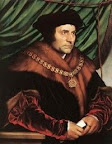
St. Thomas More (martyr) and St. John Fisher (bishop martyr)

How does one get holy while living in the world? That question underlies the life of every layperson and even every diocesan priest. We answer it with the way we live our life. The first basic ingredient to supernatural holiness is natural goodness, because grace builds on nature. The first basic ingredient to goodness is integrity. We might call integrity the virtue by which, or condition in which all of one's "parts" fit into a cohesive whole. I have integrity when I can truly say, "There is one me. I am who I am, and that's all that I am. I do not put on different acts or change faces for different audiences." Clearly, different circumstances call for different behavior; but when all these different behaviors originate with a person who is being himself, then they are integrated with each other. As I have struggled to grow in integrity, I have had to give certain things. Lying clearly has to go. But so do those behaviors that I might be tempted to lie about, and for that matter, those behaviors about which I would even be embarrassed if they became public knowledge. After all, even without lying, one might easily hide part of one's self from certain people. This hiding will lead to a rift in one's self. In that sort of situation, the parts of one's self run the danger of splitting from each other.

St. Thomas More and St. John Fisher are both excellent models of integrity because they would not split themselves. Each knew in his heart that King Henry VIII had no right to divorce his wife and take another while she yet lived; though all the world asked them to submerge their conscience so that they could continue to prosper, they refused. Even to save their lives they refused to so much as hide their conscience. "For what will it profit a man, if he gains the whole world and forfeits his soul?" (Mt 16:26). St. Thomas More and St. John Fisher knew the meaning of those words. We can't even sit back and say, "Oh, but they had it easy." They had few supporters and both lived in professions that give themselves to nuance and compromise: lawyer and bishop. If by the grace of God, they could suffer unto death rather than betray our Lord, why should we expect less grace from Him?

Growing in integrity is essential because it allows us to act as one whole person, undivided and unalloyed. Without it, genuine charity is compromised by undetected, manipulative motivations. Without it, our chastity is compromised by a body over which our soul has no real control. Without it, under the contradictory pressures the world can put upon us, our faith, which sits at the center of our being, may be snapped in half at the very end. Growth in integrity is a daily process that is greatly aided by regular confession. In confession we claim and own the darkest, most painful and despicable part of ourself: our sins and sinfulness. Rather than rationalize, we take responsibility. From there we can receive the grace to amend our ways, to mend the tears and iron out the wrinkles in the fabric of our character.

St. Thomas More and St. John Fisher, pray for us.