Intentions of the Holy Father for April

Ecology and Justice. That governments may foster the protection of creation and the just distribution of natural resources.
Hope for the Sick. That the Risen Lord may fill with hope the hearts of those who are being tested by pain and sickness.
Showing posts with label pilgrimage. Show all posts

Why I Changed the Subtitle

Those paying close attention will have noted that the subtitle of this blog recently changed from "Meanderings in Faith From One Hoping To Grow In Charity" to "A Pilgrimage Of Faith For Those Hoping To Grow In Charity."  Why, you might ask.

Well there is an anterior reason and a proximal reason.  Lol.

The anterior (earlier) reason is that I have had a growing desire to somehow draw this blog into my Christian apostolate.  Huh?  Every Christian is called to have an apostolate, a way or ways of presenting Christ to the world.  Some apostolates are really the task of every Christian: virtuous living, for example.  Other apostolates, like teaching religion, need a bit of specialized training.  Some apostolates are apostolates-by-example: working in a soup kitchen, for example.  Other apostolates are more apostolates-by-proclamation: writing books about the Faith, etc.  One's personal apostolate is the way or collection of ways in which one presents the love of Jesus Christ to the world.  Clearly, different seasons of our life will include different sorts of apostolate.

Changing the subtitle from "from one hoping to grow in charity," to "for those hoping to grow in charity," is intended to indicate the shift I am getting at here: this blog started as my personal ramblings that might or might not have been interesting to others.  Now, I would like this blog to shift focus to be ramblings (perhaps from a variety of source) that may help people to understand the holy Catholic religion, and the way we think and see the world.


The proximal reason for the change in the subtitle is the homily that I recently posted on behalf of the Rev. Mr. David Wells.  He made the point that life is a pilgrimage.  That got me to thinking: pilgrimages have points.  Meandering means wandering aimlessly, or something like it.  I am a Christian, and while I get sidetracked and sometimes wander, I certainly am not wandering aimlessly.  At least, I hope not.  A pilgrimage, on the other hand, is "a journey, esp. a long one, made to some sacred place as an act of religious devotion."  I am, please God, on a pilgrimage to heaven, as Deacon Wells pointed out.  Thanks, Rev!

So I hope, dear reader, that you will stick with me, offer your contributions, and grow with us in faith, hope, and charity though clear thinking, experiencing beauty and goodness, and praising God.

Whither, the Christian Paradox

This past Sunday's readings (V Sunday of Eastertide; Act 6:1-7; Ps 33; 1 Pt 2:4-9; Jn 14:1-12) present a few interesting themes that could be discussed for some time. I am not here going to discuss them, but rather a little point buried in the St. John's gospel reading for the day.

After Jesus says, "And if I go and prepare a place for you, I will come back again and take you to myself, so that where I am you also may be. Where I am going you know the way."

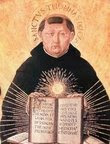
I think St. Thomas must have had a special place in our Lord's heart because of the special invitation our Lord extended to him alone, to put his hands into those Sacred Wounds. St. Thomas is accused of skepticism, but I think that isn't the case. I think that he is simply very practical. Tradition has it that he was a carpenter, or an architect of sorts perhaps, like our Lord himself. Carpenters and architects DON'T DO the impossible, because when they try, houses fall down on people's heads. Yet St. Thomas was willing to believe - he just needed a little convincing. That's sound. Here we see something of the same cautiousness:

"Master," Thomas asks, "We do not know where you are going; how can we know the way?"
Very sensible question, St. Thomas. Very sensible indeed. You see, generally speaking, before we can plot out a course, we need to know our destination. That's common sense. The goal, though it comes after the process, must in a certain sense - in our mind - come before it. Here, St. Thomas merely points that out. Now, the Apostles did not yet understand exactly how Jesus of Nazareth, their rabbi who made increasingly grand claims about himself, fit into God's ongoing plan for the Jewish people and for the world. We have the vantage point of the Resurrection and Pentecost. They didn't.

Even for us now, though, St. Thomas' concern should resonate if we are paying attention. We know that the Kingdom of God, the Heavenly Jerusalem, the New Heavens and New Earth are to be our true and final home, but what that entails, exactly, who can say? St. Paul reminds us in 1 Cor 2:9, "But, as it is written, "What no eye has seen, nor ear heard,nor the heart of man conceived,what God has prepared for those who love him."

Whither is an archaic English word that means "to where," or "to what point/purpose," and it is the Christian paradox. The whole rest of the world thinks they know what they are working for, whither they work: a big house, peace and quiet, "true love," a fancy vacation, or what have you. They spend a great deal of time planning and scrambling trying to attain the goal they think clear. When one way doesn't work, they try another way. When one career doesn't do it, they try another; when careers don't seem likely, they try the lottery. When one relationship breaks down, they try another; when relationships seem unlike, perhaps they try a shrink or medication. In reality they do not understand that what they truly seek, the answer to all their heart's longing, is Jesus Christ.

We Christians, on the other hand, don't really know what we are working toward, but in a different way. Jesus Christ and the Kingdom of His Father is our goal, the new life we seek, but what exactly that new life will look like, we cannot even really imagine because it is, in one sense, so fundamentally different than anything we've ever experienced. We know, but not really, whither we go.

But we do know the exact way to get there, "Jesus said to him, 'I am the way and the truth and the life. No one comes to the Father except through me.'" Union with Christ in our Father's House is our goal, the new life we seek, whatever it will be. Jesus Christ is the way to get there, and he is the truth, the reality check about where we are actually at. The Second Vatican Council teaches us this: "Christ, the final Adam, by the revelation of the mystery of the Father and His love, fully reveals man to man himself and makes his supreme calling clear," (Gaudium et Spes, #22). It is not quite like being given a map, but rather instructions about what-to-do-if. "If any one strikes you on the right cheek, turn to him the other also," (Mt 5:39) and the list goes on throughout the Gospel. It is like giving an explorer or pilgrim instructions rather than a map: "If you come to moutains, use your rope to climb over them; if you come to a river, use your rope to ford it. Eventually you will get to where you are supposed to be, wherever that is." Only our instructions more or less boil down to this:

"And why are you anxious about clothing? Consider the lilies of the field, how they grow; they neither toil nor spin; yet I tell you, even Solomon in all his glory was not arrayed like one of these. But if God so clothes the grass of the field, which today is alive and tomorrow is thrown into the oven, will he not much more clothe you, O men of little faith?" (Mt 6:28-30). As we explore on this pilgrimage, we must ask our Father for humility so that we can continue to trust Him through whatever hair-raising adventures our continued conversion requires.

You might say, loosely, that our instructions are, "If you are tempted by sin, trust in your Heavenly Father. If you are worried about taking care of your children, trust in your Heavenly Father. If people hate you, trust in your Heavenly Father. If you get to thinking that you have to do something bad to get by, or to get ahead, trust in your Heavenly Father."

So we Christians know exactly how we are to go. It is whither that we know only dimly. On that deepest level, we Christians are working for the same goal as all the world, for an eternal happiness, for the joy and love that never end. But woe to us if our goals don't look different than the worldlings' on another level. We might just end up going where many of them may if we don't show them a better way to get to our true and final home. St. Thomas, supposedly faithless and doubting, went all the way to India to show people the way to their unknown destination. So much for "faithless" and "doubting." And he did it without a map.

Ugliness and the Christian Spirit

This morning as I was getting out of my car, having come from Mass and arrived at my office complex, I was taken in by a contradiction. On my iPod I was listening to Pavarotti's performance of "Nessun Dorma," from Puccini's Turandot. Under my feet was cold asphalt beginning to warm in under the fresh Spring sun. Asphalt has the perhaps unique property of being the only material that is more unpleasant warm than cold. Before my eyes lay my squat, squared, sprawling office building, one of a number of identical ones all next to each other, each made with a red brick facade and with broad, black-tinted windows replacing half the exterior surface. In short, my surroundings were uniform labyrinth of modern ugliness, my escape and relief was a postmodern presentation of a piece of what might be called romantic-revival opera. The beautiful, if saccharine, opera contrasted so sharply with with the blunted, if practical, buildings that I was literally startled.

We live in a world that God has made beautiful, good, and true. Remember, truth is the conformity of our mind to reality, but in this case, I am speaking of the world as an expression of God's Mind, and it conforms, or was made to conform, to Ultimate Reality, that is, to God himself. Goodness is the moral and appetitive manifestation of truth, the aspect of truth that appeals to our desires and our will. Beauty is the manifestation of goodness to our senses, the taking in of the world's harmony and diversity by our heart through our senses.

We live in a world that we have increasingly made ugly. Since we stopped respecting the truth that the world is an expression of God's Mind, we have stopped seeing its inherent goodness, its order, and desirability as a thing in and of itself. We have increasingly come to see the world around us, and all its parts, as mere stuff to have and manipulate for our advantage. We have grown cold and hard with respect to our surroundings. Nothing is seen as worthy in itself, but only for what it can do for us. As the spiritual disease has progressed, our contributions to the world have decayed. We have gone from building lofty and inspiring cathedrals in durable materials using means that don't pollute in the slightest to squat wood and plastic buildings using what is already deteriorating into tomorrow's landfills using means of production that doubtless have left a swath of filth in their wake. Our factories belch smog and we cover over every green field on God's good earth with asphalt.

Of course our war against truth (the war is called Relativism) is closely connected with our war against beauty (called by architects Functionalism). They are both two prongs of an assault against our Good Creator and good world He made. They are both attempts to subvert His order and replace it with our own way of doing things. I think we will find the trade a stupid and unprofitable one. In fact, I think the only thing that keeps most of us from coming to that conclusion is our lack of awareness that other things are possible.

Enough ranting. It is time to propose remedies to the spiritual malady. I have in mind three:

1) Take in beautiful things: look at photographs of beautiful mosques and mountains, take site-seeing trips of inspiring cathedrals and canyons, walk through charming villages and grottos. Train yourself to enjoy opera, sculpture, classical music, Giotto, and Gregorian chant, even if you don't understand a word of them, let your heart feel them. In doing so, perhaps we can free our hearts from the bonds of ugliness, and train them to yearn for something better than what we have bought.

2) Make beautiful things: a friend of mine told me last night that he thinks he will plant a garden. Maybe stencil vines around the ceiling of your livingroom and put lots of nice plants around it. Frame a nice print of something by Bouguereau and hang it on your wall. Paint your house brightly instead of blandly. Do arts and crafts with your children. Read the great poets and try your best to imitate them, but using your own words and themes. Take up photography. Do something to contribute to the net beauty of the world.

3) Pray for the gift of yearning for heaven. Remember that this world is not all there is. Remember that God wants to instill in us a joy that makes everything we've ever experienced seem trifling. He wants to radically remake everything, even better than how it was. Let the beautiful things in this world remind us of God and the glorious dwelling He is preparing for us, and the ugly things remind us that we aren't home yet.

Mourning and Weeping in Lent

Throughout much of our lifetime, we try to be big, strong, mature, and wise - whatever we understand those things to be. Usually it involves putting on an act for ourselves, for our neighbors, and even for God. All He wants is for us to be His little children, His little boys and girls. Lent is a special time for God to break through in our lives - to puncture our defenses, pull down the walls we've put up, irrigate the dry and barren field of our heart.

But breakthroughs mean that things get broken. Getting broken (or being made aware of our brokenness) hurts. "Christ, the final Adam, by the revelation of the mystery of the Father and His love, fully reveals man to man himself..." the Second Vatican Council teaches (Gaudium et Spes, #22), and being shown ourselves can be unpleasant. But He does not show us our flaws and failures in order to mock us. Quite to the contrary, according to the same document He does so in order to make "[our] supreme calling clear," in order to show us the great destiny He wants to impart to us.

For now we labor, "mourning and weeping in this valley of tears," but God will bring us out of the exile of sin and death if we permit Him to do so. While we do our penance, especially during this season of heightened penance, we have a great sign of hope. The Blessed Virgin Mary, Mother of the Lord and our Mother, has already been crowned in glory after her long and patient wait. The Queen of Heaven knows what it is to make pilgrimage on earth. She knows what it is suffer in exile. We must not give up our hope, but fix our eyes firmly on heaven, ask God for help, and wait patiently for Him to fulfill His promises. He wants to purify and perfect us much more than we can imagine, and it is that painful purification that will enable us to enjoy heaven once we attain it. In the meantime, let us keep turning in prayer, especially to our gentle and loving Mother, so that she will help to smoothe our way and "show unto us the blessed fruit of [her] womb, Jesus."

Our exile is not forever (and neither is Lent).

Hail, Holy Queen, Mother of Mercy, our Life, our Sweetness, and our Hope, to thee do we cry, poor banished children of Eve. To thee do we send up our sighs, mourning and weeping in this valley of tears. Turn then, most gracious Advocate, thine eyes of mercy toward us, and after this our exile, show unto us the blessed fruit of thy womb, Jesus. Oh clement, oh loving, oh sweet Virgin Mary. Pray for us, oh Holy Mother of God, that we may be made worthy of the promises of Christ. Amen.

Pilgrimage Spot


The National Shrine of the Immaculate Conception is located in Brookland, a neighborhood in the Northeast quadrant of Washington, D.C. It is also located in my heart. It's a little bit away from anywhere I've ever lived. My home in Rockville is about 35 minutes away - that's the closest, so it's always been a bit of a trip, a mini-pilgrimage if you will, to go there. The Shine has something like 53 chapels devoted to different images of Our Lady as well as its great main chapel and its beautiful and large, yet homely and intimate Crypt Chapel in the basement. It has a whole chapel for hearing confessions, and another for the Blessed Sacrament. It is a wonderful place to go to make a holy hour, preceded by Mass and confession, as I did today.

Sometimes I let the beautiful, emotional Mother of Sorrows chapel draw me in. It's Pieta, which I feel superior to Michaelangelo's (in effect if not technique) is absolutely gripping. A youngish Mary holds Jesus in her lap with his lance wound facing the penitent man at prayer before the altar. She leans over him with her chest heaving and her face plunging forward and upward, toward heaven, but her eyes are closed gently and she refuses to be consoled, because her Child is no more.

Sometimes I drift into the Virgin of Guadalupe chapel. The walls are all done in mosaics, showing the Virgin of Guadalupe flanked by processions of men, women, and children bearing her gifts and homage. Among them are recognizable saints, especially saints from the Americas: St. Juan Diego, St. Frances Xavier Cabrini, St. Elizabeth Ann Seton, St. Katherine Drexel, St. Rose of Lima. But there are many more people whose identity is known only to the artist, if even to him. They are the nameless multitudes of Christians drawn into the life of holiness by the beauty of their Lord's mother.

Sometimes I make my way into the Our Lady of Lourdes chapel, which is a walk-in replica of the Grotto of Lourdes. It feels something like a cavern or a basement, and very much reminds me, when I close my eyes and let my heart see, of the Grotto. It is quiet and dark - the sort of place to which Jesus frequently retreated to pray. It never occured to me until this moment that on such nocturnal retreats He may have met His mother, already in prayer, praying for Him and His ministry. Perhaps they shared hopes and worries in those quiet, nearly wordless meetings. Sitting in that chapel, very much like at the Grotto, it is very easy for me to close my eyes, open my heart, and simply feel with Mary, my mother.

At the apse of the great chapel, there is a massive mosaic of our Lord, the Son of Man, returning in glory at the end of all things. He holds his muscular arms aloft like a traffic cop stopping cars. His blond hair is blonder than blond - it dazzles. His blue eyes are fiery and passionate. He has a halo made of flames blazing from his brow. Needless to say, He does not look happy at what He is finding at the end of all things. While few of us love Jesus the Just Judge as much as we love Jesus the Good Shepherd, the mosaic certainly is a reality check about our relationship with he who "will come to judge the living and the dead."

The liturgies at the Shrine are always conducted with the utmost reverence. Sometimes the singing is singable, and other times I, at least, cannot sing along - but then, the singing is beautiful enough that maybe it is better just to listen. The confessors have always been gentle and patient priests, prudent and straightforward, eager to help the penitent (well, in my experience at least) to change his ways. On the whole, each of my trips there (I must have made a hundred over my lifetime) has been spiritually restful.

I highly recommend a trip.

Whither, Lord?

In my heart, I feel a desire to go off someplace: to a monastery or into the wilderness; I also feel a desire to plunge into the heart of the world, and to be with my family and closest friends. These desires come from sources as conflicted as the desires are conflicted: fear and guilt, longing and love, trust and joy. With these are jumbled together our encounters and day-to-day experiences as we seek to follow Our Blessed Lord. The work of discernment, I am coming to discern, is bringing these motivations, experiences, and desires to Jesus in prayer, and asking Him to help us identify them for what they are, and sort through them, and then to understand which are worthy of a Christian.


Your Path - pt 2

Your Path


"There are many people - holy people - who do not understand your path. Do not get bent on making them understand: you will waste time and make room for indiscretions," (The Way #650).

Communion of Saints

Feast of All Saints (1 Nov)

The term Communion of Saints can give misleading impressions, or even leave the reader drawing a blank. It's really not meant to be that complicated or obscure though. Today is the Feast of All Saints, those recognized and canonized (the ones with "St." in front of their name), and those unknown and unhailed (maybe like your grandma). Today seems like an according good day to reflect on what it is that we Christians are all called to be.

Communion is an intimate sharing, to the point of oneness (unio, in Latin). What is shared? Lots of things: your stuff, your time, your hopes and fears, maybe your time and place, even yourself, your heart, your life. What kind of sharing is it? It isn't contractual sharing, where one party gives such-and-such in return for a return from the other. That's business, not communion. In communion, each party gives of himself without waiting to see whether the other makes an adequate return. In communion, each party has to make a sort of leap of faith - giving even his own self, without knowing if the other will even care. The communion happens when the return is made, and both parties are sharing - but if each party waits for the other, it never happens, and if either party only makes the gift looking for something in return, then it's only business. There might be bumps in the road. Bumps occur when one party forgets to keep giving, or starts looking for something more in return. The miracle is that as long as the one who begins to falter turns back to the right way of sharing, the communion can actually become stronger because of such trials. More sharing of more important things with less demanded in return means more communion.

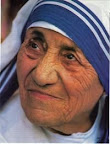
Communion is the sort of life that God has. Father, Son, and Holy Spirit each sharing their whole self with the others, without waiting or wanting anything in return. This sort of love is what fills in the communion shared by the saints, but it doesn't come from them. In fact, when the saints start loving each other, they are usually very bad at it. Mother Teresa wasn't born with that name, nor with that degree of holiness, of godliness. She was born Agnes Gonxha Bojaxhiu in a backwoods area of Albania, and was probably pretty much like all the other girls in her town.

God makes each of us an offer, "If you would be perfect, go, sell what you possess and give to the poor, and you will have treasure in heaven; then come, follow me... Enter into the joy of your master," (Mt 19:21, and 25:21). Agnes Gonxha Bojaxhiu took God up on the offer. She got rid of whatever was going to hinder her acquisition of that communion. She gave and gave of herself to all around her. She grew in sanctity until she shined like a star.

Sanctity isn't anything ethereal or fluffy, and it's not anything in a pious picture. There aren't halos around the heads of saints as they walk among us. More often than not, there's dirt or pooh on their hands. At least, that's what was usually on Mother Teresa's. That's because sanctity is holiness, intimacy with the heart and mind and ways of God, sharing in His Life of Self-sacrificing Love.

God offers us each a share in His communion of sanctity. He does not want it to be just Father, Son, and Holy Spirit; rather, He wants it to be Father, Son, Holy Spirit, and Joe; Father, Son, Holy Spirit, and you! As we take God up on His offer, leaving behind our sins and anything else that encumbers us, we are drawn closer and closer into communion with God. As we enter into that communion, we share in the same communion as the others drawn by the same God. We enter into the Communion of Saints. That Communion is made of a love so strong that, in Christ, it conquered death, fulfilling the prophecy found in the Song of Songs. "Love is strong as death," (Song 8:6) and in us, as we allow God's love to grow, our hope of conquering death also grows. It allows us to trust Him more, and to leave behind everything else of lesser value, which is everything else. This love is so powerful, this Communion so deep, that we have reason to hope, joining into it, we too will conquer death on the Last Day. Even in the meantime, we are bound by it to the Saints in heaven, and share in their communion.

But we don't start out that way. We start out as a ragtag group of disciples each looking to Jesus and Holy Church for different reasons: some for bread, others for work. Some hope for help cleaning up an addiction. Some come because their parents make them. Some are looking to get help for their kids, new friends, or a fresh start in life. For whatever reason we come, Jesus trains and disciplines us to start looking, not for what we can get, but for what we can give. He teaches us to have constant recourse to Him for all that we need - wisdom, strength, support, love. He helps to keep us focused on Him and on His Will and on His Kingdom. That's how we start: each of us a little Agnes Gonxha Bojaxhiu. The question is where we will end. Will you be the next saint in Holy Church, even if you never get your "St."?

Looking Toward Heaven

All that is meant by "modern" these days is intended to keep us from thinking about God and Heaven. Science, as a quest to no longer need God rather than to learn about His creation, is intended to distract us from God. Obscenity, modern "art", the busyness of modern daily life, the loudness of televisions and radios, and the flashiness of billboards, the excitingness of video games, are all meant to fix our attention on themselves... never to point us to something more beautiful, more good, more true and real than themselves.

God has given us EVERYTHING to help draw us to Him. We should cultivate in our hearts an "eye" for seeing things as reminders of Him, as foretastes of Heaven. We must constantly battle to push out of our mind those things that infiltrate, distracting us from the realest reality: God and His good plan for us. A deep life of prayer is the only thing that can help us focus on the heavenly bliss that God has in store for us at the end of our journey through this life.

Learn to look at the things of this life and see what they might tell us of heaven. In heaven, we will not be mere spirits, or ghosts; nor will we be angels. God made us with bodies, and in Heaven we will be reunited with our transformed, resurrected body. In Heaven, there will be nothing to prevent us from playing frisbee with our pals, sitting under a shady tree with Jesus, eating yummy strawberries and cream, and bathing in the sunlight on a warm autumn afternoon.

Here, in this video, I've compiled some things that have given me glimpses of Heaven.

Think of Heaven

I wanted to share a thought or two with you about one of my favorite topics.

Vacation.

What occasions this thought is my recent visit to the website of Communion and Liberation, which I have been (slowly) getting involved with. It's an international movement within the Catholic Church that combines a particular method for catechesis with community-based discipleship. Going to the website, and following the link below to reach the site for the US national headquarters of Communion and Liberation (CL), I saw they had a cool 3 min video on. The video is shot like a home movie, and transitions to more modern clips, and even very recent ones, with a nice song. Singing - especially folksy or charismaticky little ditties, sometimes one overladen with meaning - is part of CL gatherings.

http://www.clonline.us/

Part of CL's charism, it's gift from God to the Church and the world, is "vacation." Anyone who knows how much I like to travel (you all do), and especially anyone who knows the ridiculous amount of traveling I've gotten to do in the last year (I've been a bit more discreet on this point) can see why I might feel I share this charism with CL. But how is VACATION a charism, you might ask? It is connected with leisure, and the difference between leisure and amusement is key.

Leisure is a relaxation of the heart, mind. and body, and of relations, too. It is a release from constraint and pressure and obligation. It frees us to sit where we are and freely to flow between focusing and drifting. Moreover, the things to which we attend while at leisure are things that are voluntary and important to us: family, friends, hobbies, and the great questions of life. The Sabbath is meant to be a day of leisure, of rest, of freedom from the hustle-and-bustle of the obligatory and mundane. Heaven is to be our eternal rest. We will get to simply relax, play cards and drink wine, walk on the beach, laugh with friends, and otherwise do the sort of things that neither cost money nor can be bought - which is why commerce is excluded by levitical law from the Sabbath. The Sabbath is to be a reminder and a foretaste of heaven, heaven penetrating into our day-to-day. In leisure, there is a sort of quiet, gentle, receptive activity.

Amusement is almost the exact contrary of leisure. It replaces quietness with distraction, gentleness with exhileration, receptivity with absorption overload, and activity with passivity. Think of the immense difference between a walk on the beach with a brother or sister or lover, and going on a rollercoaster with one. On the rollercoaster, the shared experience is primarily in thinking back about the experience after it has happened, but during the experience itself, during the ride, the loud noise, the rush of adreniline, the gravity - they all conspire to absorb one's attention completely. Also, a rollercoaster is not something you do, but something you experience, something that is done to you, in a sense.

Amusement absorbs us and so distracts us from the reality of our lives, whereas leisure lifts us out of our life into a place where we can observe the reality of our lives (among other things) but without the pressure. Amusement spends our energy and scatters our focus, whereas leisure regroups our energy and recollects our focus. Amusement amplifies our experience of the day-to-day world, but only the entertaining parts. Amusement is a good thing though limited. Leisure lifts us up out of our day-to-day world in such a way that it can allow us to reflect and regroup and reenter it refreshed. Leisure does not amplify our day-to-day world, but introduces into it a little bit of heaven. Leisure is a good thing, and much less limited because it more closely reflects the unlimited joy of heaven.

When we speak here of vacation, we mean a vacation in which leisure, rather than amusement, predominates. People without any interior piece cannot really appreciate leisure, genuine relaxation, a vacation in this sense, the sense intended by Communion and Liberation. When they sit and become still, everything churning inside them rushes up. So they have to get up and DO something. DOING protects them from stopping and attending to things they would rather not address: the inner activity of their heart, the incoherence of their mind, the fragmentation of their relationships. When such people go 'on vacation' they fill up their time with incessant rush and activities, lest they actually begin to see their lives clearly.

That's not what a vacation is meant to be like, though. CL Vacations are taken as a group. Ten, twenty, even a hundred or more CL families, singles, priests, old people, young people will all go to a resort in the mountains or some other quiet place together. A priest will offer Mass and preach each day, someone will lead a rosary, maybe someone will give a talk on a spiritual topic each day. The rest of the day is filled with a gentle pace of horseback riding, rock climbing, hiking, walking, nature watching, camp fires, idle time, swimming, and laughing. It is meant to be a little piece of heaven.

When we think of heaven, really imagine and daydream about it, a little piece of heaven slips from our mind into our heart. When we experience little bits and pieces of heaven, something of it slips into our heart. When we experience and taste little bits of heaven, like when a kid licks the cake batter off an eggbeater, we begin to yearn for it. I am confident that the more we yearn for heaven, the more eagerly, happily, we will change our lives so as to be suitable for life there. We will reprioritize: God over the world, family over work, maturation over possessions. We will become more like God wants us to be - not because he is mean and pushy, but because he loves us and knows what we were made for: heaven.

A pilgrimage is something like a vacation in the sense meant by Communion and Liberation. In a pilgrimage the journey is not to relaxation but to a particular place, usually a holy site like a shrine or a tomb for the purpose of growing in faith, hope, and charity. The journey - especially to the extent that its provisions are left to Divine Providence - is an chance to grow in faith, and to the extent that one travels in faith one does not worry about details and can relax and let go. Spiritual in nature, the pilgrimage is marked by prayer, the action that most exercises hope. One may or may not chose one's travelling companions, but they are as important as the destination because they provide the most frequent occasions for charity. Pilgrimages are icons of the Church as She makes Her way from earth to heaven, to Her final rest, Her eternal vacation with Her Lord and Savior.

A conspiracy of unlikely collaborators have made it possible for me to go on a ridiculous number of overseas trips this year. A couple pals from the seminary, the IRS, my boss, my family, and the Church have all made it possible for me to go to Europe twice, and to Canada and Mexico - all in the span of the last 8 months. Each trip has been both vacation and pilgrimage. Each vacation-pilgrimage has enabled me to step out of the hustle-and-bustle of the mundane in order to relax and reflect. Each has had as its climactic destination a place of great holiness. Each has been in the company of loved ones - sometimes very close company! Not only have they been in the company of brothers and sisters in Christ, they have been in the company of the saints - especially the Blessed Virgin Mother, her chaste spouse, and her own mother, whose shrines we visited. All of the trips were exercises in self-abandonment to Divine Providence. For the most part, the itineraries were not planned out more than 12 or 24 hours in advance, nor was there any (or at least much) rushing, and we did all that we received more blessings than could have been imagined. Each journey been marked with prayer and joy and has helped me to refocus on the task assigned to me by God.

Christians probably intuit these ideas - I am only trying to help articulate what Christians making their way toward heaven already sense. Let's put away worldly (and expensive!) ideas about vacation: being waited on in nice restaurants and treated like a king, being constantly entertained, having everything exactly the way we want it, and having to make no effort. It is amazing how much less expensive Tulum is than Cancun, and how much more pleasant. We can allow Christ into even our vacation and allow Him to transform even our time away from timeliness. Isn't that what heaven is, after all - eternity with Christ, living outside of the constraints of time with the one who sets us free to be at perfect peace? It is amazing to think that our vacation can be a practice for heaven, and even help us get there.

We can put this basic principle into action more frequently and more regularly in a very simple way. Honor the Sabbath. Once a week, take a day off from hustle-and-bustle. Don't catch up on errands, go shopping, or eat at a restaurant - then others have to work. Play frisbee with your kids, or with your friends. Read a book. Notice that the world doesn't depend on your doing something. Barbaque. Go to church. Lay in a hammock and note the clear blue color of heaven. Stare long enough so that the image impresses itself on the inside of your eyelids, so that you see the shadow of heaven even when you have to go back to the things of earth.

What I Saw in Montreal


This past half-week, my boss took me with his family and some other families to Quebec on pilgrimage. St. Joseph's Oratory sits on Montreal's highest point, where just a century ago nothing but trees stood. It is well lit up at night, and is thus an apt symbol for its own situation.

Into the mid-1960s, Quebec was Catholic. Ninety-five percent baptized, and over three fourths of the baptized sat in their places in the pews of their local parish church every Sunday. Now, eighty percent are baptized, and less than three percent (!) attend Mass regularly, a seminarian for the archdiocese told me. Since the Silent Revolution of 1968 emptied Quebec's parish churches in the course of a few months, Quebec has joined most of the West in its slide into the dark night of inhumanity euphemistically called "human secularism." Still, high above the city in its dark night shines St. Joseph's Oratory, well-lit in the darkness. And there is something amazing about it. That church, at least, is not empty. In fact, it is rather well visited.

The same seminarian told me that since colonial times under the English, the French Catholic Church in Quebec had been charged with running many social services. Up until 1968, when such services were taken over by the state, the Church had run almost all of Quebec's hospitals, schools, orphanages, unemployment relief, and so on. The Church was, in many ways, coterminus with organized life of society. Those functions were taken over by the state at precisely the same time that the sexual revolution began making real inroads into Quebec; this was also the same time that liturgical "reform" radically altered everything believed sacred in the life of those people. For the most part, they were not especially educated in the faith, either. All those changes crashed upon them at once, and it was too much: the Perfect Storm against their faith. Over the course of a few months, almost everyone asked themselves, "What are we doing here?" and without protesting or shouting or demanding changes, simply stopped going to church.

As far as I can tell, it is not Quebecois that fill St. Joseph's either. They were there, to judge by the license plates in the parking lots. But most of the visitors were from other provinces in Canada, from all over the U.S. and even Mexico, and many groups speaking Asian and European languages had clearly flown in. The visitors' motives appeared to range from idle curiosity and tourism to pilgrimage and prayer. Some snapped photos while others clicked rosary beads. I did both. For whatever their reasons, visitors to the Oratory seem to remember something that the Quebecois have forgotten; perhaps they are looking for something that the Quebecois do not realize they have lost. Maybe the Quebecois do realize they have lost it, only they do not know where to look. One of the tour guides told us that formerly, one had to be very devout to work at the Oratory. That is no longer the case, he told us, because there are not enough of such people left in Montreal.

St. Joseph's Oratory was started by an almost illiterate, poor, lay brother in the Congregation of the Holy Cross during the First World War. Brother Andre Bessette will very likely be canonized by Mother Church before too long (in Church years, of course). The little brother had a big devotion to St. Joseph, and also was renowned for his deep humility and sanctity. Even in his own day he was famous, owing to the miracles he worked. He always gave credit to St. Joseph, and only intensified his devotion to that great little man. When people were healed, he asked them to leave some sign, to encourage the faith of others who came to speak with him, to ask his prayers, or to seek healing. Many left crutches, and to this day, there are warehouses full of them at the site. Thousands of crutches, old and new, are left hanging on racks all around
the place. Most of the crutches seem to me to be old, though, dating to Blessed Andre's time.

The Church in Quebec needs to take real stock of her practical situation. Practically speaking, she is dead there. But this has happened before, elsewhere - in fact, in many places. Christians know that dead things can come back to life. When the Church in Quebec focuses again on sanctity above all else, and begins to pray as earnestly as Brother Andre did, then perhaps her parishes will begin to shine. Mass-goers and coreligionists will love each other and call each other brother and sister again, as our little pilgrimage group did. Mother Church will have something to offer her children again: love and healing - antidotes and innoculations against the deadly sicknesses related to secular humanism. If the light has been snuffed out in Montreal, perhaps it will be re-ignited by tourists' curiosity and pilgrims' prayers. Perhaps it has already begun. The 49th International Eucharistic Congress is to be set in Montreal in 2008. We shall see.