Intentions of the Holy Father for April

Ecology and Justice. That governments may foster the protection of creation and the just distribution of natural resources.
Hope for the Sick. That the Risen Lord may fill with hope the hearts of those who are being tested by pain and sickness.
Showing posts with label apologetics. Show all posts

Easter: Notes on Its Historicity

In honor of Easter, I am going to be posting a series of articles and excepts about the Resurrection of Our Blessed Lord Jesus Christ, and on its significance for us.
Here's the first, some brief notes about the historicity and materiality of the resurrection, i.e., that Jesus of Nazareth, truly a man like us all in every way but sin, actually returned to life after having become completely dead.  I'll start with an excerpt from Veselin Kesich's The First Day of the New Creation: The Resurrection and the Christian Faith, an excellent book that I read for class while in seminary.  Parts of it are hard, but most are fairly accessible.

The basic agreement among the evangelists in their accounts of what happened on the first Easter morning is more significant than certain discrepancies in those accounts.  All four evangelists bear witness to the empty tomb, either stating this explicitly or, like St Mark, clearly implying it.  The variations in the accounts actually testify to their authenticity and serve as an important indicator that the story of the empty tomb belongs to the most primitive gospel tradition.  It is highly unlikely that the empty tomb stories could be legendary embellishments of a later period in the life of the Church, for if the Church had fabricated them, we should expect the Christian community to have created a harmonious account.  The Church did not try to harmonize the accounts, but instead faithfully transmitted the traditions that were received, (Kesich, 71).
The question of whether a dead man could really rise from the dead is not a new one.  The Acts of the Apostles describes the rejection of his message of the ressurection of Jesus Christ (Acts 17:32).  Later, St. Paul writes his letters, he adamantly defends the resurrection as an actual, material event in 1 Corinithians, implying that the essential doctrine of Christianity was being called into question then as well.  In fact, St. Paul asserts that the event was not only material and historical, but publicly witnesses as well.  He writes:
Now I would remind you, brethren, in what terms I preached to you the gospel, which you received, in which you stand, by which you are saved, if you hold it fast -- unless you believed in vain. For I delivered to you as of first importance what I also received, that Christ died for our sins in accordance with the scriptures, that he was buried, that he was raised on the third day in accordance with the scriptures, and that he appeared to Cephas, then to the twelve.  Then he appeared to more than five hundred brethren at one time, most of whom are still alive, though some have fallen asleep.  Then he appeared to James, then to all the apostles.  Last of all, as to one untimely born, he appeared also to me.
1 Corinthians 15:1-8
In the later New Testament writings, the generic terminology of the "exaltation" of Jesus is replaced with the more specific term "resurrection," also alerting to the likelihood that clarification of the authors' intent was felt to be important (Kesich, 81).

A great volume, monstrously long and detailed, is N. T. Wright's book The Resurrection of the Son of God (Christian Origins and the Question of God, Vol. 3).  The book is really stupendous, but I warn you: at 740 pages it is the sort of text that most people will want to take a few pages at a time and just be content to let it take a year or two!

Whether a skeptic, ancient or modern, wants to reject the accounts of the resurrection out of hand as impossible within the framework of their materialist conception, there can be in any event no doubt about what the apostles intended.  They believed and taught from the very first day that Jesus Christ is risen from the dead.

Mary, Latreia, Dulia, and Hyperdulia

Responding to a recent post on InsideCatholic, a commenter identified what he believed to be a failure of logic among Catholics and in our doctrine.  He wrote to the extent that Catholics have reserved worship for God not in practice, but merely in definition.  We treat Mary as we do God, but that we call the acts of reverence to her hyperdulia, and to Him, latreia.  He said that we define hyperdulia as whatever we do to honor Mary, and latreia as whatever we do to honor God.  It seems appropriate on the day before a great Marian holy day to consider such things, so I have decided to gussy my response up a bit and reprint it below:

Latreia has a very specific meaning. Latreia is not just "whatever is higher than hyperdulia." It is very clearly, specifically "ministerial service," (see any Greek lexicon) and it refers to the service of the altar - to sacrificial worship.

For Protestants, who have ejected the concept of sacrifice from their acts of worship, one act of reverence and devotion blends with another - prayers, catechesis, song. It is not so among us Catholics, because we have the Eucharist - not merely a memorial, but a re-presentation, a re-manifestation, a re-engagement - of Christ's self-sacrificial oblation. The Eucharistic Sacrifice is the act by which Christ worshiped the Father, and it is the act by which Catholics and the Orthodox worship the Father, because it is the way that he instructed us to do so (Mt 26:26-29; Mk 14:22-25; Lk 22:19-22; 1 Cor 11:23-26). That is latreia, and it is reserved for God the Father alone, in Christ, by the power of the Holy Spirit.

Singing, prayers, preaching - those are nice, but they aren't what we mean by latreia. At the Mass and in the rest of our lives, they build up to the latreia. That's what they are for, but they are not the "source and summit" of our life - rather, they draw us closer to God. That is why we can devote them safely to the saints - because the saints draw us closer to God as well. It is impossible to learn about their lives and to attempt to imitate them without growing closer to God... because the saints are saints precisely because of their closeness with God.

Mary is the greatest saint because she is the closest to God. She was so close to him that she bore him nine months in her womb, and many more in her arms. He surely followed her example as a child, and she followed his as an adult. She restrained him when adolescent exuberance would have launched his ministry too early, and prodded him before it was too late. She followed him around as he preached, and she met him on the Way of the Cross as he died. She alone among women is named as among those present in the Upper Room at Pentecost - surely not at the periphery of the Apostles, but at their center as the one who knew Him best. The Holy Spirit descended upon her to conceive in her the Messiah of Israel, and descended upon her and the Apostles to bring the Messiah out to the world.

Whoever would denigrate such a relationship has either not thought it through. She is not one among many Christians or saints - she is absolutely unique among God's creatures. If we honor our mothers with dulia (devotion), surely something higher is owed the Mother of God.  And that is what is hyperdulia means: higher devotion.

The End Times?

Here's another post from the desk of Deacon Dave Wells... posted under my name while he learns to post on his own :)


The year is quickly coming to a close. Now, don’t run out and buy your noise makers, balloons, or champagne just yet, because the year I’m talking about is the liturgical year. The Church’s year begins with Advent and ends with the feast of Christ the King, which we celebrated this past Sunday. As we get towards the end of the year, the Sunday readings appropriately reflect the end times. They remind us that we are on a journey, that our ultimate goal is heaven, and that Christ will come again at the end of time.

In the second to last line in the whole Bible, in the Book of Revelation, Jesus promises, “Yes, I am coming soon.” The author of Revelation then responds, “Amen! Come, Lord Jesus!” Those should be our thoughts and words as well: “Amen, come Lord Jesus!”

A question that we might have is “What exactly is going to happen when he does come?” It’s important to follow the teaching of the Church here for two reasons. One reason is that the end hasn’t come yet, so this drives people to speculate, guess. I haven’t seen the movie, 2012, which came out this past weekend, but rest assured that the producers didn’t study Church teaching before producing it. I haven’t heard anything about the movie yet, but for as entertaining as it may be, it is probably fraught with errors. The second reason why we have to be careful is because what has been revealed to us about the end times is very symbolic. The language associated with the end times is called apocalyptic language. We see it today both in the first reading and in the Gospel. We don’t read apocalyptic language as we read Sports Illustrated or a science text book, but we realize it’s very symbolic language and we must interpret it in line with how the Church has always read it.

That being said, what do we know about the end times? Christ’s second coming will follow a period of great persecution for the Church. We see this in today’s first reading and Gospel. Many believers will have their faith shaken as the evil one futilely attempts a last gasp effort at defeating Christ’s Kingdom. Following this final trial, Christ will come again in glory at the end of time to judge the living and the dead. Christ says as much in today’s Gospel: “And then they will see the Son of Man coming in the clouds’ with great power and glory.” All of those who died before this time will receive their resurrected bodies, and those still living and those who have resurrected will either be punished for their sins by going body and soul into hell or rewarded for their faithfulness by going body and soul into heaven. This event won’t just affect us, but all of creation. We read in today’s Gospel, “the sun will be darkened, and the moon will not give its light, and the stars will be falling from the sky.” This language, which we don’t necessarily read literally, does show that the end times will be a cosmic event. Christ will bring about a new heavens and a new earth, as Scripture relates. The universe will be transformed in a way unimaginable to us. This is what the Church teaches about the end times, which we must be prepared for always. There will be great persecution of the Church, followed by Christ’s coming in glory to judge the living and the dead, who will receive their resurrected bodies at this point; and, finally, his second coming will be a cosmic event, affecting all of the created universe.

“Good” you may say but, “Why hasn’t Christ come back yet?” “What’s taking so long for him to come in glory?” we might ask. One response is found in St. Peter’s second letter, “with the Lord one day is like a thousand years and a thousand years like one day.” It has been two thousand years since Christ ascended into heaven. In the grand scheme of things, two thousand years are a blink of the eye in a universe that’s billions of years old; and even less than a blink of the eye when considered from God’s perspective from eternity.

To think about this question from another way, imagine if Christ returned in glory five years ago. The world would have ended five years ago. That means that some of my youngest nieces and nephews or your sons or daughters or grandchildren wouldn’t have been born and hence, they wouldn’t have existed, much less been saved by Christ. With each passing day, new members are added to the human race, and these are people that God has willed to exist from all eternity and to be with him for all eternity. God doesn’t benefit from the passage of time before he comes in glory, because he’s already perfect; rather, we benefit because more people are brought to salvation every day. The end times won’t come until all the people God desires to save—and he desires to save all of us—have lived on earth.

Connected with this previous point, I have a third answer to our question about why Christ seems to delay in returning. It’s really an act of mercy on God’s part that he hasn’t come yet. An analogy might be helpful to explain this. As a kid, I hated getting up for school. My mom had to yell at me to get up about six or seven times a morning. Finally, I’d tumble out of bed, and take my good ol’ time in getting ready. I recall with nightmarish memories my mom sometimes yelling, “The carpool’s here to pick you up! I hope you’re ready!” And, of course, I wasn’t ready—homework wasn’t done, or teeth weren’t brushed, or one shoe was nowhere to be found. But guess what? It was too late. I couldn’t do anything more, or stall more; it was simply time to go. When Jesus comes suddenly at the end of time, it’s time to go. As the Gospel says, “He will send out the angels and gather his elect from the four winds.” Each day that Christ doesn’t come gives us another chance to grow in holiness. We have another day to improve a little more, to be a little bit nicer, to love God a little more sincerely. After Christ comes, there isn’t any chance to improve or amend our ways. So each day that Christ delays his return is a chance to grow a little bit holier so that we might be all the more fulfilled and joyful in heaven.

In answer to the question, “Why hasn’t Christ returned yet?” because one day for God is like a thousand years and a thousand years like one day; he hasn’t come because all the people he desires to save have not been saved yet; and also, each day he doesn’t come is an act of mercy for us, because it gives us a chance to improve and love God more.

Christ has accomplished his mission. God became a man, died to save us, resurrected from the dead, and ascended into heaven. The only thing that remains is for him to come again in glory. Our attitude should not be one of fear as long as we stay close to the Church and truly love God. God loves us and desires our salvation. Our attitude should be like that of the author of Revelation, who said, “Amen, come Lord Jesus!”

The End of Celibacy? What next?!

Well, not really, and probably not much that you might be worried about.

If you've heard about the Vatican's creation of provisions for married Anglican/Episcopalian clergy leaving their denomination and becoming Catholic priests, you might be concerned that big things are changing unexpectedly. You need not be.

For that matter, the Eastern Catholic churches, in full union with Rome, believing everything we believe and sharing our sacraments, have always allowed men who are already married to enter the priesthood. In the Western/Latin/Roman church, we very early on started developing a preference for ordaining men who had already committed to celibacy. That celibacy has played a crucial role in the development of Western thinking and culture, and certainly so within the Latin (our) church. That practice grew by the middle of the first millennium into a requirement - that only celibate men should be ordained. St. Paul himself expresses this preference, and our Lord set the example Himself. As such, it is not to be lightly set aside.

That said, most of the apostles were married, and we cannot conceive that they put away their wives like chattel in order to serve God, as if that were compatible with Christian living. Somehow they must have made arrangements or balanced the two, or waited til their wives had deceased in order to embark on missionary work, etc. To some extent, then, priestly life is compatible, at least in essentials if not in fullness, with marriage. The Eastern churches (both Catholic and Orthodox) have recognized this right from the start by never having permitted ordained men to get married subsequent to their ordination. And for that matter, in the East, married men have never been ordained bishops, because bishops hold the fullness of priesthood and must be freest for service to the gospel, unobstructed by any natural concerns.

For a number of years, the Roman church has allowed married clergy from other denominations who become Catholic, and whose former denominations' understanding of ministry is close enough to ours, to be ordained in the Catholic Church after their conversion. These men are typically Episcopal or Lutheran, because those denominations are liturgical, as ours is, and because these ministers typically work in ministry full-time, and so have something of a sense of how to balance ministry and marriage, as Eastern priests must have.

In the West, where we have typically had fewer priests per person, we have had higher expectations for what they can provide. Our priests have typically ridden circuits over large areas, traveled to far mission fields, and left their parishes for service in the diocesan offices - that is, gone wherever their bishops have sent them. Married clergy from other denominations admitted to the priesthood have typically functioned a bit more like deacons - less likely to be transferred from one parish to another, and more likely to be permitted a more normal work schedule. But for something between 500 and 1700 years, such circumstances have been exceptional, and not the norm. Such will likely continue for the foreseeable future.

The key thing is that prior marriage is not inherently incompatible with ordained priesthood; as femaleness is. So the discussion of whether and when and to what extent the Church might ordain married men is not the same sort of question as whether and when and to what extent the Church might ordain women. To the first question, answers are varied and the discussion is open. To the second question, the answers are no, never, not at all, and the discussion is closed. That is because priesthood is essentially connected not to a skill set, but to fatherhood. It has always been conceived as a fatherhood, and an emulation of God's fatherhood. God is not a mere parent; He does not create mere parents any more than he creates mere neuters. Jellyfish are neuter, but humans are male and female. He creates men and women, intended by their complementarity for fruitful union that models the fullness of His nature. He Himself seeks to be in fruitful union with us, the Church, His Bride. Complementarity is not imaginary. It is built into creation, as is fatherhood, as is priesthood.

Maybe I'll begin researching and writing a metaphysical anthropology paper connecting fatherhood and priesthood, and discussing how we are all priests in a vague way by baptism, as we are all vaguely masculine by being human; but how only the more clearly masculine is suitable for the more crystallized priesthood of ordination. Hmmm... Well, best to find a full-time job first.

The media is great at soundbites but bad at nuance and distinctions. Because they are by-and-large enslaved to sex they hate celibacy, for celibates are much more likely to be free with regard to sex. The media perhaps see this as a first step toward all that they hold dear.

Or at the very least, they see it as an interesting conversation starter, which it certainly is.

No Bones About It

An infamous villain was murdered on Sunday in his church; and it is a horrible thing that was done to him. Whatever his crimes were, and whatever punishment he deserved and may now receive before God, it is always and everywhere wrong deliberately to harm or kill someone who does not pose an immanent threat to oneself or to those under one's God-given duty to protect. Murder is always wrong. All that said, because a cold-blooded profiteering murderer was killed by another murder, himself deranged and fanatical, it is entirely unfair to label the pro-Life movement as hateful or to say that it incites violence. Those who hate life have already begun to use the murder of Dr. Tiller as an excuse to smear the pro-Life movement and to cow people from rallying to its cause, because they rightly understand that good-hearted, sound-minded people don't want to be associated with murderers. But murderers aren't pro-Life, and pro-Lifers aren't murderers. We must take this opportunity to state unequivocally that murder is always wrong, against not only the unborn, but also against their murderers. We must refuse to back down or to be cowed, but instead take the opportunity to be counted and to repeat firmly that no matter what, still


I am pro-Life.

Out of the Mouths of Babes

A friend of mine just shared this story with me. A twelve year old girl in Canada decides that for her persuasive speaking topic, she will speak against abortion.


Take two or three minutes to read the full story about what this kid had to deal with just to speak her mind (in the enlightened and free West).

The Perennial Philosophy

The Perennial Philosophy is a philosophy not invented, but identified, by Aldous Huxley - yes, the same dude who would go on to recommend LSD as a way to gain a new view of reality. Ok, so, before he got to that point, he wrote extensively about how certain elements of thought appeared in diverse sources. The basic principles of this philosophy found among puritans and pygmies are simple. Reality is real - both spiritual stuff and material stuff, and we cannot make them whatever we like just by intending to do so, or by calling them something different. A rose is a rose is a rose, and by any other name, it still smells the same. St. Thomas Aquinas saw it. Confucius saw it, and even said that the restoration of proper names to their things was the foundation of any real reform. We have to call a spade a spade. So those are the basic principles - reality is real, and we have to call things what they are. When we get away from this path, we get into real danger, the sort of danger of a man driving a car through a shopping mall, the whole way telling his passengers, "Relax, it's just the normal 9th Street Tunnel traffic! I can handle it."

The traditional moral code prohibiting murder, theft, etc., is part of it. The same perennial philosophy, this common inheritance of humanity's common sense, also sees marriage as the foundational unit of society and prohibits those things that directly attack it, like adultery, and also those things that call its purpose and function into question, such as contraception and homosexual relationships. These things call the purpose of marriage into question because, according to the perennial philosophy whether found in the West's Aristotelian Thomism or in China's Confucism, the purpose of marriage is the begetting of children and the mutual benefit of the spouses. Lopping off one of those purposes does not merely leave a sterilized marriage, but a crippled or imitation marriage. You can call it what you like. The pioneers of our present situation called it "companionate marriage," marriage for companionship only. But whatever they called it, it was not marriage according to the perenniel philosophy.

The trick in undermining the perennial philosophy in the West has been that the worst things are saved for last. Nobody came out eighty years ago and said what they wanted for this foundational institution not merely of the West but of all human society. They didn't say that they wanted to see it virtually liquidated. They said they wanted to make it more about love. That sounded real nice, I bet. But they snuck in a concept of love that had chiefly to do with feelings, and was not so much about permanence and the begetting of children. Everything since regarding marriage has been legitimated on the basis of this new, false concept of love - love as a feeling. The problem with feelings isn't that they are bad. They are unstable. And obedience to feelings as if they were gods explains a great deal of the fifty percent divorce rate, for starters.

It's going to be hard for us to transcend our feelings and do what's right even when it doesn't feel good. We won't be able to do it on our own, and as a culture we've gone too far down this road of irresponsibility masquerading as love merely to tweak our course. We need wholesale repentence. Only Jesus can bring it. We who know we need it also need to pray for it. If the Pelosis of the world are leading us into moral oblivion, they will be held accountable. If we who think we know better don't spend hours fervently praying, by our prayers hitting the brakes, we will be held accountable for that.

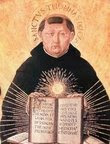
St. Thomas Aquinas made the bulk of his academic career going around Europe after a man named Sieger of Brabant, who said you could have contradictory truths (not perceptions, but realities), and that whatever you called a thing, that it was. Everywhere St. Thomas went, he calmly tried to get folks to listen to common sense and reason. While he lived, he was very successful because he was very prayerful. Let's follow his example.

St. Thomas Aquinas, pray for us.

Encountering the Risen Christ in the Scriptures

It’s fitting that I post about Encountering the Risen Christ in the Scriptures today, because today is the feast day of St. Jerome, a doctor of the Church and one of its preeminent biblical scholars of all times. In fact, St. Jerome was responsible for translating what was for over 1500 years the standard Latin text of the Bible, called the Vulgate. In this post, I want to look at three things: (1) the historical transmission of the text of the collection of books that are together called Bible; (2) the meaning and role of the Bible in the life of the Church; and (3) how I have encountered Christ therein.

The texts that became the Bible were written by a variety of authors over a period as many as a thousand years, the most recent being the Gospel, Letters, and Revelation of St. John, written toward the end of the first century after Christ. At the time of Christ, the standard translation of the Bible used in the Holy Land was actually in Greek, and it was called the Septuagint. It included the 46 books still found in the Catholic and Orthodox versions of the Bible. This Bible is the one used by Jesus and the apostles. After the Ascension of our Lord, the Christian community began to flourish and spread. The earliest books in the New Testament are actually letters written to these communities by St. Paul, St. John, St. James, St. Peter, St. Jude, and probably some of their disciples. It’s important to note that the communities to whom these men were writing already existed. It sounds like a no-brainer, but really, it’s important. The Bible and its books did not found the Church, and are not its foundation. The Church came before the Bible. These letters were mostly written between about AD 45 and AD 65, except for the letters of St. John and the Letter to the Hebrews, which probably came somewhat later – and the first Christians went out into the world to spread the Good News (the Gospel) in Jesus’ name sometime around AD 35. Apostles and their disciples later wrote biographies of Jesus of Nazareth, whom they insisted had risen from the dead, and a history of the earliest days of the movement that started around Him. These books, the gospels and Acts of the Apostles, were all written sometime between AD 60 and AD 90 or so.

Many others wrote works providing their take on Jesus and the early Church, but while their writings provide historical insight into the situation of the early Church, very early on, Church leaders became convinced that these other writings did not accurately depict Jesus or the Christian faith. As early as about AD 180, lists of which books belonged and which ones didn’t were already circulating among bishops, and these lists matched what is found in the Catholic Bible today. By about AD 400, there was nearly universal agreement as a number of local councils and popes had considered the matter with increasing unanimity. The works selected were chosen because they were clearly of apostolic origin, depicted the faith and beliefs of the Church, and were already in widespread use among Christians for the liturgy and in religious instruction. It is the constant Christian belief that these books, 73 in total, were inspired by the Holy Spirit as they were authored by their human authors in real times and places, and that the Church authorities were inspired to select them accurately.

The inspiration of the Scriptures guarantees their correctness, or inerrancy. This topic can be problematic if misunderstood. St. Thomas quipped, “If we understand the Scriptures to be wrong, it is because we wrongly understand them.” To properly understand what the intent of a passage is, it is important to know what sort of passage it is, because different types of writing use different styles to address different topics. No part of the Bible is a science textbook, for instance. So we should not take the Genesis creation stories to be rivals to scientific theories about the physical origins of the universe. That’s not what the Genesis creation stories are really about. It would be like reading a newspaper article for instructions on making a cake, and being surprised that the cake turns out badly, or using a financial ledger to woe a lover. That’s not what those things are for. The Scriptures are inerrant, without error, only in the way they were intended to be: the moral-of-the-story parts always tell the right moral; the historical parts always get the key historical details right; the praise and prayer parts rightly tell us how to pray to God; and so on. On the other hand, just because an account, say of the slaughtering of some tribe or another, is included in a historical description found in the Bible, that doesn’t mean that we are all to go out and slaughter some tribe. That’s not what that part was trying to tell us. Precisely because the Scriptures are difficult to understand, as St. Peter himself warns us (2 Pet 3:16), it is important to realize that they do not stand alone. The Scriptures themselves record the earliest Christian belief that the same Spirit inspiring the Church to write and select the books of the New Testament also inspires the Church to understand them correctly (Jn 16:13). On a natural human level, the Bible is not the foundation of the Church, nor is it exactly the rule of faith for the Church. Rather, taken together with the whole living and handed-down memory of the Church, of which the Scriptures are a part, we have the Deposit of Faith, which is our rule. Though the Scriptures are the most concretized expression of that deposit, but alone are insufficient because they do not interpret themselves, explain themselves, or enforce themselves.

Yet all the above in no way denigrates the Scriptures. Rather, it is written to put them into their natural, proper context: the life of the Church. The Scriptures contain in written form, by inspiration of the Holy Spirit, the whole Word of God, the same Word that created the world (Gen 1:1-3), and the same Word that took on human flesh in the person of Jesus of Nazareth (Jn 1:14). The Word of God is God’s self-understanding, His self-articulation, His self-expression. The Word of God is the pattern upon which God crafted the entire universe, which is why the Scriptures, themselves the written Word of God, can always be applied in every human circumstance. Jesus Christ is the Word-Made-Flesh, which is why His Life speaks to every human life. If we cannot see His Life in ours, it is because we are blind and not because He has left us. If the sacraments are the lifeblood of Christ given to us, the Scriptures are the mind of Christ given to us. All Christian thought, and all thought about Christ, should have recourse to the Scriptures, should stand on them as on a rock, and should be built of out of the Scriptures as if out of building blocks.

In my own life, I have found great consolation in the Scriptures. When read as a book of platitudes and promises, the Bible is a complete waste. But when it is read prayerfully as a witness of faith, and under the guidance of the Church’s teachers, the Bible is an absolutely indispensible tool for growth in faith, hope, charity, and all the Christian virtues. St. Therese Lisieux, whose feast day is tomorrow (1 October), is also a doctor of the Church. She died very young, and was very photogenic. These facts seem to have led many to believe unconsciously that the Church added her to the ranks of St. Jerome, St. Augustine, St. Thomas Aquinas, and the other doctors of the Church (there are 33 in total) because she was so cute. Anyone whole will read her writings, and especially her hundreds of letters, will see that this unconscious conviction is incorrect. Without any secondary or higher education, St. Therese intuited that the Bible is meant to be a living book, like a script for a play, which governs the details of our lives as medicine does – by digestion. Reading, rereading, and praying over the Scriptures led her to internalize their words so that in whatever circumstances, just the right words for the Word came to her heart, mind, mouth, and pen. She put herself into roles found in the texts, and put her friends and family into roles as well. By doing so, she was able to find sure guidance for how to live a loving, Christian life. You might call this interpretive key, or hermeneutic, that she developed the Hermeneutic of Love.

While struggling to understand God’s plan for my life, and in great anxiety that I had entirely misunderstood His purpose for me, I came across a passage in Jeremiah, at 18:1-6. The passage shows Jeremiah going, under inspiration from God, to the house of a potter. At the potter’s house, Jeremiah observes the potter working clay into one shape, and then flattening it and molding it into another, until he comes up with just the right vessel. That was what God was doing with me, I realized. He was kneading and folding me, and though I could not tell where He was going, He still had a plan for me. In understanding that, I received a peace that had eluded me up until then.

And so it goes. If we think that we can test and judge the Scriptures, their meaning will evade us, because God’s ways are far above ours, and the Scriptures are a presentation of His mind. But if we will humbly submit to them, those sacred words will be like stars above us, illuminating our paths and providing just enough light to see the signs of our life. Before reading the Scriptures, we should pray for inspiration. If our understanding of some passage upsets us, we should humbly submit it to the teachings of the community that has given us the Bible, and to the teachers that preserve that teaching. When we finish with the Scriptures for the day, we should replace them reverently to their secure and accessible home, and thank God for having opened His mind to us thus.

Encountering the Risen Christ in the Sacraments

In various ways, before ascending bodily into heaven, our Lord left for us concrete, tactile ways of making contact with Him: the sacraments. Sacrament is an interesting word. Sacramentum is what Roman soldiers called the branded tattoo on their shoulder, which read SPQR. It was a seal of loyalty to the Senate and People of Rome, and the physical manifestation of their permanent bond to their military unit. The seven sacraments of Christ have something of the same role in the life of a Christian: they seal and bind us to Him and His Church. The Eastern Christians call these same seven actions the seven mysteries. A mystery, for the ancient Greeks, was not a problem to be solved, but an interaction with the divine. In these mysteries, we Christians come face to face with the living God and share in His divine life. They are possible because in Jesus Christ, God already shares in our human life. This shared life of God is called grace, and is always freely given and only freely received. The Church defines the sacraments, the mysteries of the faith as “visible signs instituted by Christ to convey invisible grace.” It is important to note that sacraments do not merely represent grace in our life, but actually bring it into our life. This definition is not only words on a page, but it is the fabric of my spiritual life, and of the life in Christ of many, many others.

I don’t remember my baptism because I was just a few weeks old. I didn’t care much about my confirmation as a young teenager. My first communion, though, was important to me. I remember how even as a small boy, I felt drawn to the Eucharist, the sacrament by which Christians renew our relationship of intimate communion with Jesus. I couldn’t have told you why, and I know I didn’t fully understand, but I did desire it. I desired Him.

Nowadays, the Eucharist and its sister sacrament, Reconciliation, are key to my daily life. At first my thinking was, “If I botch it in life, or just need a spiritual checkup, I’ll go to Reconciliation, to make sure that I am tight with Jesus.” As time goes on now, even when I don’t have any egregious sins, I want to go to the sacrament of Reconciliation to make sure that there’s nothing between us. It’s maybe a little like a husband and wife touching bases just to make sure that nobody’s got some unvented frustration or anger. As time goes on, I find myself going more and more often. In the sacrament of Reconciliation, also called Confession, I bare my soul to the priest, and thereby give it away to the One he represents.

It’s a very small thing to give away the soul. At least, the degree to which I turn it over to Jesus is very small. I am trying, don’t get me wrong. Time after time, it seems, I confess the same sins. At any given confession I seem to confess five or six from the same pool of ten or fifteen sins. But something else deeper is happening – over years of regular confession, certain sins have dropped out, others that have been long-ingrained habits become somewhat dislodged, and still others previously undetected come to light. Each confession removes an obstacle in my relationship with Jesus, each confession uproots a rock in the soil of my soul that otherwise stunts the growth of the gospel there. Each confession confesses, in more specific language, “Jesus, I tried to do it my own way, but you’ve got a better grasp of reality than I have, and my way didn’t work, so I want to go back to your way; I tried to be like God, but you are Lord.” Every confession of sin is a confession of the humility of our condition and of the exalted Lordship of Jesus Christ. Every sincere confession of sin to one authorized to forgive on behalf of Jesus puts us back into right relationship with Him, and thus with all of creation that He is bringing, slowly but surely, into His authority. Every confession of sin unloads a burden and a weight to great for a mere mortal to bear. I along with hundreds of millions of other Catholics can attest to the relief and lifting, the ease of conscience and lightness of heart that follows a confession soaked in the genuine intention to go and sin no more, to be right with God and neighbor.

In return for kinda partly trying to give my little self to Jesus, He, the Lord and God of Heaven and Earth, fully and entirely gives Himself to me in the sacrament of the Eucharist, throwing in the beginnings of the life of heaven and a renewal of His promise to bequeath to me the whole world. It’s amazing and crazy, really. The Church fathers called it the commercium admirabilis – the wonderful exchange. In giving Himself to me, Jesus makes it possible not only for me to give myself to Him, but to discover myself, my who-I-am, in the process. In giving Himself to me, Jesus shows me in a tactile way His great love for me. He literally takes the self-sacrificial and unbounded love that led Him to Calvary, to death on a cross, and puts it into me, the way pretty much everything else is put into me: as food. Read John 6 for the most beautiful account of this reality that has ever been written.

Self-doubt riddles the fabric of my soul on so many levels, and the Eucharist, Jesus hidden behind the appearances of bread and wine, eager to dwell in my heart – so eager that He is willing to pass through my stomach – this Eucharist tells me that He loves me, that my doubts of my own worth and purpose can be set aside, because He does not doubt my worth, and for me, He has a purpose.

I am never so at piece during the day as when, after a time of hearing God’s word spoken to me, and prayerfully, quietly preparing myself, that Love that never ends makes His home in me again, unworthy tabernacle though I am. A day without the Eucharist is a waste. I plan my vacations, days off, and even hiking trips around it. This devotion to the Eucharist is not because I am a good man, but because I am a needy man. I need more Jesus in my life.

Each of the seven sacraments could have a volume written about it, but there’s no time for that. For now, I wish to make the point that the community of believers draws people into itself, and at the heart of the community of believers lay the seven sacraments, which institute the community, constitute it, and give it its shape and meaning. The sacraments bear the life of Christ using material, sensible signs to creatures made matter and endowed with senses to receive that matter. That life of Christ permeates us and, if we succeed well enough in our contest against sin – those things that oppose the life of Christ – that life will begin to radiate out from us and draw others into our company as well.

Subsequent installments of this series will address the sacred scriptures and prayer, by which Christ forms our minds and hearts more fully into the likeness of His own; and suffering, the process by which our transformative purification, started in the sacraments and guided by prayer and the scriptures, is made perfect.

...Click here for an addendum subsequently added to this post.

The Divinity of Jesus of Nazareth

Some time ago I was asked in a comment to respond to the question, "Where would you say the evidence is that compels you to believe that [Jesus] was a god?" In response to that question, I've written on the historicity and facticity of Jesus of Nazareth, and on the reality and knowability of God. Along the way, some basic Thomistic ontology and some epistemology has worked its way into my writing. In short, the one thing that hasn't entered into my writing is a direct answer to a very direct question. The groundwork is sufficiently laid, I believe, to give a cogent answer to the question asked.

As previously noted, evidence can only take us so far in things. The Church does not teach that the divinity of Jesus of Nazareth is provable as the existence of a Creator is. That said, there are serious reasons and evidences in favor of the divinity of that particular itinerant rabbi. The present treatment will treat the data recorded in the four gospels and in Acts of the Apostles as basically historical in nature though each account is not entirely reconcilable with the others. Contradictions between them on immaterial points aren't themselves troubling because they are to be expected. Even something as trivial as a traffic accident will give rise to several testimonies contradicting each other here and there, but their existence and rough congruence is enough to establish the fact of the accident and some basic details. While presupposition of the historicity of the gospels is questioned by some scholars, it is essentially respected by the majority of historians and biblicists. When accounts of miracles are excluded, the accounts in the gospels are almost uniformly accepted. Miracles can only be excluded on philosophical grounds, rather than historical. In short, one can say a particular miracle didn't happen because miracles in general are impossible and witnesses to them are either deliberate or sincere fabrications, but not because there is no historical witness to them. But having admitted the existence of a transcendent God who interacts with the universe at least as far as creating it requires, it becomes difficult to see why a miracle would be flat out impossible. Of course, to say a miracle is possible does not mean that they are common, or scientifically explainable (they wouldn't be miracles then, but natural occurences). Of course, a miracle is quite likely very rare, even very unlikely. Otherwise, they are not noteworthy. Simply by recording them as miracles, the witnesses acknowledge their unlikeliness. While the gospels witness to a number of miracles, we will only consider one - the most important one, namely the bodily Resurrection of Jesus of Nazareth from death. This miracle is the most important, and therefore the most questioned and denied. But we will come back to this miracle in a moment.

The first reason to believe in the divinity of Jesus of Nazareth is because he did not leave us any alternative. It is frequently said that he was a good and holy man, or a prophet. He himself put the kabosh on such sayings though by openly claiming divinity. One of his most dramatic claims to divinity occurs in John 8:58-59, Jesus said to them, "Truly, truly, I say to you, before Abraham was, I am." So they took up stones to throw at him; but Jesus hid himself, and went out of the temple. His claim to have existed before Abraham, who was certainly born more than a millennium before Jesus, is hard to explain as anything other than a claim to divinity. Moreover to describe himself Jesus uses the Holy Name of God revealed to Moses in the wilderness, the Sacred Tetragrammaton, YHWH, which is literally "I am," in Hebrew, and which Jews never even pronounced aloud. The claim struck them as blasphemous, and so they prepared to stone him. Rather than save himself by repudiating his words, Jesus slips away. Later, after apprehending him and dragging him to the Roman governor, the charge laid against him by the Jewish elders is this:
The Jews answered him, "We have a law, and by that law he ought to die, because he has made himself the Son of God," John 19:7. The passage notes that the governor, Pilate, became anxious as a result of their anger and his claim. The thousands of followers Jesus had gathered might very well have been stirred to rebellion if they believed him to be a deity. It seems that Jesus' enemies and the local authorities took Jesus' claim very seriously, although they clearly did not believe it.

Even if we cannot believe the claim, we must take it equally seriously. Good moral teachers, like Gandhi and the Buddha, like Confucius, do not claim to be God. For that matter, they really even claim to be good. Goodness is recognized in them and their teachings by contemporaries and subsequent generations, but everyone recognizes that to go beyond that, to claim to be God, would not be good at all. It would be lunacy (if sincerely) or deceit (if spoken in bad faith). But nobody supposes Gandhi to have been God, and Gandhi least of all.

Jesus seems several times to have made precisely this claim, both explicitly and implicitly (in the passages, for instance, in which he forgives sins, raising the question, "Who can forgive sins but God only?" Lk 5:21, cf. Mt 9:1-9). He refused to repudiate the claim when doing so would have kept followers looking for a good moral teacher from abandoning him (Jn 6:53-66). He refused to repudiate it when it would have perhaps saved his life. The claim then leaves us with two possibilities: that he was insane, or a charlatan. C. S. Lewis and George MacDonald have said that given his claim he was either a lunatic or a liar. Nonsense about him having been a nice teacher like the Buddha cannot be taken seriously in the light of such claims by anybody who believes that there is actually a God; and for that matter, it cannot be taken seriously by anyone who believes there is no God. It can only be taken seriously by someone who does not care.

But there is a third possibility, other than Jesus having been deranged or deceptive. He may, logically speaking, actually have been Divine, precisely as he seems to have claimed. The convincing proof of his divinity for his followers was his Resurrection from the dead: this Jesus, delivered up according to the definite plan and foreknowledge of God, you crucified and killed by the hands of lawless men. But God raised him up, having loosed the pangs of death, because it was not possible for him to be held by it, Acts 2:23-24. The ambiguity of the text in presenting the identity of God and Jesus is not the salient point of the passage. The key point is "it was not possible for him to be held by [death]," which asserts Jesus' divinity and takes the Resurrection as its evidence. The earliest disciples after the Resurrection believed in Jesus' divinity because of the bodily Resurrection - a miracle they certainly considered weird, even unique. Paul makes a big deal out of the importance of the Resurrection and of the large number of witnesses to it. He writes about fifteen years later to the Christians living in Corinth:

"Now I would remind you, brethren, in what terms I preached to you the gospel, which you received, in which you stand, by which you are saved, if you hold it fast -- unless you believed in vain. For I delivered to you as of first importance what I also received, that Christ died for our sins in accordance with the scriptures, that he was buried, that he was raised on the third day in accordance with the scriptures, and that he appeared to Cephas, then to the twelve. Then he appeared to more than five hundred brethren at one time, most of whom are still alive, though some have fallen asleep. Then he appeared to James, then to all the apostles. Last of all, as to one untimely born, he appeared also to me. For I am the least of the apostles, unfit to be called an apostle, because I persecuted the church of God. But by the grace of God I am what I am, and his grace toward me was not in vain. On the contrary, I worked harder than any of them, though it was not I, but the grace of God which is with me. Whether then it was I or they, so we preach and so you believed. Now if Christ is preached as raised from the dead, how can some of you say that there is no resurrection of the dead? But if there is no resurrection of the dead, then Christ has not been raised; if Christ has not been raised, then our preaching is in vain and your faith is in vain. We are even found to be misrepresenting God, because we testified of God that he raised Christ, whom he did not raise if it is true that the dead are not raised. For if the dead are not raised, then Christ has not been raised. If Christ has not been raised, your faith is futile and you are still in your sins. Then those also who have fallen asleep in Christ have perished. If for this life only we have hoped in Christ, we are of all men most to be pitied. But in fact Christ has been raised from the dead, the first fruits of those who have fallen asleep," (1 Cor 15:1-20).

And those first Christians took their claim seriously enough. Some foolish, really foolish bigmouths will say that those first Christians, the Apostles and their disciples, didn't really believe in the Resurrection, or Jesus' claim to divinity if he did make such a claim, or even that he was really a prophet, but that those first Christians were charlatans who merely smelled a profit. They are foolish for overlooking the fact that profiteers bail when their profits slow down, and they certainly bail out or 'fess up before they are executed for their crimes. But executed those first Christians were, and before long, by the dozens and hundreds - right from the very first days after the Resurrection (cf. Acts 7 for an account of Stephen's martyrdom).

Even if we cannot believe a claim ourselves, it behooves us to give the benefit of the doubt in matters of sincerity to people who are willing to die for a claim. I take very seriously the nationalist beliefs of Japanese Kamikaze pilots for that reason. But here we have an interesting difference. The Japanese Kamikaze pilots stopped. In fact, even while they were going, they had to be given hard alcohol to keep going. But they stopped because they realized that the Emperor was scamming them. They may have loved Japan, but they realized that Japan did not love them. But for two thousand years Christians in every century have been shedding their blood rather than shed blood, and rather than deny the Lordship of Jesus, the real sovereignty of Him over them, the great love He has for them and demonstrated Himself on the Cross. Also striking is the love Christians so often show for their killers. In the account of Stephen, he makes a request to God for mercy upon his killers, even as they kill him - modelling his own dying act on Jesus'. Fanatics who die "for a cause," usually go down killing others; Christians martyrs forgive the ones killing them. There is a noteworthy difference.

This testimony is the essential duty and function of the Church. I take seriously the testimony of the Church because, while composed of human beings, and not even especially good or clever human beings, she has persisted for two thousand years, shedding her blood and testifying to the Lordship of the man Jesus of Nazareth, who while a real human being was also the transcendent creator of the universe, who died and rose from the dead, and who still lives and desires a life together with us. If she were merely wicked - launching crusades and inquisitions, burning witches and putting down peasants - it makes it all the more unlikely that such a thing would be tolerated for very long. Priestcraft isn't a compelling answer to this problem of why the peasants and kings of Europe tolerated such horrors for so long, because it takes a real idiot to endure someone making your life and the life of everyone you know intolerably miserable when you can just as easily pop him in the nose or hang him from a rope - if the Church was just so wicked, and nothing more.

Despite the great deal of wickedness in many of her members, despite the idiocy of most of her members, despite the sluggishness of nearly all her members, still she trudges on in all four corners of the world proclaiming the same central fact proclaimed on the first Christian Pentecost: "Let all... know assuredly that God has made him both Lord and Christ, this Jesus whom you crucified," (Acts 2:36). And what's more, she has grown steadily in the midst of vicious persecutions, and where she is persecuted she has grown the most, defying all odds and expectations. I cannot think of another explanation for this literally unparalleled phenomenon except that she has an unparalleled source of power. In a weird way, the wickedness of many Christians convinces me of the lordship of their lord, because otherwise I cannot see how they could have managed from then til now. No other group has made such claims, and no other group has got such a mass of testimony.

Now, these are all reasons that the Christian faith is reasonable, but they are not proof, as I said at the start. They are reasons to believe that Jesus made such a claim, that his disciples sincerely claimed to witnessed his Resurrection, and that the Church of which they were the beginning has since continued the same message. They are not proof, but they are reasons to believe, or at leasts reasons that belief is reasonable. However reasonable, before I would believe that the man Jesus was also God, and before taking on all the consequences for how I live my life, I would want more than reasons that belief is reasonable. I would want to meet the man that I was supposed to worship, around whom I was supposed to reorganize my entire life.

And meet Him I have. In the next installment I will briefly outline the five principle kinds of encounter I have had with the Risen Lord Jesus in my own life. I may go into more detail about each one; we'll have to see. Thank you for your patience, and if I've left anything out, or made some blunder in logic, please point it out to me so that I can address the point.

Knowability and Demonstrability of God

Before proceeding to a discussion of the Divinity of Jesus Christ, we should first make a pit stop to discuss the basic argument for the existence of a transcendent divinity, i.e., of a all-powerful being that exists beyond the rest of reality and is responsible for its creation, in the first place. It is important to establish this fact, because later we are going to look at the possibility that a man named Jesus of Nazareth was actually that all-powerful, transcendent Being in human form. That is a central claim of Christianity - and it is distinct from many common ideas that, say, Jesus was a special prophet of God, or a special spiritual leader of men. We claim that He was God-in-Flesh, God-with-Us.

So first, let's look at the plausibility of God in the first place. We must be clear about two things: (1) what exactly we are trying to demonstrate; (2) how such things are demonstrated.

Regarding the first point, we must be clear that we are not here trying to prove that the God of Christianity or Judaism exists: the God who interacts with His creation, loving it and us, and revealing His to humanity His plan for us. Far from it. We are only trying to prove that a God, of some sort or nature exists, and to see what is discernible about that God using our observations and common sense reasoning. The second point is about the ability to prove things. We are used to speaking of "scientifically proven," with very little understanding of what that means.

Interestingly enough, careful scientists do not speak that way - usually mostly the Newsweek reporters relaying their stories speak so boldly. The scientific method isn't intended to prove anything, but rather to disprove something. The scientific method entails looking at the data, forming a theory to explain it, imagining defects in the theory and the sort of new data that would disprove the theory, and then an experiment (in a lab or otherwise) to try to see whether the new theory is false or not. As test upon test fails to disprove a theoretical explanation for a set of data, that explanation gets more and more accepted. It is laymen like myself who are prone to say, "Science has proven X," when in reality, what has really happened is that no scientist has disproven X and formed a better theory to explain what is known. The scientific method, then, adds greatly to the information we have to operate with, but always with a certain uncertainty, a little openness to new ideas in the future that might overrule our older ways of thinking.

The scientific method has one notable weakness. It only deals with material causes - with matter and energy. If I push a block, and the block moves, a scientist might be able to address all sorts of questions about the force and friction undergone by the block - but his methods will not explain what was going on in my mind, why I decided to move the block. Its ability to explain intention, motivation, or decision (pertaining to what Aristotle calls formal causes) is fairly limited. Formal causes are not contrary to material causes - both can exist simultaneously. If I move a block, and someone asks why the block was moved, it would be equally accurate to give the material answer ("A force pushed upon it sufficiently to overcome the friction holding it in place,") and the formal answer ("Ryan decided to move it"). In fact, a full answer requires both. Even though formal causes aren't material and cannot be measured very well, we all know they exist because we all have the experience of making decisions that we did not have to make.

Remember, the scientific method is based on human experience of the exterior, material world. If we are going to deny the usefulness of the human experience of our own thought processes, then we might as well throw out all human experience, because we only come to know the exterior world through thought processes. If we are going to admit "scientific evidence," things measured and weighed, the we have to admit experiential evidence in general, even if we must use different means to sort through different kinds.

Now, logic, on the other hand, can prove some things - but only using the sort of data we already know - categories of thought. If an elm is a tree, and no tree is a dog, then it is absolutely certainly true that no elm is a dog. Of course, this sort of reasoning isn't very interesting, because it doesn't add very much to what we already knew. Both sorts of knowledge - scientific and logical - are very powerful. We previously explored historical knowledge, whose methods provide less certainty than science, but still useful and important information. There are other sorts of knowledge, too. We might call relational knowledge all that "data" we acquire about persons and people in general as we interact more with more people. This sort of knowledge is certainly very useful and important, even if the methods we use are usually informal and not very certain.

These different ways of knowing things to different degrees of certainty shouldn't bother us too much. Part of human maturation is learning to deal with uncertainty. Loving our mothers requires uncertainty, and so does astrophysicists. The only absolutely certain people probably insane. Now back to the question of the existence of God. Can we know God's existence certainly? Well, no, given what we've just discussed - but we can know it as certainly as we know anything else. Here's one line of reasoning that makes the case. If you sense a weakness in the reasoning, it is probably my fault - I am trying to condense St. Thomas Aquinas' reasoning, which is a difficult task because he was not given to rhetorical frills in the midst of his arguments.

A. Each composite thing (things made up of other things - e.g., dogs, Lego structures, houses, cities, etc.) that we experience has a beginning and an end.

B. Because before its beginning a thing does not exist, we would not expect it to be able to bring itself into existence. In fact, our expectation is matched by our experience, at least negatively, because we have never witnessed a thing bringing itself into creation, but have always been able to identify something(s) outside of it, and existing before it, acting upon its parts to compose it.

C. If the universe is taken as a single thing composed of all those things that are part of it, each of which came into being through a process of creation or composition, the universe too would have a composer entirely outside of it and prior to it, composing it.

D. The creator/composer of the universe, being fundamentally outside of it, must not be of the same sort of thing as the universe it created. Among the ways it differs, it must be a sort of thing that does not need a creator because of having always existed. If the creator needed a creator itself, and so on, there would have to be an infinite number of them, in which case, none of them would actually get around to creating the universe.

E. We cannot expect the universe to have been self-creating (autochthonous is the Greek word for this idea) because nothing in the universe is self-creating, and if the universe is the sum-total of its parts, it cannot be expected to be so radically different from its parts.

Now, the argument above does not exactly prove the existence of God, but does point in favor of it. The Greek realist philosophers held essentially this position, although they believed that the material of the world was eternal, and that its composition into its current form was the work of God. Christians have readily admitted that creation from nothing (ex nihilo) cannot be proven logically, but have nonetheless taken it as a matter of faith, and that point aside, used the substance of the Greek argument in our own favor.

This argument does not tell us much about the Creator/Composer of the Universe: only that the Creator must exist, in order to explain everything else, and that the Creator must be totally outside of, and radically different from the created universe. It does not tell us the means or process by which the Creator created the universe, nor does it tell us the Creator's attitude toward or purpose for the universe. We are most certainly not trying to prove the Judeo-Christian conception of God here.

The Real Scandal


Christ is risen, alleluia!

The real scandal of Christianity, it's real shocker, isn't that Jesus died on a cross. Please don't understand me here to mean that Paul was mistaken to call the cross a scandal. Not at all. It's just that the Romans crucified people all the time. That's no secret, nor is it a shock.

The real scandal is that God loves us that much. The idea that the Force behind the Universe is really a Being - that much can be accepted by almost all. That the Being behind the Universe is really a Person - that too, can be accepted by almost all. That the Person loves us, so much that He entered into our pitiful condition - that is something many of us, even practicing Christians, don't really buy very easily. And even if we buy it, we usually brush over it. We think we "get it," when we've only just begun to fathom what that means.

The Resurrection of our Blessed Lord, which we celebrate this Easter Week, is a direct consequence of God's immense love. In the words of the Song of Songs, "Love is strong as death," (Sng 8:6). The same Love that brought the Son of God to take on human flesh led the Son of God to die for the sake of that human flesh. The same Love that brought the Son of God to die for the sake of that human flesh overpowered death in all of its manifestations and implications (disease, suffering, hatred, etc.) and conquered the grave. That Love restored the Son to His Father, and bound to Him in that Love we now have the hope of being restored to the Father as well. Christ is risen, alleluia!

We need to be clear what is meant by "Resurrection" because there has been renewed confusion about it in recent years. Four major points need to be laid out that come to us from the Scriptures and the Gospel Tradition.

1. The resurrection is historical.
2. The resurrection is witnessed.
3. The resurrection is bodily.
4. The resurrection is supernatural.

The articles that follow over the next few days will address these points, each in turn. In doing so, the articles will lay out a brief apologetic regarding each point. Finally, the last article will be devoted to drawing out some basic implications of the Resurrection of Jesus. In the meantime, rejoice, for Christ is truly risen, alleluia!