Intentions of the Holy Father for April

Ecology and Justice. That governments may foster the protection of creation and the just distribution of natural resources.
Hope for the Sick. That the Risen Lord may fill with hope the hearts of those who are being tested by pain and sickness.
Showing posts with label philosophy. Show all posts

The Real Question of (Gay) Marriage

The Washington Post's On Faith religion blogs are asking whether New Hampshire's new law is a legitimate solution to the gay marriage question. The law simultaneously recognizes gay marriages, authorizes ceremonies to perform them, and protects authorized marrying agents (ministers, rabbis, and perhaps court clerks, etc.) from lawsuits stemming from refusal to perform them. I wrote the following response to one write-in respondent, LorenInCA. Because the WaPo often does not permit my responses to post in a timely manner, I have decided to post it here, on my own blog.

LorenInCA wrote, "The only equitable solution is to pull marriage away from the churches, codify it as civil institution, and allow each church to solemnize unions as they see fit and exclude any persons who don't share their particular credo." In doing so, I believe that she represents a growing consensus among those who do not object to gay marriage.

The question has been put all wrong. What prerogative has the state to "pull" away from religious bodies an institution that has always, until very recently and then only by a minority, been conceived as an essentially religious institution. It is no coincidence that less religious people marry their lovers less frequently or not at all. An argument to pull bar mitzvahs and baptisms away from religious institutions makes the point more obvious. It has been in the regulation of inheritances first, then of divorces, and most recently of taxation, that civil authority has codified marriage at all. The first case dates to ancient times, to be sure, but the civil codification of divorce and taxation (vis-a-vis marriage status) is certainly an innovation of the most recent century.

So I would like to ask LorenInCA upon what basis s/he would nullify the First Amendment's anti-interference clause in order to remove an essentially religious concept and institution from the religious bodies among which it grew up.

Secondly, I'd like to point out that the oft-used analogy between the homosexualist lobby-agenda and the African-American civil rights movement is a very, very weak one. Discrimination is a vital part of human life. We daily discriminate between things we will put into our bodies, for instance, and things we will not. The steak goes in, the styrofoam in which it is packaged does not. And so forth. But the key achievement of the civil rights movement in the U.S. was legally to exclude irrelevant or arbitrary criteria from civil decision-making processes. Specifically, but not only, racial characteristics (and then sex) were to be excluded as legal criteria for making decisions where they were, naturally speaking, irrelevant.

So refusing sale of a home to an African-American family on the basis of their race/ethnicity is forbidden, because it is not a relevant factor. Relevant factors in the sale of a home include income, credit history, etc., but not skin tone or hair color.

On the other hand, I, a balding white man, cannot model hair care products intended for African American women. Is that unfair discrimination? Of course not, because the factors mentioned, though superficial to my character, etc., are directly relevant to my natural ability to do the job.

It is in this legal context that we must position the question of gay marriage. And to address the question we must first ask, rather than assume, the question, "What is marriage? What is it for? What does it do?"

The religious context in which marriage arose has always posited marriage as stable location in which a couple could raise the offspring of their sexual union. That's all. It is not a question of whether Adam and Steve love each other; people do not need marriage or other institutions simply to love each other. The question is whether a gay couple meets the criteria natural to a marriage as it has always been conceived. I think the answer is fairly clear.

Moreover, the question is not one of whether Adam and Steve can inherit each other's property at death, visit each other in the hospital, name each other as beneficiaries of insurance policies, or appoint each other with power of attorney in the event of incapacity. All those questions have been settled decades ago by contract law. Of course they can do any of those things. There are tax benefits to marriage conferred by the government, again, originally to facilitate family stability and the rearing of offspring.

The ready availability of almost all the rights of marriage through contract or other arrangements makes me think that gay couples don't actually want marriage. Many homosexuals have spent most of their lives being scorned by those around them, from hurtful cries of "faggot" on the playground to devastating abandonment by their families that so often accompanies "coming out." I think that they want acceptance and approval.

And that's fine. I can accept gays living as they wish, and approve of them as persons, without reorganizing society to suit their demands. Moreover, as a grown man, I am not going to acquiesce against my conscience because they (or anyone else) may call me mean, cry really hard, label me a homophobe (which is a funny label, coincidentally - of what, exactly, is one supposed to be afraid?), or make bad historical analogies to the civil rights movement.

I stand on my conscience. Marriage is a religious institution, to be left to religious institutions for governance, and is oriented toward the rearing of the offspring of the married persons. It exists for no other reason, and ancillary benefits are themselves oriented toward that purpose. It is not fearful to refuse a demand or to defy public pressure or coercion. Society must not tolerate the hateful treatment of homosexuals, but nor should it let itself be guilted or bullied into acquiescence by them.

The Perennial Philosophy

The Perennial Philosophy is a philosophy not invented, but identified, by Aldous Huxley - yes, the same dude who would go on to recommend LSD as a way to gain a new view of reality. Ok, so, before he got to that point, he wrote extensively about how certain elements of thought appeared in diverse sources. The basic principles of this philosophy found among puritans and pygmies are simple. Reality is real - both spiritual stuff and material stuff, and we cannot make them whatever we like just by intending to do so, or by calling them something different. A rose is a rose is a rose, and by any other name, it still smells the same. St. Thomas Aquinas saw it. Confucius saw it, and even said that the restoration of proper names to their things was the foundation of any real reform. We have to call a spade a spade. So those are the basic principles - reality is real, and we have to call things what they are. When we get away from this path, we get into real danger, the sort of danger of a man driving a car through a shopping mall, the whole way telling his passengers, "Relax, it's just the normal 9th Street Tunnel traffic! I can handle it."

The traditional moral code prohibiting murder, theft, etc., is part of it. The same perennial philosophy, this common inheritance of humanity's common sense, also sees marriage as the foundational unit of society and prohibits those things that directly attack it, like adultery, and also those things that call its purpose and function into question, such as contraception and homosexual relationships. These things call the purpose of marriage into question because, according to the perennial philosophy whether found in the West's Aristotelian Thomism or in China's Confucism, the purpose of marriage is the begetting of children and the mutual benefit of the spouses. Lopping off one of those purposes does not merely leave a sterilized marriage, but a crippled or imitation marriage. You can call it what you like. The pioneers of our present situation called it "companionate marriage," marriage for companionship only. But whatever they called it, it was not marriage according to the perenniel philosophy.

The trick in undermining the perennial philosophy in the West has been that the worst things are saved for last. Nobody came out eighty years ago and said what they wanted for this foundational institution not merely of the West but of all human society. They didn't say that they wanted to see it virtually liquidated. They said they wanted to make it more about love. That sounded real nice, I bet. But they snuck in a concept of love that had chiefly to do with feelings, and was not so much about permanence and the begetting of children. Everything since regarding marriage has been legitimated on the basis of this new, false concept of love - love as a feeling. The problem with feelings isn't that they are bad. They are unstable. And obedience to feelings as if they were gods explains a great deal of the fifty percent divorce rate, for starters.

It's going to be hard for us to transcend our feelings and do what's right even when it doesn't feel good. We won't be able to do it on our own, and as a culture we've gone too far down this road of irresponsibility masquerading as love merely to tweak our course. We need wholesale repentence. Only Jesus can bring it. We who know we need it also need to pray for it. If the Pelosis of the world are leading us into moral oblivion, they will be held accountable. If we who think we know better don't spend hours fervently praying, by our prayers hitting the brakes, we will be held accountable for that.

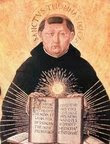
St. Thomas Aquinas made the bulk of his academic career going around Europe after a man named Sieger of Brabant, who said you could have contradictory truths (not perceptions, but realities), and that whatever you called a thing, that it was. Everywhere St. Thomas went, he calmly tried to get folks to listen to common sense and reason. While he lived, he was very successful because he was very prayerful. Let's follow his example.

St. Thomas Aquinas, pray for us.

Meditation on the Falls

So over the weekend I went to one of my favorite spots to get out and away, to think and pray, to read and have a private little picnic: Great Falls National Park in Potomac, Maryland. It's just a few minutes from my house and it's easy to do for just a couple hours. It needn't take even a full afternoon. This time, while hiking on the Billy Goat Trail (which is pretty rocky and craggy, right along the river) I stopped for lunch, and then hiked back to the C & O Canal Trail, where I walked a few miles up to the Great Falls overlook. Staring at the raging waters, I was taken with them. They are not as big and majestic as Niagra Falls, to be sure - not by a longshot. But they are homely and they are ours. And whoever jumped in or was dropped into them would certainly be destroyed. The Great Falls are a lot like reality in that way. Our own little corner of reality is homely and we can take it for granted. It is beautiful, though, and if you take it seriously, will be fulfilling. If you treat reality, real life, the world, like a game for your own amusement by your own rules - you will almost certainly end by killing somebody.


Another thing I noted was that after all the turmoil of the Falls, further downstream, things turn more or less placid again. Life is like that. Things get hard sometimes. Real hard. You think they will break you. But you hang on, ask Someone for help, and in the end, he leads you to rest by still waters. There, you can eat your ham sandwich and read your book in a bit of peace for a while. So to speak. Eventually, we hope, He will lead us into an everlasting rest. But in the meantime, hold on tight. It'll probably be a wild ride.


I think a large part of the Christian life, at least for me, is about learning to trust God and go with the flow - to let Him steer the ship. By that I mean both to prioritize my decisions based on my best estimate of His will, and also to remember that whatever happens, He's still God and ultimately, He's still calling the shots. Since He's smarter than me and loves me more than I love myself, that's not an entirely bad thing. It's just bad for the ego. Or it may be good, depending how you look at it.

What I Saw in Mexico

My vacation in Southern Mexico from St. John Vianney Day (August 4) until Assumption Day (August 15) with my friend, Fr. Bob Lacey, was immensely fun and generally pretty relaxing. Going with Fr. Lacey was great for a variety of reasons including his perceptive insight. Here are a few things that we saw in Mexico.


1. People there are very young. Wikipedia reports that the average age there is 25, whereas the average age of an American is about 40. There are lots of children everywhere. The youthfulness there is beautiful.

2. There is construction work going on all over Mexico. People are working and building, and unemployment is very low (3.2%, give or take). It was more expensive to be in Mexico than it had been on previous visits, which means that their economy is not as weak compared to ours as it used to be. The vibrancy and energy there is beautiful.

3. Despite ongoing trends of secularization, religion is not dead in Mexico. Our Lady of Guadalupe is everywhere. She dangles from rearview mirrors, reposes in bus station shrines, and has special places of honor in most homes. Whereas in Montreal, St. Joseph's Oratory seemed bereft of local visitors, the Basilica of Our Lady of Guadalupe was swarming with Mexican pilgrims. Crucifixes are also prominent in the country. Generally, and especially in churches, their crucifixes are not for sissies or the faint of heart. Our Lord is depicted as suffering upon the Cross, writhing with wounds and soaked in blood. Each is like a still-frame shot of Mel Gibson's The Passion of the Christ. They very much want to remember, meditate upon, and soak up our Lord's suffering. Tellingly, a priest indicated that prayer groups have been springing up everywhere in the wake of the decision of the capital city's legislature to legalize abortion within city limits. The devotion there is beautiful.

4. In my experiences, things have been getting steadily more efficient in Mexico. Even with the efficiency, there is still a real warmth and humanity in Mexico, even while waiting in line at government offices. There is also a sense that not everything has to happen right now. This awareness helps them to be patient - incredibly patient, I suspect. Every single time I've been to Mexico, I've been invited for dinner to the home of a total- or near-total stranger. The family that had me over for dinner also drove me to the airport the next day. Their hospitality is astounding. The humanity there is beautiful.

5. As Fr. Lacey and I prepared to leave the Cathedral of Mexico City, several bishops, numerous priests, and dozens of seminarians processed in. Taking their seats in the choir, they chanted first vespers for the Solemnity of the Assumption of the Blessed Virgin Mary. Everything stopped. The tourists, idle wanderers, ushers - everyone stopped and listened as those well-trained voices chanted those ancient prayers in that most ancient and lavish cathedral in the Americas. All the noise and hubbub of Mexico City's thirty million residents was drowned out by sung prayers ascending to heaven. Time simply fell away as businesswomen, father-and-son tour pilgrimages, and scruffy and awestruck tourists stood captivated for forty five minutes. The beauty there is beautiful.

Our countries are divided from each other by a lot of "political concerns" (that really means "by politicians"). But there is an immense amount of beauty and good in their country and in ours. Beauty is the manifestation of goodness to our senses. It is what makes the good not only known as desirable, but felt as desirable. Beauty is what attracts us to goodness, and ultimately to God, the Ultimate Good (if we do not take a wrong turn). Dostoyevsky once wrote that "Beauty will save the world." We should pray that by whatever means, God draws our two countries closer together in a way that draws each closer to Himself.


Islam, Reformation, and Philosophy

I don't really follow blogs - creating an irony in that I have decided to start writing one. But I do periodically check in on the Washington Post's comments boards for interesting tidbits. Here's one I'ld like to share:

http://newsweek.washingtonpost.com/onfaith/samuel_rodriguez/2007/07/the_muslim_reformation_time_fo.html

In it, the Rev. Samuel Rodriguez, president of the National Hispanic Christian Leadership Conference, and a Protestant, argues briefly that what Islam needs is a Protestant Reformation of its own. One Mr. Chase makes a briefer argument against him, in effect saying (1) there is no superstructure or hierarchy to reform against; and (2) the Islamic equivalent to a Reformation has already happened.

I decided to chime in and expand upon Mr. Chase's second point by looking at the philosophical underpinnings of the Reformation, and how those underpinnings are already in place in Islam, but have played out in a way that makes the Middle East a sort of photographic-negative from Europe. I have copied my argument below.

One of Martin Luther's fundamental gripes against the Catholic Church was its use of Greek
philosophy to structure its understanding of the Christian Gospel. That is at the heart of his idea of "Sola Scriptura" demand: don't try to 'figure out' all this stuff - just read the Bible and do what it says, he insisted. The corollary was that religion did not "fit in" with the rest of reality as an integrated whole, but rather was a separate thing, a separate reality. Thus Luther's interpretation of the command to render to Caesar what is Caesar's and to God what is God's. The secular sphere and the religious had, in Luther's thinking, no real interaction (let alone integration). This disconnection is why Protestantism and secularism get along so nicely - each is content to let the other do its own thing without trying to connect between the two.

The Catholic Church, on the other hand, has always insisted that there is just one reality, one universe, and that its different facets have ordered relationships with each other. The most important facets of reality are those that pertain to eternal destiny, it argues, which are the same facets about which the Church speaks. Thus the Church takes for itself a sort of overarching supervisory position: not in charge of anything in particular, except religious life, but with a certain oversight of everything in general, even things like politics and scientific research. Naturally, politicians and scientists chafe at this ordering, and prefer a separation. A secularization, made possible by the Protestant Reformation, is what they looked for.

The problem with a Muslim Reformation is that it has already happened, and failed. In the 11th and 12th centuries AD, Islam saw its philosophical hayday. Ibn Sina (Avicenna), Ibn Rushd (Averroes), and Ibn Farabi among a host of others labored to integrate their Koranic religious convictions with systematic thought in a way that could give a "big picture" of the whole world, sustain scientific discoveries, and help address questions not obviously answered in the Koran. They were in pursuit of the same project that the Catholic Scholastic philosophers (Thomas Aquinas, et al.) undertook about a century later (and mostly in light of the progress made by the Muslim philosophers first!). It was the same project that Martin Luther rejected in Catholic Europe. In Muslim Persia the project was torn down by Abu Hamid al-Ghazzali, a theologian and cleric, like Luther, who was convinced that thinking about religion and faith somehow undid them. He wrote oodles of volumes, but his most significant is also one of his latest. It is most significant because it is a reversal of the earlier. "The Incoherence of the Philosophers" is a proposal of epistemological skepticism that would make Descartes or Hume blush. It denies any real ability to know anything outside of one's own mind, cutting off the subjective from the objective, the religious from the material universe.

So if this division of religious from secular has occured in both the Western world (in the 16-17th centuries) and in the Muslim world (in the 12th-13th centuries), why they both look so different from each other?

Simply put, the West has tended toward interest in the material and thus become more secular, while the Muslim world has tended toward interest in the religious and thus become more 'fundamentalist'. It was the same basic philosophical thrust to separate religion and the secular from each other that has allowed each to become unbalanced. If we separate the two so completely, we are left to chose between (on the one hand) a secularized scientism with no room for human values and transcendence, without wonder and awe; and (on the other hand) a detached religiosity with no room for inquiry or reasonability, nothing to prevent it from becoming unhinged in its own little mental universe, nothing to prevent it from becoming fanatical.

The two worlds we have thus face face each other in gaping incomprehension, each thinking of the other, "How can you be so obtuse?"

What is needed in both the Western world and in the Muslim world is a philosophical understanding in which there is one reality, and each thing has its proper place and can be understood analytically (in its parts and in itself) and comprehensively (as part of the bigger picture) - so that science is not closed to the transcendent and religion is not hostile to reason and thought. What is emphatically NOT needed in either the Western world or the Muslim world is a new Reformation, a new division of this-world from that-world. We've had quite enough of that already. Maybe, what is really needed is a new scholasticism.