 This past Sunday was designated as Solemnity of Christ the King. Originally promulgated in the 1925 document Quas Primas by Pope Pius XI to occur on the last Sunday of October, the feast is now celebrated each year on the last Sunday of the liturgical year - the Sunday before the beginning of Advent.
Culturally, the feast is meant to fly in the face of all that we hold dear in democratic countries: self-determination, representation, policy by consensus. Pope Pius XI read the signs of the times and could smell the growing determination by world leaders not to be bound by traditional morality. While Communists overthrew Russia and the revolutionary government in Mexico became violently anti-Christian, even Christian Europe witnessed new trends and social programs opposed to good morals. It was clearer and clearer to the Holy Father that an assault against Jesus Christ himself was underway. Placing the feast at the end of the year is perfect. The readings taken from the Mass and the Liturgy of the Hours (especially those from the books of the Maccabees) for the end year all draw our attention to the Lordship of God. The readings do so in a stark way: example after example is given of worldly rulers claiming absolute dominion - even insisting that people violate the laws of God to prove their loyalty. In these cases, the readings dramatically highlight the necessity of martyrdom by those who love God.
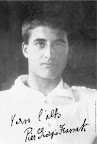
One modern example given to the Church on November 23 is that of Blessed Miguel Pro, S.J. The young Jesuit found his studies for the priesthood interrupted by the Mexican Revolution. His seminary was moved to Texas, and after a time there, he finished his studies in Belgium. By then, the persecution of the Catholic Church in Mexico was in full swing. Where the laws were enforced, priests were forbidden to wear special attire, renounce allegiance to the Church, cease performing sacraments, required to marry, and executed for refusal to any of those things. Priests were literally being shot in the street wherever they were found. Bl. Miguel volunteered to return to this environment because he suffered to see his countrymen go without the sacraments, with nobody to preach the Gospel to them, with nobody to remind them that God heard their cries and would not leave them alone forever.
After sneaking back into Mexico, Bl. Miguel evaded the authorities for a few years. Frequently he would slip right under their noses using the same sort of clever disguises  that he and his siblings had used in their amateur theatre performaces as children. He even made so bold as to evangelize soldiers and police officers in places where "wanted posters" displayed his picture! By the time the young priest was apprehended in Mexico City, he was personally arranging the food and rent money for hundreds of families dispossessed for adhering to Holy Church, as well as offering Mass illegally numerous times weekly to crowds of people numbering into the hundreds. At last he was betrayed, like Christ, by one of those who benefited from his labors. Arrested with two of his younger brothers on the pretext of an assassination attempt, he refused the opportunity to disavow his priesthood, and was ordered to be shot by a firing squad in front of ambassadors and the press corps of the world's socialist and communist countries and organizations. So it was that, refusing a blindfold, Bl. Miguel stood before his murderers, facing them calmly, and forgave them aloud. Then, as the command to raise rifles was given, he threw wide his arms and shouted out "Viva Cristo Rey!"
Long Live Christ the King!
This pose is the one captured by photographers. Some of them, though socialists, were awed by his bravery, and within days holy cards had been made from the photographs and were circulating illegally. He was forbidden a public funeral, but the government was unable to act against the tens of thousands who showed up to escort the body to its burial site.
The question we have to ask ourselves, whatever our state in life, is whether Christ is king over us.Do I avoid sin for fear of offending Him? Or do I make excuses?
Do I engage in thankless service in order to please Him? Do I only do the good things I like?
Do I rearrange my affairs to accord more completely with His desires?
Do I fear the opinion of other people, even strangers, more than I fear provoking God?
Am I willing to part with anything - ANYTHING - material possessions, habits, relationships - the moment it begans to interfere with my relationship with Jesus Christ?
In calling myself a Christian, "One of Christ's" I am implicitly answering the above questions. Do I answer them the same way in acting like Christ?
If Jesus Christ is not the Lord of my Life, the King of my Heart, then He is just a nice prop in my life that I take out sometimes, maybe once a week or so, to make me feel better about myself. We have cause to concern about this situation because Our Lord, the King of the Universe, himself said,
Not every one who says to me, `Lord, Lord,' shall enter the kingdom of heaven, but he who does the will of my Father who is in heaven. On that day many will say to me, `Lord, Lord, did we not prophesy in your name, and cast out demons in your name, and do many mighty works in your name?' And then will I declare to them, `I never knew you; depart from me, you evildoers,' (Mt 7:21-23).
Again, it is fitting that the feast of Christ the King comes at the end of the year, because when all is said and done, Jesus Christ is Lord. On the Last Day, He will have the last word.








 Posts
Posts


