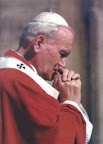
Intentions of the Holy Father for April

Ecology and Justice. That governments may foster the protection of creation and the just distribution of natural resources.
Hope for the Sick. That the Risen Lord may fill with hope the hearts of those who are being tested by pain and sickness.
Showing posts with label confession. Show all posts

But Can I Be Peter?

The readings today (Third Sunday of Easter: Acts 5:27-32, 41-44; Ps 30; Rev 5:11-14; Jn 21:1-19) got me thinking on an old topic.  A few weeks ago, I asserted that I am Judas.  A friend blogger begged to differ.  LuceMichael commented:

I dunno Ryan, I'm going to have to disagree with you on this one. What Judas did was purely evil. Not just sinful, but truly and historically evil. Saying "I am Judas" is akin to reckoning ourselves as the contemporaries of Jesus who condemned Him to death, a view which VII rejects, btw.

More appropriate is a comparison to Peter, or the other apostles who abandoned Jesus in fear and denial. They sinned, turned away from doing the right thing, but in the end, were redeemed and in the case of Peter, who was exhorted by the Lord to "turn back and strengthen" the others, much good came from a flawed man. In fact, the papacy and Magisterium came from him, once he was humbled, contrite and forgiven.

There is always the philosophical and theological conundrum of whether Judas is in Hell. While none of us can say for sure, there is at least a strong likelihood that he *is* in Hell, having sold out the Lord, and taking his own life in despair of mercy.

Judas and Peter make an interesting contrast in their response to the own guilt in the passion. But most of we Christians are NOT Judas; most of us, though we sin carelessly, thoughtlessly, or maliciously and with intent, still do not come to the level of evil that Judas attained. With the grace of God, I will never completely deny Jesus. Through all my sins and faults, I know Him to be my Lord and Savior.

And He is Risen!
My major point was that my sins are the things that necessitate the death of the Messiah.  In a way, Judas was less culpable than I, perhaps, because he was more confused about who Jesus is.  I, on the other hand, know precisely who Jesus is, and yet sin and sin again.  We must be careful here, because the sin that landed Judas in hell, if that is where he is, was not treason against God, nor was it apostasy.  Those sins are forgivable (Jn 20:23).  St. Peter committed the same sins after all, though in a different way.  The sin of Judas was rejection of forgiveness, rejection of the Holy Spirit prompting him to repentence.  Judas thought that somebody like himself, someone so enormously important who had done a thing so enormously wrong, could never be forgiven.  And, in a sense, he was right.  Without repentence, there can be no forgiveness of sins (Mk 3:29; CCC 1864).

But St. Peter repented.

Her point is very well made.  Judas killed himself (Mt 27:5-8) but St. Peter repented.  In today's gospel reading, our Lord asks St. Peter three times if he loved Him as they strolled along the beach together, perhaps arms-over-shoulders.  The threefold act of love that St. Peter makes rehabilitates him after the threefold betrayal.  Note well that these acts of love, these acts of contrition, do not undo what Peter has done, but rather, they set him on a new path.  So it is with the penances that we perform after our confessions.  They actualize our repentence and put us on a new path  So how do we get to be like St. Peter, who did so many wonderful things for the Church, even dying for the sake of our blessed Lord?
 
We repent.

Face it.  We are probably not going to stop sinning any time soon - though make no mistake: in grace, it is possible, so strive for heavenly perfection.  Strive for sanctity!  But, observing our own failure, our own repeat failures, even our own egregious failures, we must not give up.  We must not go hang ourselves as Judas did, either literally or metaphorically.  Do not say of our holy religion, "This is a hard saying; who can listen to it?" (Jn 6:60) and then abandon it as those who could not stand the Eucharistic teaching of our blessed Lord (John 6:66).  Examine your conscience and pray for the grace of honesty.  So many people are afraid to confront their own sins, so they say, "Oh yeah, well the Church sucks because of X."  When we have reached our maximal efforts and failed yet again, perhaps we will then realize on a deep, deep level that it is not our own efforts that save us.  Most of us, Catholic, Protestant, Evangelical, Pentecostal, really believe deep down inside believe that we can save ourselves, that we must save ourselves, that we must prove ourselves to God.  That is all bosh.

Jesus Christ saves us.

"While we were yet sinners Christ died for us," (Rom 5:8).  He loves us even in the midst of sin.  And no matter how badly we sin, we have only to turn back, confess our sins to a priest, and receive the gift of a fresh start.  We must pray for the courage to face our sins head on, for the grace to be St. Peter.

The Resurrection: Fridays in Eastertide

So during this eight-days-in-one that we call the Easter octave, we've been reflecting about what the Resurrection of Jesus of Nazareth, the Christ, means.  We've looked at what the Apostles meant, and that the Church still means the same thing today.  We've looked at how the Resurrection manifests Jesus as Lord and God, with power over life and death - and how he plans to share his kingdom with us by giving us a new way of life.  We've looked at how that new way of life can begin now, and how it will lead us to an eternity of joy.

So what is the proper response of a Christian?  Let's look at Psalm 116, my favorite, for some suggestions.

I love the LORD, because he has heard
         my voice and my supplications.
Because he inclined his ear to me,
         therefore I will call on him as long as I live.
The snares of death encompassed me;
          the pangs of Sheol laid hold on me;
          I suffered distress and anguish.
Then I called on the name of the LORD:
          "O LORD, I beseech thee, save my life!"
Gracious is the LORD, and righteous;
          our God is merciful.
The LORD preserves the simple;
          when I was brought low, he saved me.
Return, O my soul, to your rest;
          for the LORD has dealt bountifully with you.
For thou hast delivered my soul from death,
          my eyes from tears,
          my feet from stumbling;
I walk before the LORD
          in the land of the living.
I kept my faith, even when I said,
          "I am greatly afflicted";
I said in my consternation,
          "Men are all a vain hope."
What shall I render to the LORD
          for all his bounty to me?
I will lift up the cup of salvation
          and call on the name of the LORD,
I will pay my vows to the LORD
          in the presence of all his people.
Precious in the sight of the LORD
          is the death of his saints.
O LORD, I am thy servant;
          I am thy servant, the son of thy handmaid.
         Thou hast loosed my bonds.
I will offer to thee the sacrifice of thanksgiving
          and call on the name of the LORD.
I will pay my vows to the LORD
          in the presence of all his people,
          in the courts of the house of the LORD,
          in your midst, O Jerusalem.
Praise the LORD!
The Psalmist is deeply grateful to the LORD for having saved him from the "snares of death," the "pangs of Sheol," and from anguish and distress.  When he was tearfully stumbling, consternated by the abandonment of human consolations, God "dealt bountifully" with him.  The Psalmist, as he often does, prefigures Christ with his prayers.  The Holy Spirit invites us to make the prayer our own, to pray like Jesus, and so the prayer is an invitation to the imitation of Christ.  Jesus was raised up from "the snares of death" by God.  What was Jesus' response to being raised from the dead?

He offered the Eucharist (Lk  24:30), a word that means "thanksgiving" in Greek, a ceremony that He made a sacrifice of His flesh and blood (1 Cor 11:23-5; Mt 26:26-8) by His sacrifice on the cross, a sacrifice that draws us into communion with Him, and thence to God, and thence to all the others in communion with God for an eternity of Joy (Jn 6:48-57).  The Eucharist is literally our participation in Jesus' sacrifice of thanksgiving.  It is how we thank God for what He has done for us.  Moreover, it is how God does for us what He has done for Jesus.

(hat tip to Veritas Vos Liberat)

"Whoa... wait a minute," you might be thinking.  "The Eucharist is how God saves me," you start, and then continue, "and it is how I thank God for saving me?"  Yup.  "But, I don't get it.  What does that mean?  What do I have to do?"  Nothing.  Just accept it gratefully.  Make it our weekly (daily?) act of thanksgiving to God, and we will have received what He would give us.  He doesn't want our actions - whatever you and or I can do, He can do better anyway.  He doesn't want our charity.  He doesn't want our money.  He doesn't want our apologetics or evangelization or even our prayers.  Doesn't need 'em.
God, infinitely perfect and blessed in himself, in a plan of sheer goodness freely created man to make him share in his own blessed life. For this reason, at every time and in every place, God draws close to man. He calls man to seek him, to know him, to love him with all his strength. He calls together all men, scattered and divided by sin, into the unity of his family, the Church. To accomplish this, when the fullness of time had come, God sent his Son as Redeemer and Savior. In his Son and through him, he invites men to become, in the Holy Spirit, his adopted children and thus heirs of his blessed life.
He just wants us.

The rest will follow.  So simple.  Die to yourself by going to confession.  A real deathblow happens there - the ego is given a tough kidney shot, at the very least.  Then go to Mass.  Pray silently along with the priest.  Enter into the prayers.  Enter into Christ.  Receive Him with an open heart to whatever He wants.  Give thanks and praise.  And then "do whatever He tells you," (Jn 2:5).

Friday is the day on which Catholics generally (at least in former times, though we are still asked to) give up meat, in honor of the day on which our Lord gave up His own flesh.  May I humbly suggest that, at least during the fifty days of Eastertide, we take up the sacrifice of thanksgiving by going to Mass an extra time, perhaps on Fridays, to sing the praises of God?

The Resurrection: Eyes on Jesus

Excerpts from the gospel reading for the day is one of the most excellent:

That very day, the first day of the week, two of Jesus’ disciples were going to a village seven miles from Jerusalem called Emmaus, and they were conversing about all the things that had occurred. And it happened that while they were conversing and debating, Jesus himself drew near and walked with them, but their eyes were prevented from recognizing him. He asked them, “What are you discussing as you walk along?”  They stopped, looking downcast.

One of them, named Cleopas, said to him in reply, “Are you the only visitor to Jerusalem who does not know of the things that have taken place there in these days?”

And he replied to them, “What sort of things?”

They said to him, “The things that happened to Jesus the Nazarene, who was a prophet mighty in deed and word before God and all the people, how our chief priests and rulers both handed him over to a sentence of death and crucified him.  But we were hoping that he would be the one to redeem Israel; and besides all this, it is now the third day since this took place.  Some women from our group, however, have astounded us: they were at the tomb early in the morning and did not find his Body; they came back and reported that they had indeed seen a vision of angels who announced that he was alive.  Then some of those with us went to the tomb and found things just as the women had described, but him they did not see.”

And he said to them, “Oh, how foolish you are! How slow of heart to believe all that the prophets spoke! Was it not necessary that the Christ should suffer these things and enter into his glory?”  Then beginning with Moses and all the prophets, he interpreted to them what referred to him in all the Scriptures.  As they approached the village to which they were going, he gave the impression that he was going on farther.

But they urged him, “Stay with us, for it is nearly evening and the day is almost over.”  So he went in to stay with them.  And it happened that, while he was with them at table, he took bread, said the blessing, broke it, and gave it to them.  With that their eyes were opened and they recognized him, but he vanished from their sight.  Then they said to each other, “Were not our hearts burning within us while he spoke to us on the way and opened the Scriptures to us?”  So they set out at once and returned to Jerusalem where they found gathered together the Eleven and those with them who were saying, “The Lord has truly been raised and has appeared to Simon!”  Then the two recounted what had taken place on the way and how he was made known to them in the breaking of the bread.

Luke 24:13-35

In his homily, Monsignor made a couple astounding points.  "[The disciples'] eyes were prevented from recognizing him," Monsignor conjectured, because they were "downcast."  The disciples were not looking for Jesus in those darkest days of human history; they were looking at the ground.  They thought that He was done and that they were abandoned.  We must not focus so much on ourselves and on our own problems that we miss Jesus even while He is there with us, teaching us, and setting our hearts aflame - if only we will look to Him and listen.


I would like to point out that the disciples actually recognized Jesus for who He is in "the breaking of the bread," the Eucharist.  Hearing the Word of God explained to them prepared them to receive the Word of God into their fellowship and into their very bodies.  I would also like to point out that the disciples conversed with Jesus, frankly expressing their troubles and their doubts to Him.  That honesty is part of sincere faith for those who have troubles and doubts.

If we bring our even our dashed dreams and deepest despair to Jesus, who knows what he might make of them?  Keep praying.  After you have said your peace, listen in prayer.  Speak with other disciples.  Read the scriptures.  Confess your sins, if needs be.  Visit the Eucharist at church, hear Mass, receive communion.  Don't give up on Jesus, and try not to be downcast, but fix your eyes on Him and look for Him.  He is risen!

(Lastly, here's a link to the Men of Emmaus, a Catholic fellowship for men based in Gaithersburg, Maryland, for those of you who might be looking for fellow disciples and who live in the area.)

The Communion of Sinners

So, I've had this thought bouncing around in my head over the last few weeks.  Lining up for the confessional, I bumped into an acquaintance of mine.  Since I mostly make my confessions at the same time and same place each week, it's actually not that odd for me to bump into people I know in line at the confessional.  A smile or a nod passes between the two of us.  The smile or nod means a lot.  It means, "Hi."  It means, "Glad I'm not the only one I know that uses this thing."  It means, "Hey, another sinner.  That's great!"

 In Line for Confession
Well, clearly it's not great that we are all sinners.  What is great, though, is that it's not just one of us.  Wouldn't that stink?  Literally, one person would be to blame for all the world's mess.  It would be easy for the rest of us to feel self-righteous, especially toward that poor slob, but I do not believe that would be a good thing.

Instead, we have the situation of all of us needing Jesus.  Our sins may be different in "species and number," and even in gravity, but not in essence.  In essence, our sins are all affronts to the will of our Creator and against our own dignity.  We are called to live in the communion of saints, the strong bond of those redeemed and sanctified by Christ.  For the time being, while we haven't left sin behind entirely yet, we might as well get on with the work of building up a strong bond of those being redeemed and sanctified by Christ.  This communion will only grow among us to the extent that we admit what we have in common: that we are all sinners.  There's no use pretending, acting like we don't see each other in line for the confessional.  Instead, it's probably best to admit to ourselves that we are sinners, and in very specific terms what sort of sinners we are.  We should also admit to each other freely, easily in general terms, that we are sinners.  We can do so, if in no other way, by making an appearance in our local parish's confessional line.  To the extent that we can safely do so with people we trust, it might not hurt to share with each other in more specific terms the ways we sin.  In fact, it might heal to know that we are loved, not only by God, but by our brothers and sisters... sins and all.  Confessing our sins to our priest and, when prudent, to each other can only build up the communion of sinners until, hopefully, one day we enter perfectly into the communion of saints.

Oh, wait a minute.  You weren't in line for the confessional?  Oh.  I see.  Well, I suppose there's one thing more priggish than a person who sins and then tries to act like he's perfect: someone who doesn't even think he sins.  You do sin, don't you?  Then 'fess up.  Join the confessional line, the communion of sinners - so that you can be made worthy to enter into that other communion line.

And The Ayes Have It!


One lesson that leaps out on the Feast of the Annunciation is obedience to God.  Mary's yes to God literally revolutionized the entire world and all of human history.  It rerouted us from the downward spiral of sin and slavery onto the upward path of redemption and grace.

But how can a single yes be so powerful?

A clue can be found by delving into what happens to be my favorite beatitude, if beatitudes are the sort of thing that can be ranked.  Blessed are the meek, for they shall inherit the earth (Mt 5:1) provides deep inside once we understand what is meant by meekness.  Meekness is not door-mat-ishness.  Meekness is the acceptance of reality.  Now, that doesn't sound too hard, but when we consider how much time, energy, money, thought, and emotion are invested into iPods, movies, shopping sprees, expensive vacations, distracting hobbies and enterntainment, and worse, darker things like addictions, we can quickly see that a lot of people prefer to avoid reality.  When we look at the power politics in a place like Washington, D.C., the micromanagement in our own office, or the violent behavior that often dominates in places like the Beltway, we can quickly see that a lot of people prefer to control reality.  The meek person, far from passively giving in to adverse forces, evaluates reality, understands what is possible to him without sinning against God or his neighbors, and then works within those parameters.  The meek person realizes that not only he or she, but also reality, is real too.  The meek person realizes that God is God, and that he is not.  Reality is real, and lying, cheating, or stealing won't make it go away.

This message can be really hard.  Some people feel very deeply that they have been jipped by life, and all of us have some hard knocks, from time to time, that tempt us to lash out against them, against somebody in our life, or against God.  The meek person, trusting in God's providence, rolls with the punches.

The virtue of meekness makes me think of a favorite movie of mine, Slumdog Millionaire. If you haven't seen it, you should.  Two of the movie's main characters are brothers.  One spends his life in tremendous violence, always grasping for a better life.  The other sets his heart on love, accepts circumstances as they come without letting them deter him, and refuses either to do wrong or accept discouragement along the way.  The characters are not Christians, but they come very close to a perfect illustration of the polar opposition between the one who does whatever it takes to get what he wants, and the one who accepts reality as the framework for living life.  If to the latter way of life we add humble trust in God's will and fatherly providence for us, we have the Christian virtue of meekness, the virtue that wins us the whole world.

If we, moved by grace, can be open to God's will and say, "Yes," whatever may come, we will be amazed by what follows.  Since we are not immaculately conceived, we'll typically have years or decades of spiritual grime clogging our heart.  But even this first yes will begin to move things along, open things up, turn things around.  God will begin, perhaps slowly, but certainly surely, to move in our life.  He will not suddenly transplant us to a rose garden of a life - that wouldn't be real.  But as long as we keep saying, "Yes," to Him, He will keep giving us more and more of the raw stuff that joy is made of - love, peace, service, friendship, virtue, a clean conscience, and a sound relationship with Him.  He will give us all the things that we can never seize for ourselves or control like masters.

A great way to say, "Yes," to God, to accept the reality of our own sinfulness and to proclaim the reality of God's amazing justice and mercy, is to go to confession.  Especially during these last days of Lent, and especially if you haven't been in a few months or years, consider going.
Take, Lord, and receive all my liberty, my memory, understanding, and will.
All that I have and am You have given to me,
And I surrender it now to be governed entirely by Your will.
Your grace and Your love: these are wealth enough for me.
Grant me these, Lord, and that shall be enough for me.
Amen.
The Suscipe Prayer of St. Ignatius Loyola

Patrick Madrid on the Quakes

On his blog, Patrick Madrid writes:

First, the devastating quake in Haiti 45 days ago, and now this one in Chile. My guess is that more of these disasters will strike more frequently. I hope not, but that's a hunch. Sooner or later, one of these BIG quakes will strike within the U.S. — Los Angeles? St. Louis? Chicago? San Francisco? New York? It's just a matter of time, the scientists have been telling us.

Two things we should do:

1) Always be ready to meet the Lord by staying close to him in prayer and the sacraments, especially frequent confession. This is a no-brainer, but it's amazing how many people, including Catholics, never give the four last things any thought: Death, Judgment, Heaven, and Hell;

and

2) If you haven't already, start making practical preparations in your own home so that, if find yourself in a quake-stricken area, you and your family can fare better and be in a position to help those around you. Lay in a supply (even if just a small one) of extra water, foods that will keep without refrigeration, medicines like Ibuprofen, a hand-crank radio (no batteries needed), etc. Make a plan with your family, especially your kids, so that they will know where to meet up. You know, those kinds of basic preparations.

We should pray to God that these disasters spur us to greater charity, and to deepen our Lenten devotion, in a sense: to remember that we will die, and that we know neither the day nor the hour.

What the Priest Told Me in Confession Today

The priest to whom I made my confession today told me the coolest thing:

When you wake up in the morning, that is God saying to you, 'Get up! I've got something important for you to do today!' And you want to get in the habit of asking yourself and asking God throughout the day, 'OK, God, so what's the next thing I do today?'
I believe that he was bearing in mind that, being underemployed right now, I have more free time than normal. Such time is often squandered unintentionally on frivolities, and the long term effect of such leaking is demoralization.

Before You Welcome Jesus

We celebrate the Word of God coming into the the world made by God on Christmas Day. The Holy Family was turned away from the inn because there was no room. The inn of our hearts are often cluttered with sins that prevent the Christ Child from being born anew in our own hearts and lives. What better way to clear out the clutter and welcome in Christ, than by going to confession. If you haven't in a while, all the better to go now. Remember, we Catholics are required to confess to a priest at least once each year. Why not before Christmas?

Below is a brief video produced by a friend of mine on how to make a good confession.

All Called to Be Saints

Here is the first contribution of Rev. Mr. David Wells to this blog.  I have adapted slightly, with his permission, the homily that he gave on the Feast of All Saints, about two weeks ago.  Before long, his posts will appear with his own signature.  Enjoy!

The Marine Corps Marathon on a recent Sunday in D.C. and I know a few people who ran in the race.  One was a priest who used to be where I currently serve as deacon, at St. Jude’s, Rockville, Maryland; he goes by the name of Fr. Rob Walsh.  From what I hear, Fr. Walsh finished the marathon but it was not beautiful to behold.  Even with months of training, running a marathon is no easy feat.  Everyone who runs a marathon follows a training regimen, more or less strictly, so that when race day comes, they don’t get to mile seven and start looking for the nearest metro stop.  In other words, they have a goal—finishing the marathon—and a plan for how they will carry that out—their training regimen.

"My uncle was fond of saying that the goal of life is heaven.  “The goal of life is heaven.”  One spiritual writer puts it this way: “The ultimate failure in life is not to be a saint.”   Recently, the Church celebrated the Feast of All Saints.  We honor those who have reached that goal of heaven and we ask for their help and prayers to rally us on to the finish line.  The saints are like those people who cheer us on after they’ve finished the race, because they know that the award is well worth the struggle.  But even if we have the goal firmly established, how do we reach that goal?  The last thing we want is to be like that person who decides to run a marathon and has no plan for running it.

"Now the plan for going about reaching our goal of heaven is unique for each of us.  God has a distinct plan, a distinct mission, for each one of us.  But that being said, there are some things we all share in common.  There are certain things that if we keep them in mind and carry them out, will aid all of us in reaching our goal of heaven.  I’ve come up with three suggestions, but the Lord knows there are many other things.

"The first piece of advice I have is “keep your eye fixed on the prize.”  When you first begin training for the marathon and you’re sore and out of breath after a half mile; when it’s 95 degrees out and not a bit of shade on the route; and when those shoes everyone says you have to buy cost more than your last suit.  When you encounter all of these setbacks, if your goal is not fixed firmly in place—to run a marathon—you’ll soon give up and head back for the air conditioning.

"The saints recognized and always kept at the forefront that the goal of life is union with God in heaven.  This motivated not just their big decisions but was the motivating factor behind their small decisions as well.  We should think about heaven . . . a lot.  It should fascinate us.  The first reading from the Book of Revelation powerfully and symbolically illustrates the glory of the saints in heaven.  St. John asks who the persons wearing white robes and holding palm branches are.  He is told that these are the saints who suffered great tribulations on earth but whose robes have been washed by Christ’s blood and now glorify God forever.

"In the second reading, St. John reminds the community to whom he writes that they are God’s children now.  This great saint and mystic admits next, “What we shall be hasn’t been revealed.”  It’s beyond our wildest imagination and surpasses our greatest hopes what we shall be like in heaven.  And finally, in the Gospel, Jesus encourages his disciples to undergo suffering and face difficulties during this life, because they will enjoy great glory in heaven.  “Blessed are the poor in spirit, for theirs is the kingdom of heaven.”  “Blessed are they who are persecuted for the sake of righteousness for theirs is the kingdom of heaven.”  The saints greatly look forward to heaven and to being with God forever.  We, too, must keep our eye fixed on the prize, and not get too distracted by our everyday problems.  This world is short, eternity is forever.

"The second thing we should keep in mind to reach our goal of heaven is that it’s possible.  It’s possible to be a saint.  No, this is too weak a statement.  It’s expected of us, it’s normal in God’s eyes.  Not only that, but God wants us to be saints and will give us every aid necessary in order to reach our goal.  Sometimes it feels like God is working against us, but this is never the case.  He’s our number one fan and supporter.   Pope John Paul II canonized more saints in his 25 years as pope than were canonized in the previous 450 years.  In doing this, he wanted to show us that not only is it possible to be a saint, it should be thought of as normal to be one.  We’re all called to be one.

"One of the things that makes this difficult is that we think the saints were superhuman and we could never equal their feats.  We don’t read souls, pray all day, talk with God in mystical prayer, or appear in two places at once.  Well, don’t worry, because the saints, apart from Mary, were far from perfect.  St. Padre Pio, an Italian, was known for being short-tempered.  St. John Marie Vianney failed out of seminary and was sent to the middle-of-nowhere city of Ars, France because it was thought there he could do the least damage.  St. Teresa of Avila got so mad at God once, she shouted at him, “if this is the way you treat your friends, no wonder you have so few!”  The saints weren’t great because they were superhuman or perfect, but because they realized they were sinners and relied totally on God.  Reaching our goal is possible, because God desires it, the saints root us on, and the Church is like our mother, giving us the spiritual nourishment to accomplish it.

"The third thing to keep in mind as we strive toward our goal is that we fail daily, but we should persevere nonetheless.  Discouragement is one of the most debilitating things for us as faithful Christians.  Scripture says that even the just man falls seven times a day.  Mother Teresa wisely said that she received so much grace because she was such a great sinner.  The great St. Paul tells us that he is the foremost of sinners.  But this doesn’t get him down.  He recognizes his sin, and then abandons himself to god’s infinite mercy.  After a century of two World Wars, countless other massacres, and many other evils, humanity is tempted to reflect and concentrate on its own sinfulness.  This couldn’t be any more false.  The message Christ gives us is that of mercy.  His mercy completely swallows up the worst of our sins if we turn to him with true contrition.  If we are faithful to the sacrament of confession, we are well on our way to reaching our goal.

"If we keep our eyes fixed on the prize of heaven, realize that it is not only possible but it’s expected of us, and if in spite of our failings we persevere in the race, we shall surely be among those who are with God forever in heaven.  This is our hope and this drives us on.  My brothers and sisters, let us enter the race, so that one day we may share the joy of the communion of saints in heaven.  My all the angels and saints pray for us and intercede for us."
Awesome, Deacon Dave! Thanks!

People Say That God Has a Plan

So right now I am going through a lot of uncertainty in life, some emotional turbulence, and some minor practical chaos. To specify a bit, just enough to give a feel, but not so much as to spill my guts inappropriately, the "minor practical chaos" of the last week has included our basement flooding three (3!) times, my car breaking down, and some hay fever (a day or two after the rains finished flooding our basement and all the watered plants went back to pollinating). So, yeah, things have been kinda rough.

A theme emerging in all this s...tuff is God's providence, that "God has a plan for everything." Other people have been relating to me, unsolicited, the stuff in their lives past and present, and sharing with me this confidence: God has a plan for everything, and everything is part of his plan.

Fine. Why did God make mosquitoes, then, I protested to a friend years ago, just rhetorically, when he told me that God has a plan for everything. The biologically minded conversation friend told me that the mosquito's role is to spread disease to cull herds. Fine. Where mosquitoes failed me, I now have a better challenge to God's providence. If God has a plan for everything, what's His bright idea about the shield bug? It doesn't bite or sting or carry disease as far as I know. It just smells kinda poopy, and they sneak into our house a lot when the screen door isn't shut all the way. They don't really bother us overly, not enough to make us (or, I suspect, other large mammals) migrate or anything. They don't get into our food, but they do gravitate toward light bulbs. But none of those observations gives a clear answer to the question. The "why?" remains.

So it is with the flooding that caused no damage, but just annoyance; and so it is with a lot of the other s...tuff in the last few weeks. Of course, the stuff I do to myself is explained by just that fact alone: I do it, and God permits it so I can learn and grow up finally. Fair enough. But still, what about the shield bugs of life?

I think, in the end, I am going to have to side with Job here. I am gonna have to just admit I don't know, and with out being too pushy, tell God I'd like an answer, and wait on Him to decide when it's best for me to know. Something in me really strongly rebels against not knowing everything about everything that affects my life, against not being in charge of everything around me. That's OK, too. That's the way it is. I just keep going to confession in those cases. Every time, the Son of David is merciful to me (Lk 18:38), a sinner. So until I have a better answer, that's what I'm gonna have to try to get through my thick skull - God's mercy. To paraphrase the Little Flower, everything is a mercy. Even the shield bug.

Ashes: The Christian in Lent

Ok, so I am going to try, briefly, to tie a few things together.

1. Every Christian is by baptism a priest, prophet, and king (or queen, as the case may be). That includes every man, woman, and child who has been claimed by Christ under those regenerating waters. What does this mean, though? I am going to strip away the rhetoric for once and (try to) get to the point.

1A. Christ is the Great High Priest, the Great Prophet, and the King of All Creation. In baptism, we are united with Him and become part of Him, and adopted brothers of His, and adopted sons and daughters of the Living God with whom He is One, and we through Him.

1B. A priest, fundamentally, is one who makes intercession to God and offers sacrifices to Him on behalf of the people, and gives to the people God's blessings. Every Christian is called to be a man or woman of prayer, especially for others, and of sacrifice, especially of our own bodies and wills. We offer these prayers and sacrifices, in imitation of Christ, on behalf of ourselves, our loved ones, and the world. Ordained priests serve this role in a particularly acute, sacramental way within the Church, and the whole Church (that's all the baptized!) serves this role within the world in a less crystalized, more day-to-day way.

1C. A prophet, fundamentally, is not one who tells the future (though he might), but one who speaks for God - "pro-pheme" in Greek, a "speaks-for." Christ came as the final, fullest revelation of God's love for us. In His own flesh, He (God) manifests His desire to be with us intimate in bodily union, a union accomplished first in baptism and then most perfectly in Eucharistic Communion. Jesus' very existence makes this will of God clear to us. His words announced what He and His Father are about. We Christians, sharing in the mission of our Master, our Friend (John 15:12-17, esp., 15:15), also must speak God's word. We must put priority on living it out though. We cannot wait to live it perfectly before we speak it, or else we'll never speak it. But the emphasis in our lives must be on prayerfully hearing God, digesting and living His voice, and then amplifying it to the world in our own deeds and words.

1D. A king (or queen), fundamentally, is not one who bosses around and tyrannizes, but one who has been given authority by God to make a patch of the world more like the Kingdom of Heaven. That's all of us. We all have a patch of the world over which we have influence or even authority: our homes, friends, work environments, students, neighborhoods - all of these to varying extents are within our reach, as it were. We are, like Jesus, to use what the Father has given us to make our area more like God would have it be. We are to use our abilities, influence, and authority firstly for service - never for lordliness (Mt 20:20-28). We are to heal hearts, serve the weak and poor, right wrongs, salvage relationships, make good use of resources - all to make the world more like the Kingdom.

1E. These three dimensions of Christ's life and of our life in Christ are called the Triple Munera, the Three Offices/Duties/Functions of Christ. The Church, His Mystical Body, shares in them - our ordained clergy firstly and in a particular, sacramental and directing-leadership sort of way - and all the rest of us in a general and raw-horsepower sort of way.

2. We have just begun Lent. During Lent we are commended to remember our sinfulness and God's mercy in a particularly acute way in order to prepare for the remembrance of the Passion, Death, and Resurrection of our blessed Lord. The Church has three ways of life that are now more than ever to be lived out with diligence - prayer, fasting, and almsgiving.

2A. Prayer is time spent opening our heart and lifting it toward union with God. It might be while we do something else, but like everything else, if we want to really get good at it (like all communication, it takes practice) we need to set aside time for it daily. Lent is an especially good time to adapt some new prayer discipline - a daily rosary or morning offering, weekly Stations of the Cross, something. Prayer is especially important for living our our priestly office, but also for our prophetic office, and even for our royal office. After all, if we are to govern as God would have us, we had better be listening to Him.

2B. Fasting is, broadly speaking, abstaining from some food, drink, (or other other pleasure) or food and drink in general. The Church's rule is minimal: on Ash Wednesday and Good Friday we must carry out a simple fast, which means we take no meat, only one full meal, and up to two other meals that combined are smaller than a meal, without any snacking in between. Only those who have reached adulthood and haven't yet reached old age are required to fast. Everyone else merely abstains from meat, and everyone abstains from meat on Fridays in Lent. Really, the Church encourages us to abstain from meat on all Fridays, or to do some other sacrifice instead. During Lent, we pick an additional Lenten abstinence or fast that can hopefully be a sacrifice we continue in altered form after Lent, something that will change our lives for the better, for the godlier. Fasting is especially important to the prophetic office because one who preaches the Word of God had better feed on it, and remember that it is his primary food (Mt 4:3-4). Because priests offer sacrifice, a sacrifice of our time and even of our own bodily needs and desires, is perhaps the most concrete way to sacrifice our will to God. But good kings also sacrifice to God because they know that they are not the real top-dog, but that God is.

2C. Almsgiving is giving to the poor. It should be a near daily way of life for Christians, something we plan into our budget and not just something we do if we have anything left over (who really ever does?). Living a Christian life, or working for the Church, is not a substitute for generosity to her poorest children. I used to work for the Church and was given a small salary, and did not give to the poor very much. I am very embarrassed of that now. I might have given something. I earn less now, because I am studying full time, but give a lot more than I did then (it is still not much, lol). Even homeless people can give a bit of change. At least I know now that I am doing what I can to support the Church (the tithe) and care for those in need (almsgiving, properly speaking). Almsgiving is especially important to our royal office as Christians because as Christian king-lets and queen-lets, we are not to lord our Christianity over others ("See how holy I am!") but to serve them. The neediest first. Almsgiving keeps us oriented in that direction.

2D. As per Matthew 6, we are not supposed to do these things SO THAT others can see them. But as per Matthew 5, we are also supposed to be a good example to glorify God by our good deeds. How do we reconcile these two things? We should do our good deeds as part of our ongoing interior conversion. The quieter the better, generally speaking. If, for the sake of another, it is useful to the other that he should know of a good deed of ours, then we may allow him to know. And we need not be ashamed of our good deeds, either, especially when we are doing them as part of a group activity of the Church, as part of a public gesture of the People of God. If you are as vainglorious as I am, then it is probably best to keep your personal good deeds as private, tucked inside your vest when possible. The whole idea is to lose ourselves a bit in the heart of God and in the needs of the world.

2E. For each of our disciplines of prayer, fasting, and almsgiving, we should pick something that fulfills all four of the criteria that follow:


  1. It should be difficult. A challenge, people. Lent is not supposed to be easy, but a reminder of our weakness.


  2. It should be doable. Lent is not setting us up for failure, but setting us up to remember that we need God.


  3. It should be permissible. We must not do anything contrary to our real duties. A student cannot give up homework for Lent. Nice try, kids.


  4. It must be good. We can commit to going to Mass on Wednesday evenings. We can commit to giving up sweets. Mass is a good thing. Sweets are good things. We are supposed to be giving Jesus good gifts, whether we give him prayers or sacrifices or acts of love to his poor brethren. We must not give up fornicating. Fornicating is bad. We should have given that up ANYWAY. Although, frankly, I suppose Lent is a good time to do so if you haven't already. But give up sweets, too.
2F. And don't forget to go to confession before Easter. It is the solemn duty of a Christian to so. In fact, we call (confession) + (receiving holy communion during the Easter season) our "Easter duty," or the "Easter obligation." By secretly confessing our sins, we loudly proclaim not only our sinfulness (our true, current condition) but also the Lordship of Jesus. It's the only time of year that we are required to go to communion in order to maintain our communion with the Church. And to do so, we should prepare by going to confession. Especially if we haven't been in a while. If it kinda hurts, or you can think of ten reasons not to go, or you are scared - that's all pride and fear waging a spiritual warfare in your head to keep you from God. Don't listen. Just go to the priest and receive Jesus' mercy like the Bible tells us to (James 5:16 and John 20:23). You won't regret it.

Happy Lent!

A Threaded Heart

He bows his head quietly and listens to the words of the priest at the altar. The priest never seems to speak especially slow, yet somehow things stretch out as Mass progresses. He thinks to himself, "I have walked away from You so many times... so casually... my heart doesn't lift that easily anymore." It is hard for him to feel grateful, even though it is right, and his praise feels leaden. The choir begins to sing the "Holy, Holy, Holy." In a single motion he hooks and lowers the kneeler with his ankle and sinks to his knees without lifting his head. It is a familiar motion, and strangely the weight of his heart helps his mass to sink down between the pews. The names of the saints rise up from the altar and begin to surround him. He doesn't feel special today, when the priest mentions St. Matthew. In fact, it has been years since that first thrill at hearing the priest say his name. He keeps his head bowed down through the time when the priest says Jesus' words. "Christ has died, Christ is risen," he hears the people recite, but hardly greets the fact, and forgets to rise with the faithful. The words, "though we are sinners," roll down from the altar and over his head. "I confessed," he thinks, and, "I didn't leave anything out." It never worked, though. Around him people are standing up, and over his bowed head people begin shaking hands and kissing each other's cheeks. "Peace," he hears. But the words cannot enter his laden heart. At last he hears words that hook into his heart like a threaded needle through cloth. As the needle pierces him and pulls through, he feels a rub or drag inside him: "Lord, I am not worthy to receive you, but only say the word..." He straightens his back a bit and lifts his eyes from the bench of the pew in front of him until he can see the priest in front, over the heads of his coparishioners. The thread pulls and he feels his heart lift with a gentle jerk. "You, also," he hears so clearly that the words cannot quite come from inside where he hears them. The thread pulls more, gently now, but firmer all the more. He watches as if something wonderful is passing by, something he can grab, if only he'll reach out and grab it, like the sleeve of someone famous. And he rose and followed Him up the aisle.

Zeal and the Fire of Faith

My politically-liberal, religiously agnostic office mate and I came upon what I think is a very good analogy for the zeal, the ardor of faith. As a bit of background to my thinking, reflect for a moment on the ideas of fundamentalism and dogmatism. Both of them get bad reputations that aren't necessarily so.

If fundamentalism is the idea that it's good to stick to the fundamentals, well, don't we all agree? I mean, who thinks it best to get off on irrelevant tangents, or to build mental castles in the sky. "Keep it simple, stupid," is a pretty American maxim. When we speak of fundamentalism as a bad thing, we don't mean architects who want to build simple buildings, or even of Christians who just want to believe in Christ. We mean people who get overzealous, irrationally (by which we usually mean unpleasantly or inflexibly) dogmatic, people who get abusive or violent. That's why we can speak of "fundamentalist Christianity" and "fundamentalist Islam" as being something alike, when adherents of either way of thinking are ready to nuke each other, and when there are, in fact, stark differences in their beliefs, worldviews, etc. What they share in common is a certain out-of-place rigidity in their thinking and overheated zeal in their attitude.

Not that rigidity or zeal are always out of place. Dogmatism, you might say, is not so much holding this dogma to be unquestionably true, as it is the attitude that makes into matters of dogma things that are really practical matters, or matters of opinion. After all, we all have dogmas - the goodness of democracy is a very American dogma, for instance. Virtually anything we don't bother to question (and we can't always be questioning everything) can settle into a sort of dogmatic position in our thinking. Dogmatism is an attitude that says "Red is the best color, and if you disagree, then you are stupid." Favorite colors aren't matters of dogma, but of preference. A dogmatist might get very dogmatic about the best route to get from A to B. Provided that A and B are both morally acceptable places to be, and that the routes in consideration are morally acceptable, the best route is really a matter of practical planning, rather than dogmatic preaching.

Now add to that dogmatism a dose of zeal, which for now we'll define as passionate self-investment. Not only is one practical path the best and others worse, as for the dogmatist, but the zealous dogmatist might very well shout you down or even shoot you down if you have you beg to differ and make your own decision. He might even bloody your nose red for having disliked the color red. This sort of person is what we usually mean by a "fundamentalist," and I think that it is becoming increasingly clear to most folks that atheists, agnostics, and skeptics might be "fundamentalist" in this sense as well.

A particularly American thought-disease to to think that everything, simply everything, is a purely practical matter: the dogma that there should be in our thinking no dogmas, just practical results. "Whatever gets the job done," is another very American saying. A first problem is that this sort of thinking gives no guidepost in our dealings, even with other people, other than efficiency. This efficiency is a very rough way of handling human hearts, aspirations, and lives. Any decent worker who's been laid off rather than retrained or relocated, for the sake of efficiency, knows what Efficiency is an ugly god to worship, or at least an ugly dogma to live by. Combined with shortsightedness, this worship of efficiency will cause disaster for all involved.

In a culture that worships dogmalessness to the point of turning her into a goddess, Efficiency, Practicality, or whatever you want to call her, the Catholic faith very easily seems very rigid and doctrinaire. "So many rules," people say, and, "How unreasonable, if they'd just change X belief or do Y or Z, they'd solve all their problems." But in reality, the Catholic faith is shockingly practical and undogmatic. One or two brief examples will do:

(1) Sunday attendance of Holy Mass, even when one cannot receive communion for some reason, is an absolute non-negotiable of the Catholic religion. Unless. Unless? Yes, unless you cannot. Then, you don't have to. If illness, care of an ill person or infant, physical obstruction, dangerous weather, or some other very serious obstacle arises, then no problem. It happens. See you next week. Now the soccer game is not a legitimate reason. Miss the game. But the blizzard? Well, these things happen. No biggy. The idea isn't one more "rule," but a new heart. Worshipping God should be our central purpose and top priority, not an obligation. Having been established in this new way of thinking, we'll probably stay on the right track. We should feel the soccer game less important, and be disappointed when a hurricane or sick baby keep us from leaving the house on Sunday. Once we've gotten to that point, the "rules" about attending Mass seem aside from the point.

(2) Marriage requires witnesses for each party and a cleric to witness the vows in a public setting. Unless. Unless? Yes, unless the right number of witnesses is simply unavailable. Then you can make do with fewer. Unless. Unless? Unless a serious fear of reprisal for undertaking the marriage requires it to be kept secret, then it can be done secretly. So if having a public marriage would reveal one's Christian faith to a hostile culture, or to parents who oppose the plan, then a secret marriage is OK, too. Unless. Unless? Unless a real impediment causes a cleric to be unavailable, then any baptized, or even in the case of no other Christians around, an unbaptized person can witness the vows, and the marriage can be registered later, and undergo any necessary regularization when things change. Unless. Unless? Unless no other person can be found to witness the exchange of Christian vows, and then the couple may do so privately, provided they regularize things when they have a chance, and provided they really intend a Christian marriage. Now a Christian marriage, what that is (the permanent, exclusive sexual union of a man and a woman for their mutual support with an openness to children) is completely non-negotiable. But the nitty-gritty details? No need for dogma, just good practice to protect the main thing - the marriage.

Now, many of us have known new Catholics, converts, reverts, etc., who, in their new found faith, have become quite "zealous." Dogmatic. Rigid. Harsh. Fiery, even. "Ardour" and "ardent" come from the Latin word for "burning." "Zeal" is related to the word for "jealous," again with the ideal of a driven passion. Such people can have an overly-rigid and simplistic understanding and bring it to the table with a fiery vengeance. They have sometimes been known to damage family relationships, alienate friends, and in general make the holy Catholic faith look terribly unpleasant. They can be like people who inadvertently burn down their own house because they weren't careful with candles or a fireplace. In their more self-righteous moments, they might think they are being persecuted for their faith when in reality they are being asked to quite down about the latest papal encyclical and to please pass the butter. These people can find themselves hemmed in and surrounded by tired or distant former friends, struggling to attain the virtues they very loudly proclaim, and running out of fuel for their fire.

I speak here of myself, but I hope in the past tense.

Two things to note about our Lord on this matter of zeal and passion for God:

(1) Our Lord was indefatigable, untiring, in His work for the good news of the Kingdom. He healed countless sick, gave His undivided attention to anyone who needed it, spent hours and hours teaching. His zeal made Him, in Mother Teresa's words, "Our only human ideal." Yet, he wasn't some kinda social worker just trying to help people. He knew the truth, and knew that only truth could really be a basis for living a real life in reality, and he wouldn't budge on the truth. Not a little bit.

(2) No weird personal, emotional baggage made it a lot easier to keep His cool. His deep, passionate desire to love and obey the Father, the zeal that fed Him and gave him energy late into the night, never once went astray and burned the wrong person. When He got angry, He didn't lose His cool but gave the exact right amount of anger to the right person for the right reason - to help that person. No temper tantrums for Jesus.

(3) Our Lord's unquestionable passion for righteousness led him not to rebuke sinners, but to the most unfathomable gentleness with them - tax collectors felt He wouldn't hold their livelihood against them; prostitutes felt He wouldn't treat them as countless men doubtless did - an object of lust or of self-righteous indignation. He never wrote somebody off or treated them as a nobody.

(4) His zeal led Him to willingness to be misunderstood even by His closest friends, without lashing out against them. At His trial, when He was arguably being most wildly misunderstood, He was arguably at His calmest. The will of His Father so consumed Him that He hardly seems to have noticed what was being done to Himself.

So, now here's the metaphor. Faith is like a charcoal fire, like a barbecue fire. An initial bit of grace, like lighter fluid, will cause a big, flashy fire. But it isn't good for much because it is so wild and uncontrolled. People standing nearby will be well advised to take care lest they get burned. In fact, such a zealous faith might, if not properly nurtured, simply burn itself out in a puff of smoke when just a bit of the first grace is withheld. A faith must be properly protected and nurtured in order to gain a deeper, more authentic zeal: baptism, honest self-examination and confession, Holy Eucharist and prayer, good spiritual reading, a strong, mature Christian community - these are the way to go. Such a faith might seem to simmer down, or never even to have flashed, but like the charcoal fire, the fire of faith is most intense, most heated, and useful when it has simmered down. Such a faith burns intensely and continually draws from the springs of the life of Jesus himself. It is not the sort of faith that sears or burns passersby, let alone burns bridges unnecessarily. But it is the sort of faith that can cook a burger, that can get the job done for Jesus. No decent person, Christian or otherwise, will hate such a faith, but be amazed by what it accomplishes.

The psalmist writes, "For zeal for thy house has consumed me,and the insults of those who insult thee have fallen on me," (Ps 69:9). If our zeal for the House of God consumes other people, maybe they should taunt us a bit. Such a faith will injure others rather than draw them to Jesus through us; such a faith will flicker and fizzle when we fatigue, because it won't have been genuinely rooted in Jesus and a life together with Him.

Encountering the Risen Christ in the Sacraments: An Addendum From the Day

Scholastic matters brought me to my university's campus, unusual since normally I am in my office on Thursdays. Confessions are scheduled there for a couple hours before mid-day, and I had a bit of free time, so I slipped in. The priest listened patiently. I try not to make confessions perfunctorily, but to put my heart into it, to give myself back to Jesus. I ask Him to take me back, to come back to me, to come back into me, and to draw me back to Himself.

"Don't be discouraged. Perseverance is the key thing in the Christian life," Father, whose given name I will never know, told me from behind the screen. "Jesus will always be here waiting, waiting for you. However deep the woundedness runs in you, remember that God's love runs deeper." He spoke simple words to me and a power beyond those words and filling them entered into me. As I left the anonymous confines of the box where, nameless, I am known in some ways better to a stranger and to God than to anyone else, the spring was back in my step.

"That's right. God does love me. He does have a plan for me. And I am on the right track. How silly of me to have forgotten. Thanks, Jesus."

My penance was also simple but clever. He said, "Pray to the Virgin, who knows what each soul needs, to suggest an acquaintance who needs prayers, and for that person offer an Our Father, a Hail Mary, and a Glory Be. Now make your Act of Contrition and I will give you absolution." The privatest of sacraments, Confession, is still very much a public thing. The priest stands in for Christ and the Church. I, while confessing only my own sins, in that moment somehow symbolize the whole Church in our sinfulness, returning to the Eternal Father. In some way, I even symbolize Jesus, offering Himself (though He was perfect and did so perfectly) to the Father. My pride being as immense as it is, I am very grateful for the anonymity, and awed by the love that transcends it without violating it.

Another thing that hits me again in a fresh way is that I prayed for someone who at that moment, as far as I know, needed it more than anyone else I know. And he or she will not know until heaven that those little prayers were offered on their behalf.

A last thing strikes me. Maybe someone is praying for me right now. Maybe someone in the Body of Christ, right now, is praying for you, dear reader. It's a beautiful thought that we are loved and cared for far beyond our knowledge. In fact, I think as I lay falling asleep, I will mutter a few decades for all of you, especially whichever of you needs them most. God knows.

Encountering the Risen Christ in the Sacraments

In various ways, before ascending bodily into heaven, our Lord left for us concrete, tactile ways of making contact with Him: the sacraments. Sacrament is an interesting word. Sacramentum is what Roman soldiers called the branded tattoo on their shoulder, which read SPQR. It was a seal of loyalty to the Senate and People of Rome, and the physical manifestation of their permanent bond to their military unit. The seven sacraments of Christ have something of the same role in the life of a Christian: they seal and bind us to Him and His Church. The Eastern Christians call these same seven actions the seven mysteries. A mystery, for the ancient Greeks, was not a problem to be solved, but an interaction with the divine. In these mysteries, we Christians come face to face with the living God and share in His divine life. They are possible because in Jesus Christ, God already shares in our human life. This shared life of God is called grace, and is always freely given and only freely received. The Church defines the sacraments, the mysteries of the faith as “visible signs instituted by Christ to convey invisible grace.” It is important to note that sacraments do not merely represent grace in our life, but actually bring it into our life. This definition is not only words on a page, but it is the fabric of my spiritual life, and of the life in Christ of many, many others.

I don’t remember my baptism because I was just a few weeks old. I didn’t care much about my confirmation as a young teenager. My first communion, though, was important to me. I remember how even as a small boy, I felt drawn to the Eucharist, the sacrament by which Christians renew our relationship of intimate communion with Jesus. I couldn’t have told you why, and I know I didn’t fully understand, but I did desire it. I desired Him.

Nowadays, the Eucharist and its sister sacrament, Reconciliation, are key to my daily life. At first my thinking was, “If I botch it in life, or just need a spiritual checkup, I’ll go to Reconciliation, to make sure that I am tight with Jesus.” As time goes on now, even when I don’t have any egregious sins, I want to go to the sacrament of Reconciliation to make sure that there’s nothing between us. It’s maybe a little like a husband and wife touching bases just to make sure that nobody’s got some unvented frustration or anger. As time goes on, I find myself going more and more often. In the sacrament of Reconciliation, also called Confession, I bare my soul to the priest, and thereby give it away to the One he represents.

It’s a very small thing to give away the soul. At least, the degree to which I turn it over to Jesus is very small. I am trying, don’t get me wrong. Time after time, it seems, I confess the same sins. At any given confession I seem to confess five or six from the same pool of ten or fifteen sins. But something else deeper is happening – over years of regular confession, certain sins have dropped out, others that have been long-ingrained habits become somewhat dislodged, and still others previously undetected come to light. Each confession removes an obstacle in my relationship with Jesus, each confession uproots a rock in the soil of my soul that otherwise stunts the growth of the gospel there. Each confession confesses, in more specific language, “Jesus, I tried to do it my own way, but you’ve got a better grasp of reality than I have, and my way didn’t work, so I want to go back to your way; I tried to be like God, but you are Lord.” Every confession of sin is a confession of the humility of our condition and of the exalted Lordship of Jesus Christ. Every sincere confession of sin to one authorized to forgive on behalf of Jesus puts us back into right relationship with Him, and thus with all of creation that He is bringing, slowly but surely, into His authority. Every confession of sin unloads a burden and a weight to great for a mere mortal to bear. I along with hundreds of millions of other Catholics can attest to the relief and lifting, the ease of conscience and lightness of heart that follows a confession soaked in the genuine intention to go and sin no more, to be right with God and neighbor.

In return for kinda partly trying to give my little self to Jesus, He, the Lord and God of Heaven and Earth, fully and entirely gives Himself to me in the sacrament of the Eucharist, throwing in the beginnings of the life of heaven and a renewal of His promise to bequeath to me the whole world. It’s amazing and crazy, really. The Church fathers called it the commercium admirabilis – the wonderful exchange. In giving Himself to me, Jesus makes it possible not only for me to give myself to Him, but to discover myself, my who-I-am, in the process. In giving Himself to me, Jesus shows me in a tactile way His great love for me. He literally takes the self-sacrificial and unbounded love that led Him to Calvary, to death on a cross, and puts it into me, the way pretty much everything else is put into me: as food. Read John 6 for the most beautiful account of this reality that has ever been written.

Self-doubt riddles the fabric of my soul on so many levels, and the Eucharist, Jesus hidden behind the appearances of bread and wine, eager to dwell in my heart – so eager that He is willing to pass through my stomach – this Eucharist tells me that He loves me, that my doubts of my own worth and purpose can be set aside, because He does not doubt my worth, and for me, He has a purpose.

I am never so at piece during the day as when, after a time of hearing God’s word spoken to me, and prayerfully, quietly preparing myself, that Love that never ends makes His home in me again, unworthy tabernacle though I am. A day without the Eucharist is a waste. I plan my vacations, days off, and even hiking trips around it. This devotion to the Eucharist is not because I am a good man, but because I am a needy man. I need more Jesus in my life.

Each of the seven sacraments could have a volume written about it, but there’s no time for that. For now, I wish to make the point that the community of believers draws people into itself, and at the heart of the community of believers lay the seven sacraments, which institute the community, constitute it, and give it its shape and meaning. The sacraments bear the life of Christ using material, sensible signs to creatures made matter and endowed with senses to receive that matter. That life of Christ permeates us and, if we succeed well enough in our contest against sin – those things that oppose the life of Christ – that life will begin to radiate out from us and draw others into our company as well.

Subsequent installments of this series will address the sacred scriptures and prayer, by which Christ forms our minds and hearts more fully into the likeness of His own; and suffering, the process by which our transformative purification, started in the sacraments and guided by prayer and the scriptures, is made perfect.

...Click here for an addendum subsequently added to this post.

Last Night in the Woods

So last night my (re-)scheduled long-steady-distance run was down to 10 miles, as a sort of recovery period. I had intended to go on Sunday night, as scheduled, but then did homework and stayed late at a party instead. Anyhow, I decided to run on the C & O Canal Trail. It's really beautiful, and also a very easy run on packed gravel at a very slight incline, laden with beautiful scenery. I aimed to get there about 7 p.m., and calculated that if I got running pretty quickly, I'd finish before the park closed at dark. Since the distance was shorter and the path easier, I decided to run it a little faster and budgeted 80 minutes for the run. I putzed around though, and got there a few minutes late. While I was stretching, a friend of mine walked up out of the blue (well, actually off of the Canal Trail) and so we had to catch up a bit. Long story short, it was almost 7:30 when I started my run. That meant it would be darker when I finished, and on top of that, since the park closes at dark, I would officially be an outlaw. It sounded enticing, so off I went, first running north 2.5 miles, then back to the start where I picked up a pack of calorie gel I had planted for myself, and then south 2.5 miles, and then back to the beginning again.

It tasted tolerable, and didn't seem to give me any stomach problems (my main concern), but at a mere 100 calories (about enough for 1 mile) I couldn't imagine how it could keep me from "hitting the wall." Maybe eating a pack every few miles on a longer run, but for just ten miles. Well, the experiment was to test the effects it would have on my stomach, acid reflux, cramping, etc. Happily it seems to have had none.

Now, running at night in a closed park was a new experience for me. The gravel path is white, which was literally the difference between running on the path and running off a cliff into the Potomac or into the Canal. For the first quarter of my run, it was dusk. The middle half, it was progressively more twighlight. During the darker part of this stage, as I moved into the second half of the run, I passed a utility road turnoff from the trail, at the end of which there was some vehicle with its lights on. The vehicle itself was too buried in the dark and woods to be visible, but the headlights were very clear. Seeing them through the trees as I ran by created the illusion that it was moving slowly, almost in circles. Then it occured to me, "Might I not be the only person in this park illegally?" The thought was, as you can imagine, a bit unnerving.

The last quarter, even though I was running northwest toward where the sun had been, at 8:30 p.m. in September, it was just plain dark. Signs standing on double posts looked like sturdy men at the path's side until I was very close. Dark spots in my field of vision looked like strangers in the shadows up ahead. A number of times I became suddenly unsure of my footing and slowed down to reorient myself. I took my headphones out of my ears so I could "run aware." The soothing sounds of folk music or my favorite quirky bands gave way to the rhythmic sounds of my feet scraping the gravel, and to the woodland noises I've grown up with, but that now sounded menacing and eerie for the first time since my childhood. Prayers for protection floated into my heart. Even the white gravel path melted into the river and the woods only four or five yards ahead of my feet. I found myself running faster and faster, developing self-defense plans. As I passed by the utility road again, I saw the headlights still down at the bottom of the hill, through the trees that were themselves now blotted out by night. "What are they DOING down there?" Faster and faster, until suddenly a new thought entered into my mind. "I went to confession yesterday. What am I worried about?"

Immediately, even unintentionally, my pace relaxed again. The earphones found their way back into my ears, and were singing one of my favorite songs. Within a few more minutes I came back to my starting point, ten miles done. I stretched for a few minutes and ate a bagel and drank the liter of water I'd left for myself in the car. A milkshake pit-stop at McDonald's kicked things up another notch on the pleasantness scale. After getting home I made myself dinner - chicken on Spanish rice, and while eating I studied for my Syriac class.

Last night, I learned to write the Holy Names of Jesus and Mary in Ancient Syriac, one of the first scripts to write those names in the Christian era. That made me immensely happy. After studying, a warm shower and my rosary made things even better. I conked out and, as you will imagine, slept very, very well.

The Divinity of Jesus of Nazareth

Some time ago I was asked in a comment to respond to the question, "Where would you say the evidence is that compels you to believe that [Jesus] was a god?" In response to that question, I've written on the historicity and facticity of Jesus of Nazareth, and on the reality and knowability of God. Along the way, some basic Thomistic ontology and some epistemology has worked its way into my writing. In short, the one thing that hasn't entered into my writing is a direct answer to a very direct question. The groundwork is sufficiently laid, I believe, to give a cogent answer to the question asked.

As previously noted, evidence can only take us so far in things. The Church does not teach that the divinity of Jesus of Nazareth is provable as the existence of a Creator is. That said, there are serious reasons and evidences in favor of the divinity of that particular itinerant rabbi. The present treatment will treat the data recorded in the four gospels and in Acts of the Apostles as basically historical in nature though each account is not entirely reconcilable with the others. Contradictions between them on immaterial points aren't themselves troubling because they are to be expected. Even something as trivial as a traffic accident will give rise to several testimonies contradicting each other here and there, but their existence and rough congruence is enough to establish the fact of the accident and some basic details. While presupposition of the historicity of the gospels is questioned by some scholars, it is essentially respected by the majority of historians and biblicists. When accounts of miracles are excluded, the accounts in the gospels are almost uniformly accepted. Miracles can only be excluded on philosophical grounds, rather than historical. In short, one can say a particular miracle didn't happen because miracles in general are impossible and witnesses to them are either deliberate or sincere fabrications, but not because there is no historical witness to them. But having admitted the existence of a transcendent God who interacts with the universe at least as far as creating it requires, it becomes difficult to see why a miracle would be flat out impossible. Of course, to say a miracle is possible does not mean that they are common, or scientifically explainable (they wouldn't be miracles then, but natural occurences). Of course, a miracle is quite likely very rare, even very unlikely. Otherwise, they are not noteworthy. Simply by recording them as miracles, the witnesses acknowledge their unlikeliness. While the gospels witness to a number of miracles, we will only consider one - the most important one, namely the bodily Resurrection of Jesus of Nazareth from death. This miracle is the most important, and therefore the most questioned and denied. But we will come back to this miracle in a moment.

The first reason to believe in the divinity of Jesus of Nazareth is because he did not leave us any alternative. It is frequently said that he was a good and holy man, or a prophet. He himself put the kabosh on such sayings though by openly claiming divinity. One of his most dramatic claims to divinity occurs in John 8:58-59, Jesus said to them, "Truly, truly, I say to you, before Abraham was, I am." So they took up stones to throw at him; but Jesus hid himself, and went out of the temple. His claim to have existed before Abraham, who was certainly born more than a millennium before Jesus, is hard to explain as anything other than a claim to divinity. Moreover to describe himself Jesus uses the Holy Name of God revealed to Moses in the wilderness, the Sacred Tetragrammaton, YHWH, which is literally "I am," in Hebrew, and which Jews never even pronounced aloud. The claim struck them as blasphemous, and so they prepared to stone him. Rather than save himself by repudiating his words, Jesus slips away. Later, after apprehending him and dragging him to the Roman governor, the charge laid against him by the Jewish elders is this:
The Jews answered him, "We have a law, and by that law he ought to die, because he has made himself the Son of God," John 19:7. The passage notes that the governor, Pilate, became anxious as a result of their anger and his claim. The thousands of followers Jesus had gathered might very well have been stirred to rebellion if they believed him to be a deity. It seems that Jesus' enemies and the local authorities took Jesus' claim very seriously, although they clearly did not believe it.

Even if we cannot believe the claim, we must take it equally seriously. Good moral teachers, like Gandhi and the Buddha, like Confucius, do not claim to be God. For that matter, they really even claim to be good. Goodness is recognized in them and their teachings by contemporaries and subsequent generations, but everyone recognizes that to go beyond that, to claim to be God, would not be good at all. It would be lunacy (if sincerely) or deceit (if spoken in bad faith). But nobody supposes Gandhi to have been God, and Gandhi least of all.

Jesus seems several times to have made precisely this claim, both explicitly and implicitly (in the passages, for instance, in which he forgives sins, raising the question, "Who can forgive sins but God only?" Lk 5:21, cf. Mt 9:1-9). He refused to repudiate the claim when doing so would have kept followers looking for a good moral teacher from abandoning him (Jn 6:53-66). He refused to repudiate it when it would have perhaps saved his life. The claim then leaves us with two possibilities: that he was insane, or a charlatan. C. S. Lewis and George MacDonald have said that given his claim he was either a lunatic or a liar. Nonsense about him having been a nice teacher like the Buddha cannot be taken seriously in the light of such claims by anybody who believes that there is actually a God; and for that matter, it cannot be taken seriously by anyone who believes there is no God. It can only be taken seriously by someone who does not care.

But there is a third possibility, other than Jesus having been deranged or deceptive. He may, logically speaking, actually have been Divine, precisely as he seems to have claimed. The convincing proof of his divinity for his followers was his Resurrection from the dead: this Jesus, delivered up according to the definite plan and foreknowledge of God, you crucified and killed by the hands of lawless men. But God raised him up, having loosed the pangs of death, because it was not possible for him to be held by it, Acts 2:23-24. The ambiguity of the text in presenting the identity of God and Jesus is not the salient point of the passage. The key point is "it was not possible for him to be held by [death]," which asserts Jesus' divinity and takes the Resurrection as its evidence. The earliest disciples after the Resurrection believed in Jesus' divinity because of the bodily Resurrection - a miracle they certainly considered weird, even unique. Paul makes a big deal out of the importance of the Resurrection and of the large number of witnesses to it. He writes about fifteen years later to the Christians living in Corinth:

"Now I would remind you, brethren, in what terms I preached to you the gospel, which you received, in which you stand, by which you are saved, if you hold it fast -- unless you believed in vain. For I delivered to you as of first importance what I also received, that Christ died for our sins in accordance with the scriptures, that he was buried, that he was raised on the third day in accordance with the scriptures, and that he appeared to Cephas, then to the twelve. Then he appeared to more than five hundred brethren at one time, most of whom are still alive, though some have fallen asleep. Then he appeared to James, then to all the apostles. Last of all, as to one untimely born, he appeared also to me. For I am the least of the apostles, unfit to be called an apostle, because I persecuted the church of God. But by the grace of God I am what I am, and his grace toward me was not in vain. On the contrary, I worked harder than any of them, though it was not I, but the grace of God which is with me. Whether then it was I or they, so we preach and so you believed. Now if Christ is preached as raised from the dead, how can some of you say that there is no resurrection of the dead? But if there is no resurrection of the dead, then Christ has not been raised; if Christ has not been raised, then our preaching is in vain and your faith is in vain. We are even found to be misrepresenting God, because we testified of God that he raised Christ, whom he did not raise if it is true that the dead are not raised. For if the dead are not raised, then Christ has not been raised. If Christ has not been raised, your faith is futile and you are still in your sins. Then those also who have fallen asleep in Christ have perished. If for this life only we have hoped in Christ, we are of all men most to be pitied. But in fact Christ has been raised from the dead, the first fruits of those who have fallen asleep," (1 Cor 15:1-20).

And those first Christians took their claim seriously enough. Some foolish, really foolish bigmouths will say that those first Christians, the Apostles and their disciples, didn't really believe in the Resurrection, or Jesus' claim to divinity if he did make such a claim, or even that he was really a prophet, but that those first Christians were charlatans who merely smelled a profit. They are foolish for overlooking the fact that profiteers bail when their profits slow down, and they certainly bail out or 'fess up before they are executed for their crimes. But executed those first Christians were, and before long, by the dozens and hundreds - right from the very first days after the Resurrection (cf. Acts 7 for an account of Stephen's martyrdom).

Even if we cannot believe a claim ourselves, it behooves us to give the benefit of the doubt in matters of sincerity to people who are willing to die for a claim. I take very seriously the nationalist beliefs of Japanese Kamikaze pilots for that reason. But here we have an interesting difference. The Japanese Kamikaze pilots stopped. In fact, even while they were going, they had to be given hard alcohol to keep going. But they stopped because they realized that the Emperor was scamming them. They may have loved Japan, but they realized that Japan did not love them. But for two thousand years Christians in every century have been shedding their blood rather than shed blood, and rather than deny the Lordship of Jesus, the real sovereignty of Him over them, the great love He has for them and demonstrated Himself on the Cross. Also striking is the love Christians so often show for their killers. In the account of Stephen, he makes a request to God for mercy upon his killers, even as they kill him - modelling his own dying act on Jesus'. Fanatics who die "for a cause," usually go down killing others; Christians martyrs forgive the ones killing them. There is a noteworthy difference.

This testimony is the essential duty and function of the Church. I take seriously the testimony of the Church because, while composed of human beings, and not even especially good or clever human beings, she has persisted for two thousand years, shedding her blood and testifying to the Lordship of the man Jesus of Nazareth, who while a real human being was also the transcendent creator of the universe, who died and rose from the dead, and who still lives and desires a life together with us. If she were merely wicked - launching crusades and inquisitions, burning witches and putting down peasants - it makes it all the more unlikely that such a thing would be tolerated for very long. Priestcraft isn't a compelling answer to this problem of why the peasants and kings of Europe tolerated such horrors for so long, because it takes a real idiot to endure someone making your life and the life of everyone you know intolerably miserable when you can just as easily pop him in the nose or hang him from a rope - if the Church was just so wicked, and nothing more.

Despite the great deal of wickedness in many of her members, despite the idiocy of most of her members, despite the sluggishness of nearly all her members, still she trudges on in all four corners of the world proclaiming the same central fact proclaimed on the first Christian Pentecost: "Let all... know assuredly that God has made him both Lord and Christ, this Jesus whom you crucified," (Acts 2:36). And what's more, she has grown steadily in the midst of vicious persecutions, and where she is persecuted she has grown the most, defying all odds and expectations. I cannot think of another explanation for this literally unparalleled phenomenon except that she has an unparalleled source of power. In a weird way, the wickedness of many Christians convinces me of the lordship of their lord, because otherwise I cannot see how they could have managed from then til now. No other group has made such claims, and no other group has got such a mass of testimony.

Now, these are all reasons that the Christian faith is reasonable, but they are not proof, as I said at the start. They are reasons to believe that Jesus made such a claim, that his disciples sincerely claimed to witnessed his Resurrection, and that the Church of which they were the beginning has since continued the same message. They are not proof, but they are reasons to believe, or at leasts reasons that belief is reasonable. However reasonable, before I would believe that the man Jesus was also God, and before taking on all the consequences for how I live my life, I would want more than reasons that belief is reasonable. I would want to meet the man that I was supposed to worship, around whom I was supposed to reorganize my entire life.

And meet Him I have. In the next installment I will briefly outline the five principle kinds of encounter I have had with the Risen Lord Jesus in my own life. I may go into more detail about each one; we'll have to see. Thank you for your patience, and if I've left anything out, or made some blunder in logic, please point it out to me so that I can address the point.