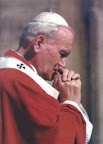
Intentions of the Holy Father for April

Ecology and Justice. That governments may foster the protection of creation and the just distribution of natural resources.
Hope for the Sick. That the Risen Lord may fill with hope the hearts of those who are being tested by pain and sickness.
Showing posts with label deadly sins. Show all posts

But Can I Be Peter?

The readings today (Third Sunday of Easter: Acts 5:27-32, 41-44; Ps 30; Rev 5:11-14; Jn 21:1-19) got me thinking on an old topic.  A few weeks ago, I asserted that I am Judas.  A friend blogger begged to differ.  LuceMichael commented:

I dunno Ryan, I'm going to have to disagree with you on this one. What Judas did was purely evil. Not just sinful, but truly and historically evil. Saying "I am Judas" is akin to reckoning ourselves as the contemporaries of Jesus who condemned Him to death, a view which VII rejects, btw.

More appropriate is a comparison to Peter, or the other apostles who abandoned Jesus in fear and denial. They sinned, turned away from doing the right thing, but in the end, were redeemed and in the case of Peter, who was exhorted by the Lord to "turn back and strengthen" the others, much good came from a flawed man. In fact, the papacy and Magisterium came from him, once he was humbled, contrite and forgiven.

There is always the philosophical and theological conundrum of whether Judas is in Hell. While none of us can say for sure, there is at least a strong likelihood that he *is* in Hell, having sold out the Lord, and taking his own life in despair of mercy.

Judas and Peter make an interesting contrast in their response to the own guilt in the passion. But most of we Christians are NOT Judas; most of us, though we sin carelessly, thoughtlessly, or maliciously and with intent, still do not come to the level of evil that Judas attained. With the grace of God, I will never completely deny Jesus. Through all my sins and faults, I know Him to be my Lord and Savior.

And He is Risen!
My major point was that my sins are the things that necessitate the death of the Messiah.  In a way, Judas was less culpable than I, perhaps, because he was more confused about who Jesus is.  I, on the other hand, know precisely who Jesus is, and yet sin and sin again.  We must be careful here, because the sin that landed Judas in hell, if that is where he is, was not treason against God, nor was it apostasy.  Those sins are forgivable (Jn 20:23).  St. Peter committed the same sins after all, though in a different way.  The sin of Judas was rejection of forgiveness, rejection of the Holy Spirit prompting him to repentence.  Judas thought that somebody like himself, someone so enormously important who had done a thing so enormously wrong, could never be forgiven.  And, in a sense, he was right.  Without repentence, there can be no forgiveness of sins (Mk 3:29; CCC 1864).

But St. Peter repented.

Her point is very well made.  Judas killed himself (Mt 27:5-8) but St. Peter repented.  In today's gospel reading, our Lord asks St. Peter three times if he loved Him as they strolled along the beach together, perhaps arms-over-shoulders.  The threefold act of love that St. Peter makes rehabilitates him after the threefold betrayal.  Note well that these acts of love, these acts of contrition, do not undo what Peter has done, but rather, they set him on a new path.  So it is with the penances that we perform after our confessions.  They actualize our repentence and put us on a new path  So how do we get to be like St. Peter, who did so many wonderful things for the Church, even dying for the sake of our blessed Lord?
 
We repent.

Face it.  We are probably not going to stop sinning any time soon - though make no mistake: in grace, it is possible, so strive for heavenly perfection.  Strive for sanctity!  But, observing our own failure, our own repeat failures, even our own egregious failures, we must not give up.  We must not go hang ourselves as Judas did, either literally or metaphorically.  Do not say of our holy religion, "This is a hard saying; who can listen to it?" (Jn 6:60) and then abandon it as those who could not stand the Eucharistic teaching of our blessed Lord (John 6:66).  Examine your conscience and pray for the grace of honesty.  So many people are afraid to confront their own sins, so they say, "Oh yeah, well the Church sucks because of X."  When we have reached our maximal efforts and failed yet again, perhaps we will then realize on a deep, deep level that it is not our own efforts that save us.  Most of us, Catholic, Protestant, Evangelical, Pentecostal, really believe deep down inside believe that we can save ourselves, that we must save ourselves, that we must prove ourselves to God.  That is all bosh.

Jesus Christ saves us.

"While we were yet sinners Christ died for us," (Rom 5:8).  He loves us even in the midst of sin.  And no matter how badly we sin, we have only to turn back, confess our sins to a priest, and receive the gift of a fresh start.  We must pray for the courage to face our sins head on, for the grace to be St. Peter.

I Am Judas

Today is Holy Thursday, the Feast of the Lord's Supper, the Solemnity of the Betrayal of Judas.  If we contemplate sin seriously, it can quickly become overwhelming.  Even venial sins - little white lies, sharp words, petty refusals of generosity or gratitude - deserve a terrible punishment because of the majesty of the Creator whose Law they offend.  The most terrible crimes, though, can only leave us unfazed if we are truly callous and hardened.  The temptation we experience all year long, I propose, is not to this sin or to that, but toward this callous failure to understand the horror of sin.  It is rooted perhaps in many foundational failures: carelessly failing to note the glory of God's creation and plan; failure to really take in the dignity of our wife, neighbor, child, coworker; failure to take our own sins as seriously as we take the sins of others.  It is upon this last point that I want to reflect more particularly for just a moment.


It is very common for us to coin new terms like stupak, which nowadays means to betray one's convictions in a self-congratulatory way and to abandon those counting on you to help them in a very important cause.  It's easy to think of the Nazi leaders as the ultimate evil, and their party members as the ultimate colluders of evil, the ultimate opportunists.  It's easy to think of this or that disgraced priest as the ultimate scandal, the most wretched of men.  It's easy for us to think of the school board's ridiculous and immoral curriculum as the ultimate lesson in degradation.

What's hard is to remember that my sins are made of the same sort of thing.  It's hard to remember that I sit silently while others mock the church or make pro-lifers out to be wackos.  It's hard to remember that I buy my food and clothing without a care or a thought toward what "causes" the manufacturers support: gay marriage, abortion, no matter - as long as I get the best ice cream or the best coffee.  It is hard to remember that I have neglected my family obligations because other opportunities were more alluring.  It's hard for me to remember that many of the movies and songs I put into my head that "don't have that effect on me" all the while corrode my heart and thinking.

This, then, is the hard work of the Christian: to remember that I am Judas.

It isn't as dramatic as it sounds.  I am going to set aside the cases of people whom I believe to be possessed outright, like Hitler.  Even in the matter of Judas Iscariot, the gospels tell us that the devil entered into him.  The gospels also show something more to the present point: Judas did not suddenly, dramatically betray our Lord.  His betrayal was the final acheivement in a string of interior desertions.  Fulton Sheen does a good job in one of his books illustrating how Judas is the apostle who never quite got it.  He got money.  That he understood.  He got the Romans.  Them he understood.  But Jesus: Judas never quite understood Him.  Many of us think that we "get" Jesus.  I, like Judas, do not understand Him nearly as well as I think.
The simple fact is that tonight is Holy Thursday.  Tonight, in some way big or small, I will almost certainly betray our blessed Lord with sin - perhaps even between confiteor and communion.  That's something like betraying with a kiss, isn't it?

I am Judas.

Can Anyone Guess?

Can anyone guess what is the problem with the views expressed in this interview?


Well, that's a trick question. Problems would better state the matter. In case you don't know, the "Rev." Mary Glasspool has recently been elected by separated "Christians" to be their second gay "bishop".  She will serve as an auxiliary in Los Angeles. (The quotation marks are deliberate, and yes, I mean exactly what they imply.)

Her last comments are what are most profoundly disturbing and revealing about what's wrong in the Anglican Communion. On the surface we seem closest to them in theology, and for years, there was a more apparent similarity that has now broken down because of the Episcopalians' acceptance of every sort of sexual aberration.

Here's what's wrong. Mary Glasspool, and many Episcopalians with her, believe that as long as we can all gather for the Eucharist and share communion together, then we are OK. It doesn't matter if we all believe different things - some accepting the Gospel, others implicitly rejecting it and trying to reshape it in their own image; it doesn't matter if some are striving to live Christian lives dependent on grace, overcoming their vices and growing in virtue - while others do whatever the hell they want and call it living in grace rather than law (the Gospel calls this lifestyle lawlessness, e.g., Acts 2:23, 2 Thess 2:8, 2 Thess 2:9, 1 Tim 1:9, 1 Pet 4:3, 2 Pet 2:8, 2 Pet 3:17).  According to Mary Glasspool, now a "bishop" of the Episcopalian "Church," none of that matters, as long as we can come together for communion.  The Latin word means "strong union," it is exactly what does not exist within the Anglican Communion, and especially within the American branch - the Episcopalian "Church".  There is no doctrinal union - union in how they see the world; nor is there moral union - union in how they live their lives.  They haven't got any communion at all, really.  And their "Eucharist" means about as much.

The Anglican Communion started off with compromise - the Bishops of England deciding to go with Henry VIII's flow.  Then, to quell internal dissent about this doctrine or that, they came up with 16 and then 39 points of agreement, written so vaguely that anyone could sign in "good conscience."  The Communion has since then seen itself as a "Via Media," a broad, middle way between "Roman" Catholicism and "Reformed" Protestantism.  They'd have the best of both worlds, they would.  Two contradictory propositions can be held at the same time by a thinker or by a Church, given enough latitude between them so they won't fight.  That's their thinking.  Implicit in that attitude, as much as in Mary Glasspool's, is that none of it is really that true, or at least, not that important.  This is the very serious deadly sin, the dreadful decay, of sloth: seeing a good (truth) and just not caring about it.  From the moment one embraces this sin, even if one likes the various Christian doctrines, one doesn't accept them as true and conform one's life to them.  Instead, one just likes them.  If we treated our knowledge of gravity with such mental laziness, we'd fall very visibly.  But we cannot see spiritual truths quite so obviously as material truths, and so it is easier to fake them.  But precisely in thinking that contrary spiritual propositions can be held simultaneously as true, they reveal what they believe: spiritual propositions aren't real.

We Catholics have something of this tendency - but it is always about matters of practice and discipline - never about faith and morals.  That is, our latitudinarian expansiveness requires celibacy for priests in the West and marriage for priests in the East.  It allows colored vestments in the Roman Rite and white ones only in the Byzantine.  We can fast from meat on Fridays, or from whatever else is suitable.  We can read this spiritual writer or that, it's all of a piece, really.  We can depict Christ on the Cross as African, Asian, or Australian.  These distinctions are based on prudential judgments and aren't really from God, but by convention.  But it's all prudential judgments based on the same faith and morals throughout the Catholic world, and those are real and they are really from God.  What we are not free to do is to insist upon celibacy for all priests or to prohibit it.  We are not free to say, "Mass on Sunday isn't obligatory."  We must not say that because we can depict Christ as whatever sort of man we like, he was no man at all.  These things are from God and to reinvent them is to fake them, to lie.

We must do the hard spiritual work of maintaining real spiritual unity, based on real love and real agreement on the real essentials of Christian faith and morals.  Far from scoffing the erosion of Christian faith in separated Christian communities, we should take a warning from the direction they take, pray for them, and extend to them a hand, an invitation to rediscover Christ and the Church that He founded.  Otherwise, we will have abandoned Christ.

How Britain Is Eating Its Young

I have decided to embed below one of the very best articles I have ever read on modern socio-economic woes, written from a macroscopic perspective. I am embedding it, because if I made it downloadable now that the original magazine has it archived and available only for purchase, I would certainly get my pants sued off - or at least be violating their copyright.

You need the Adobe Reader plugin to view this document.

The Slaughter of the Innocents Goes On...


Today, Monday 28 December 2009, is the feast of the Holy Innocents, those children slaughtered by Herod (Mt 2:16) in his demented plot to destroy the Christ Child, thereby winning the notorious distinction of being the first manifestation of anti-Christ in history.  The Church recognizes his little victims as something like martyrs, even donning red on their feast day in honor of their blood.  They did not voluntarily give their lives rather than deny Christ, yet their innocence poured out still bears witness to His.

In our times, anti-Christ has been powerfully active in many modern regimes.  The Nazis and the Soviets were both explicitly anti-Christian.  They were defeated, but we must not lull ourselves into thinking that anti-Christ was, or even that his plan was delayed.  The Evil One is crafty beyond our reckoning.  I believe that part of his plan was to discredit evil itself - he has done this by psychologizing sins into mere neuroses on the one hand, and by making us think that a plan or idea cannot be evil unless it is proposed by a short man with a funny mustachio and a German accent.  We are mistaken if we believe either of those two lies.  Sin is sin, and we are all guilty of it.  Some sins are small, and others are immense.  We must use our meager powers and whatever grace God gives us to resist it all.  We cannot compromise with it, and must realize that the Enemy always tries to sell us sin by bundling it with genuine goods, because only a lunatic would pick sin otherwise.  So intimacy and pleasure, both good, are used to sell adultery; adventure and profit, both good, are used to convince people to burgle or rob.

Now health care is being used to push abortion.  Make no mistake - unless the law specifically forbids the funding of abortion, it will be slipped in as one more entitlement.  If the developers of the health care proposals under consideration did not want abortions to be funded directly or with subsidies, they would include prohibitive provisions in their bills.  And I can think of no better way - nor can Uncle Sam - to encourage something, other than to pay for it.
Please pray for Bart Stupak (D-MI) and the group he is rousing to resist this atrocity, this holocaust to Moloch. Rumor has it that he and his group are already being brought under tremendous pressure from the highest levels.

Fellow Americans, we are capable of helping each other out without paying to kill each other's babies.  America, we can do better than abortion!

Guidelines for Fraternal Correction, pt 2

The last article discussed when to fraternally correct, and this second one will address how. As in all things, the Golden Rule (Mt 7:12; Lk 6:31) applies.

First, consider how we would react if someone, even someone we liked and who liked us, came to us arrogantly making demands and threats. It probably wouldn't go over well, and if we complied, it would be out of fear or guilt, and resentment would accompany our compliance. True?

So as a matter of sheer practicality, it is best to take the opposite approach once we've decided that someone must be fraternally corrected, and that we should be the one to do it. An attitude of humility and concern for the one corrected is key. The attitude must not be fake, nor should it be a ruse or a cover for other motivations. If we have more personal reasons for wanting a change, we should be honest with ourselves and the other about that.

To humble our heart, I have found a few reflections helpful. I try to think of ways I have contributed to the negative situation. I consider times when I have harmed the other, or done the same thing to another person that I want to challenge the correctee about. "He lives dirty dishes all over the house," should be balanced in our mind with, as applicable, "and I leave laundry in a big pile in the basement." This balanced recollection should be part of the discussion we have with our correctee. In such a situation, the correction is also a self-correction.

"Hey, dude. I've been thinking. Our house is trashed. I'm not blaming you at all - all those clothes piled in the basement are mine. I don't know how you feel about it, but I'd like to live in a tidier place. Maybe we could each resolve to straighten up our stuff in the next day or two. Would you be willing to clean up these dishes and put them away? I've definitely got to get those clothes to where they belong."

Another approach, rather than simply making a demand, "You have to stop doing X," is to show how the other's actions affect us. "Buddy, I don't think you know, but last night, I had a hard time falling asleep because of the music you were playing. I was useless at work today because I was so tired. Do you think you might be able to turn it down on weeknights, to help me out?" By temporarily abandoning the language of rights and justice, and simply sharing our heart and mind with our brother, we will often move him to compassion and sensitivity, building our community. If that doesn't work, then we may need to take stronger action, but usually easy does it, and a mild approach is more effective.

In cases where there are wrongs done in both directions, we must be willing to take responsibility and apologize for our share of the hurt. The killer thing about being a Christian, and the nature of a sincere apology, is that both are free. That is, we Christians make our apologies for our sins without regard to any sort of recompense. We apologize for our faults as they negatively impact others because that is the right thing to do, the thing that reflects our true role in the situation. It is not our concern whether the other accepts our apology or responds in kind. Often, he will not. He will feel he is righteous and that our apology has vindicated him and proven that aching spot in his conscience to be wrong. So be it. It may often be that, for the sake of doing the right thing, we must tolerate harm done to us or a justice left undone. I apologize to try to make amends, and he responds arrogantly. I cannot affect his response. I only know that I have at last done the right thing; any harm that comes to me as a result, even a mild one, is a harm that makes me more like Jesus. And that is a very good kind of harm to endure.

Guidelines for Fraternal Correction, pt 1

I learned about the concept of fraternal correction for the first time in the seminary. The concept is simple. When one has a complaint or problem with another, and neither has authority over the other, the one with the complaint shares it with the other in an attempt to correct him or the situation as a whole.

In another post I will babble on about how to do a fraternal correction. The spiritual director gave us guidelines for the how. For now, I will discuss briefly the why and when. These come from my own observation. Take them for what they are worth.

Fraternal correction is important in the life of a community because it prevents a grievance from festering. By providing a healthy outlet for problems, it reduces the temptation to the divisive and diabolic sin of gossip. Make no mistake about it: gossip destroys the life of a community and comes straight from hell. The Greek word for gossip, or slander, is diabolos. There is a good test for whether "sharing" is "healthy venting to a third party," "seeking outside advice," or whether it is actually vicious gossip. The test is to consider our willingness or eagerness to relate the events only to persons who know nothing of the situation or the individuals involved, and to leave out all identifying characteristics. If we are just itching to say someone's name, we are almost certainly about to engage in malignant gossip. Don't. Now, back on track.

Fraternal correction encourages proactivity and ownership on the part of the members of the community, rather than passively waiting around for someone else, someone in authority to solve every interpersonal tension. Fraternal correction should be a skill in the repertoire of every grown man and woman.

When should we fraternally correct? I mean, if we all run around venting all of our grievances all the time, without ever being judicious and careful in doing so, we will almost certainly tear everyone around us down, and ourselves too, and end up friendless. Sensing this possibility, I came up with these criteria for a correction. All three criteria being met fully, I proceed with my intended correction.

#1. I must like the person whom I am considering correcting. Love isn't good enough a criterion because we Christians are supposed to love everyone, and boy, do we. Lol. We fool ourselves too easily on this point. But if I actually like the person and feel warmth and affection toward him, then I can be confident that my motives are pure enough, that I am doing it at least partly for his own good and not my own weird, selfish motivations.

#2. My complaint must be graver than my ability to endure. If it is a petty thing that I can deal with on my own, then I do. The expression, "suck it up," comes to mind. If what the person is doing is an objective wrong against me and is making hard for me to avoid doing wrong to him, then I should bring it to him in correction. If my brother is doing something that will lead him or others to real harm, then I should bring it to him. If my brother chews with his mouth open and it disgusts me, but doesn't actually harm me or immediately lead me to sin against him seriously, then I should chill out a bit. At this point, I need to be careful there is nothing I can do to let go of the problem: work through my own issues, reprioritize my values (close friendship over mere table manners, etc).

#3. I should be reasonably confident that he will heed my concern. We listen most to peers whom we know to care about us and to like us. The more serious the matter, the more personal or painful, the more confident we must be that the person confronting us is doing so out of love. There are extremes, though. I cannot wait until I am absolutely sure that someone will listen to me, when I am concerned that he is suicidal, or that someone under his care is in harm's way. At times we must discharge our conscience and let the chips fall where they may. The more grave the concern, the less confident I need to be and the more willing I should be to go out on a limb.

These three criteria are those I came up with. It would be great to receive feedback and correction from a brother or sister on the matter. In part two I will outline the procedure for correction that the spiritual director laid out before us at the seminary.

Signs of the Times

It is not terribly shocking to hear that Fr. Alberto Cutié has decided to defect from the Catholic Church, and go to one (the Episcopal - that is, Anglican-in-America) in which things will be more to his liking. For one, they don't mind his inability or lack of ongoing commitment to celibacy. Fair enough - they don't require or esteem celibacy in the first place. More intriguing is the fact that they don't mind that he is an oath-breaker. He made solemn promises of obedience and celibacy, and now has unilaterally dodged them both in one fell swoop. They don't suit him anymore. One would think that Fr. Cutié's new superior would at least want to be sure that he can stick to a vow, no?

Well, it's perhaps fitting, after all. After all, the Anglican Communion was founded when an oath-breaking king became tired of his promises regarding sexuality, and decided to put away his first wife for another. And another. And another. One wonders how many churches Fr. Cutié will put away to suit his evolving tastes before the whole thing is done. It's a little known fact that England and her kings were legal vassals (governmental subordinates) of the Pope until Henry VIII broke his forefathers' faith. In most of Europe, the Pope could take up special collections and so forth; in England, he could collect taxes and call for soldiers. Henry VIII would rather have things his own way, though, rather than honoring the promises of his fathers. Now that Fr. Cutié has broken with Rome, one must wonder if he will really let himself be governed by another master, or if he will be his own... if perhaps he is already his own master. That's the devil's motto, in Milton's Paradise Lost: "I will not serve." That and his television show frankly smack of a towering pride.

Meanwhile, our President has named an ambassador to the Holy See: Miguel Diaz. He is Catholic, in the way that the Sandinistas are. He is "pro-Life," in the way that Douglas Kmiec and the President are. He publishes on presses that call themselves Catholic but are either notorious for dissent, uncommitted to the teachings of the Church, or flat out deny the entirety of Christian revelation. Like Fr. Cutié and the President, he is young, good looking, smooth, and charismatic. He has a track record of supporting social justice issues for the poor and weak (except for, as one commentator has pointed out, the poorest and weakest, i.e., the unborn). He is suave and probably very convincing, and will probably be charged by the White House with getting the Vatican to believe that white is black and black is white, that good is evil, and evil good.

And against these slicksters, whom can Holy Church send forth, tattered and bruised by her own conduct as much as by that of her enemies? The likes of this man:

Now, don't get me wrong. Archbishop Favalora of Miami is likely a very competent administrator, strong shepherd, and loving father. He has enormous responsibilities of which, dear reader, you and I cannot even dream. I wouldn't criticize a bishop to save my life, I hope. I used to, but I'm done with that. It just helps out our enemies. And His Excellency's words regarding Fr. Cutié strike me as very well chosen. Still, looking at him and hearing his words will not be very convincing to most Americans - Catholic or otherwise - when the likes of Fr. Cutié or Prof. Diaz is sitting on the opposite side of the talk-show host. The Archbishop certainly has authority over both them (well, over Diaz only indirectly, since Diaz doesn't live in his diocese), and his reasoning is doubtless sounder than that of Cutié. All the same, I have a sickening feeling in my gut that many, many of the priest's fans, preferring to have their ears tickled, will choose him over Jesus' plump, wrinkly old vicar in Miami.

"For the time is coming when people will not endure sound teaching, but having itching ears they will accumulate for themselves teachers to suit their own likings, and will turn away from listening to the truth and wander into myths," 2 Tim 4:3-4.

A close friend of mine is being ordained a priest this weekend in Burlington, Vermont. Several more friends from my time in seminary will be ordained priests and (transitional) deacons in the next few weeks. They are young. Some are more charming and charismatic than others, but they are all very good men and that shines through. They believe in Jesus. They love and obey his Church. They defend life. I couldn't close without pointing out a few stars amid the dark night sky.

AIDS Worker Says Africans Don't Need Condoms

I just picked up on this awesome article in Zenit's newsfeed from last week. Thanks to Dara for posting it herself.

I've heard the AIDS worker from Meeting Point Kampala speak. Her name is Rose Busingye and she is a part of the Communion and Liberation movement. She is amazing, and so is the work of Meeting Point. These people know what they are talking about. It is a little reported fact that of all African countries, Uganda, with its Christianity-friendly government, has led the way in reducing the spread of HIV/AIDS. In fact, in Uganda, the disease has been brought almost to a standstill, not by condoms or other prophylactic measures, but by chastity-related education.

Stupid Pharisees

The Gospel reading for today (Wed after V Sunday in Lent: Dn 3:14-20, 91-92, 95, Daniel 3:52, 53, 54, 55, 56, Jn 8:31-42) is among my favorite passages. Jesus' discourses have caused many to come to believe in Him (Jn 8:30). He adds to those who have started coming to faith, "If you remain in my word, you will truly be my disciples,and you will know the truth, and the truth will set you free," (Jn 8:31). But at these last words, his hearers choke.

"WHAT?!" they demand, "We're not SLAVES! We're sons of Abraham! How can you call us slaves?" (Well, that's my paraphrasing. It actually says, They answered him, "We are descendants of Abraham and have never been enslaved to anyone. How can you say, 'You will become free'?" Jn 8:32).

This snippet of their exchange needs years of delving. Let's try something brief though. The descendants of Abraham, just three generations after Abraham, went to Egypt for help during a famine, and got ensnared in the Egyptians' social structure and were pushed into a slave class. They escaped under Moses' leadership after 400 or so years of oppression. After settling in back home, they repeatedly came under the domination of neighboring civilizations, most notably the Philistines. They were only able to escape that domination by taking for themselves a king, against God's expressed preference on the grounds that their kings would come to dominate them as well. That's what happened, in fact - one king more domineering and harsh than the last. It culminated in the sacking of the northern half of Israel by Assyria, and the southern by Babylon, so that half the Israelites were hauled off into captivity in those kingdoms, and the remainder lived as subjects of them in their own homes. When Persia conquered Babylon, the Israelites there were "freed" to go home and live as obedient vassals of Persia. Then Alexander the Great came through and conquered the place, and the Seleucid and Ptolemaic dynasties of Greek rulers that came after him began to treat the Jews more and more brutally. The Jews were finally able to get the Greeks off their backs by enlisting the Romans to come in and help. Only, the Romans never left, and it is under their oppression that the Jews labored in the time of our Lord.

It is purely self-righteous stupidity, defensive unto blindness, that lead Jesus' listeners to cry, "We have never been enslaved to anyone." It would have been better if they had asked, "When have we NOT been enslaved to someone?!"

Interestingly, Jesus brushes all this political oppression aside and makes it clear that He means a much more universal sort of slavery: spiritual slavery caused by sin: "everyone who commits sin is a slave of sin," (Jn 8:34). That's a funny thing for us to hear. In fact, it probably bounces off most people's ears as one of those things that Jesus said that doesn't really make sense (anymore?). That's because we have a warped understanding of freedom that essentially says, "Freedom is being permitted to do whatever you want." So a law against using marijuana makes us less free, most Americans would agree, and it is only a question of which freedoms are good or bad.

The traditional Christian understanding of freedom is much more comprehensible to a recovering cocaine addict than to the typical American. I'm not being smart here, but very serious. I, who have never used a narcotic, am free of their power. I can choose to use a drug, or can abstain. It's all the same to me. Not so with someone in the throes of a deadly addiction, though. A chronic drunk cannot choose to abstain from alcohol - at least not for long. He is a slave to booze in a way that most people are not. After we sin, we either repent of the sin, or else rationalize it, make excuses for it, and thereby begin to incorporate it into the structure of our life. Slowly but surely we become dependent on it and cannot imagine life without it, and the thought of breaking with it becomes repugnant. Whether it is telling lies, looking down on people, using narcotics, fornicating - whatever - we begin to defend it as if it were part of ourself. It becomes first part of our lifestyle, then part of ourselves. This addictive quality of sin is what our Lord is getting at.

Jesus makes an offer, though. He says that slaves don't really have a place in the household, and will be tossed out eventually. But a son has a place, and if a son of the household frees the slave, they can have a shot at freedom, and even getting to be part of the family. This reference might be to household slaves, especially nannies, tutors, physicians, who might be freed and adopted by the family. He is hinting that the Jews could lose their place in God's household if they don't take up his offer of freedom from sin - just being a physical child of Abraham isn't enough (Jn 8:39-40).

Now the listeners, who were friendly at first to his message, but when it was clarified for them became hostile, set up a precedent followed by heretics ever since. Heretics are those in the Church who rebel against her teachings. When Jesus questions the usefulness of their bloodline, the unhappy hearers growled, "We were not born of fornication. We have one Father, God," (Jn 8:41). From that time onward, heretics have always taken shots at Mary. By defending the social legitimacy of their birth, which had not been questioned, they are calling Mary a fornicator, and Jesus her bastard. Them's fightin' words.

As the story continues, after the conclusion of the passage read in church today, Jesus basically says, "If you were from God, you'd recognize me..." and then, "You are of your father the devil, and your will is to do your father's desires. He was a murderer from the beginning, and has nothing to do with the truth, because there is no truth in him. When he lies, he speaks according to his own nature, for he is a liar and the father of lies," (Jn 8:44).

So it is to this day. Heretics the world over, throughout history, in their self-righteous pride, have opposed their teacher, the Body of Christ on earth, and have as a rule found a bone to pick with His Mother, as well. Consequently they stay bound in innumerable sins - first and foremost, pride. They've got entirely the wrong attitude. If we can humble ourselves to the teachings of Christ, He will set us free from all manner of sins, addictions, and oppressors.

Ashes: The Christian in Lent

Ok, so I am going to try, briefly, to tie a few things together.

1. Every Christian is by baptism a priest, prophet, and king (or queen, as the case may be). That includes every man, woman, and child who has been claimed by Christ under those regenerating waters. What does this mean, though? I am going to strip away the rhetoric for once and (try to) get to the point.

1A. Christ is the Great High Priest, the Great Prophet, and the King of All Creation. In baptism, we are united with Him and become part of Him, and adopted brothers of His, and adopted sons and daughters of the Living God with whom He is One, and we through Him.

1B. A priest, fundamentally, is one who makes intercession to God and offers sacrifices to Him on behalf of the people, and gives to the people God's blessings. Every Christian is called to be a man or woman of prayer, especially for others, and of sacrifice, especially of our own bodies and wills. We offer these prayers and sacrifices, in imitation of Christ, on behalf of ourselves, our loved ones, and the world. Ordained priests serve this role in a particularly acute, sacramental way within the Church, and the whole Church (that's all the baptized!) serves this role within the world in a less crystalized, more day-to-day way.

1C. A prophet, fundamentally, is not one who tells the future (though he might), but one who speaks for God - "pro-pheme" in Greek, a "speaks-for." Christ came as the final, fullest revelation of God's love for us. In His own flesh, He (God) manifests His desire to be with us intimate in bodily union, a union accomplished first in baptism and then most perfectly in Eucharistic Communion. Jesus' very existence makes this will of God clear to us. His words announced what He and His Father are about. We Christians, sharing in the mission of our Master, our Friend (John 15:12-17, esp., 15:15), also must speak God's word. We must put priority on living it out though. We cannot wait to live it perfectly before we speak it, or else we'll never speak it. But the emphasis in our lives must be on prayerfully hearing God, digesting and living His voice, and then amplifying it to the world in our own deeds and words.

1D. A king (or queen), fundamentally, is not one who bosses around and tyrannizes, but one who has been given authority by God to make a patch of the world more like the Kingdom of Heaven. That's all of us. We all have a patch of the world over which we have influence or even authority: our homes, friends, work environments, students, neighborhoods - all of these to varying extents are within our reach, as it were. We are, like Jesus, to use what the Father has given us to make our area more like God would have it be. We are to use our abilities, influence, and authority firstly for service - never for lordliness (Mt 20:20-28). We are to heal hearts, serve the weak and poor, right wrongs, salvage relationships, make good use of resources - all to make the world more like the Kingdom.

1E. These three dimensions of Christ's life and of our life in Christ are called the Triple Munera, the Three Offices/Duties/Functions of Christ. The Church, His Mystical Body, shares in them - our ordained clergy firstly and in a particular, sacramental and directing-leadership sort of way - and all the rest of us in a general and raw-horsepower sort of way.

2. We have just begun Lent. During Lent we are commended to remember our sinfulness and God's mercy in a particularly acute way in order to prepare for the remembrance of the Passion, Death, and Resurrection of our blessed Lord. The Church has three ways of life that are now more than ever to be lived out with diligence - prayer, fasting, and almsgiving.

2A. Prayer is time spent opening our heart and lifting it toward union with God. It might be while we do something else, but like everything else, if we want to really get good at it (like all communication, it takes practice) we need to set aside time for it daily. Lent is an especially good time to adapt some new prayer discipline - a daily rosary or morning offering, weekly Stations of the Cross, something. Prayer is especially important for living our our priestly office, but also for our prophetic office, and even for our royal office. After all, if we are to govern as God would have us, we had better be listening to Him.

2B. Fasting is, broadly speaking, abstaining from some food, drink, (or other other pleasure) or food and drink in general. The Church's rule is minimal: on Ash Wednesday and Good Friday we must carry out a simple fast, which means we take no meat, only one full meal, and up to two other meals that combined are smaller than a meal, without any snacking in between. Only those who have reached adulthood and haven't yet reached old age are required to fast. Everyone else merely abstains from meat, and everyone abstains from meat on Fridays in Lent. Really, the Church encourages us to abstain from meat on all Fridays, or to do some other sacrifice instead. During Lent, we pick an additional Lenten abstinence or fast that can hopefully be a sacrifice we continue in altered form after Lent, something that will change our lives for the better, for the godlier. Fasting is especially important to the prophetic office because one who preaches the Word of God had better feed on it, and remember that it is his primary food (Mt 4:3-4). Because priests offer sacrifice, a sacrifice of our time and even of our own bodily needs and desires, is perhaps the most concrete way to sacrifice our will to God. But good kings also sacrifice to God because they know that they are not the real top-dog, but that God is.

2C. Almsgiving is giving to the poor. It should be a near daily way of life for Christians, something we plan into our budget and not just something we do if we have anything left over (who really ever does?). Living a Christian life, or working for the Church, is not a substitute for generosity to her poorest children. I used to work for the Church and was given a small salary, and did not give to the poor very much. I am very embarrassed of that now. I might have given something. I earn less now, because I am studying full time, but give a lot more than I did then (it is still not much, lol). Even homeless people can give a bit of change. At least I know now that I am doing what I can to support the Church (the tithe) and care for those in need (almsgiving, properly speaking). Almsgiving is especially important to our royal office as Christians because as Christian king-lets and queen-lets, we are not to lord our Christianity over others ("See how holy I am!") but to serve them. The neediest first. Almsgiving keeps us oriented in that direction.

2D. As per Matthew 6, we are not supposed to do these things SO THAT others can see them. But as per Matthew 5, we are also supposed to be a good example to glorify God by our good deeds. How do we reconcile these two things? We should do our good deeds as part of our ongoing interior conversion. The quieter the better, generally speaking. If, for the sake of another, it is useful to the other that he should know of a good deed of ours, then we may allow him to know. And we need not be ashamed of our good deeds, either, especially when we are doing them as part of a group activity of the Church, as part of a public gesture of the People of God. If you are as vainglorious as I am, then it is probably best to keep your personal good deeds as private, tucked inside your vest when possible. The whole idea is to lose ourselves a bit in the heart of God and in the needs of the world.

2E. For each of our disciplines of prayer, fasting, and almsgiving, we should pick something that fulfills all four of the criteria that follow:


  1. It should be difficult. A challenge, people. Lent is not supposed to be easy, but a reminder of our weakness.


  2. It should be doable. Lent is not setting us up for failure, but setting us up to remember that we need God.


  3. It should be permissible. We must not do anything contrary to our real duties. A student cannot give up homework for Lent. Nice try, kids.


  4. It must be good. We can commit to going to Mass on Wednesday evenings. We can commit to giving up sweets. Mass is a good thing. Sweets are good things. We are supposed to be giving Jesus good gifts, whether we give him prayers or sacrifices or acts of love to his poor brethren. We must not give up fornicating. Fornicating is bad. We should have given that up ANYWAY. Although, frankly, I suppose Lent is a good time to do so if you haven't already. But give up sweets, too.
2F. And don't forget to go to confession before Easter. It is the solemn duty of a Christian to so. In fact, we call (confession) + (receiving holy communion during the Easter season) our "Easter duty," or the "Easter obligation." By secretly confessing our sins, we loudly proclaim not only our sinfulness (our true, current condition) but also the Lordship of Jesus. It's the only time of year that we are required to go to communion in order to maintain our communion with the Church. And to do so, we should prepare by going to confession. Especially if we haven't been in a while. If it kinda hurts, or you can think of ten reasons not to go, or you are scared - that's all pride and fear waging a spiritual warfare in your head to keep you from God. Don't listen. Just go to the priest and receive Jesus' mercy like the Bible tells us to (James 5:16 and John 20:23). You won't regret it.

Happy Lent!

Losing Your Life

Before I put up posts on the priesthood, prophecy, and kingship of the Christian lay faithful, I have a brief observation to make.

"For whoever would save his life will lose it, and whoever loses his life for my sake will find it. For what will it profit a man, if he gains the whole world and forfeits his life? Or what shall a man give in return for his life?" (Mt 16:25-26).

Many people may prance through life happily doping themselves up and dodging reality. They might try to do things their own way, and then find diversions and medications to cover up the pain - TV, sex, drugs, exercise, career, whatever. But we Christians do not have that option. We will either give up Christ's way or give up our own way. We can try to play it both ways, to serve both God and Mammon, but we will end up hating one or the other (Mt 6:24). Something has to give way, and if we continue to serve Christ, but have a hard time dying to ourselves, then Christ will kill us.

That sounds horrible, but I mean it, though not as it might sound. What I mean is that as we cling to him, he will will continue to work on us, to cut out the sick and cancerous parts of our souls. If we are recalcitrant and backslide, it will take longer to die to ourselves, but as long as we keep clinging to Christ, He will keep killing us, peeling away the things that we use to hide from Him, to hide from reality.

When we have finished dying to ourselves, or maybe even as we learn to die to ourselves (oh God, bring it sooner), a new sort of Life begins to grow in us. That Life is Christ in us, the engine (if you will) by which we are propelled into an eternity of joy. But the old way of living has got to die first.

Most of the Evil in the World

It occurs to me that most of the evil in the world is not mass-murdering and other "sociopathic" behavior. It's little things that we minimize or rationalize: corner-cutting, white lies that aren't so white, fierce tempers indulged and left unchecked. Of course, there are bigger "little" sins, "little" only because socially acceptable in moderation: fornication, petty embezzlement, misrepresentation of oneself, etc. These sins only become socially unacceptable in gross quantity or grotesque manifestations: prostitution, multimillion dollar graft, defrauding droves of workers of their retirement funds, etc. These bigger sins, it should be obvious, have littler sins as their stepping stones, and often times are no more than conglomerations, sum totals of "little sins." After all, Enron executives didn't swindle anybody in one fell stroke, but by a thousand signatures on little documents that few people bothered to read.

When we read of these "bigger" sins in the newspapers, we run the risk of self-righteousness because we would "never do such a thing," we think. We fail to realize that those big sins aren't the sins of bigger sinners than ourselves, but only of slobs like ourselves with bigger opportunities to sin. In self-righteousness we also fail to realize that the seeds of sin, fully sprouted and flowering in another, are also planted in our soul. "So-and-so cheated on his wife. What a creep!" we think. Oh, really? Our Blessed Lord said, "You have heard that it was said, `You shall not commit adultery.' But I say to you that every one who looks at a woman lustfully has already committed adultery with her in his heart," (Mt 5:27-28). Many of the sins we blame in others, we care about in our own heart.

Beware of "little" sins.

I Don't Normally Get Political...

But does anyone else think that a multi-gajillion (that's 700 with about a billion zeros following it) dollar bail-out right now is a bad idea? I mean, we've already floated $10,000,000,000,000 in debt in the last 8 years. That's ten trillion dollars, if you lost track of the zeros. No joke. That's $33,500 per man, woman, and child - citizen, visitor, undocumented migrant in the entire USA in debt in the last 8 years. About 70% of it is owed to Chinese interests, I believe. Now, who still thinks a bail-out right now is very smart? Maybe I'm being too conservative or old-fashioned. I mean, what's another trillion or so dollars borrowed from our bossom buddies? I mean, I've got an extra $33,500 laying around to pay off what we already owe - don't you? And so do each of our children, or retirees, and our well-paid guest workers.

At the very least, does anybody else think that some personal responsibility is called for?

Now, we don't want our economy to tank (by objective standards left unreported, it is not doing badly at all, and certainly not in a recession). And we certainly don't want to see lots of new homeless. Perhaps a solution this mess might be something like:

1) Defaulted adjustible-rate mortgage (ARM) loans are legally cancelled and their collateral (the house) is reclaimed by the lending institution, which then has no further recourse against the borrower.

2) Banks get the houses, but will receive no further money, so should not auction them too cheaply. What they do with the houses (probably auction them) is their business.

3) Dispossessed (and presumably bankrupt) borrowers are given, as a one-time gift, a voucher for two months' rent (a LOT cheaper than bailing out the mortgage industry) so they have some time to get their lives in order without being homeless.

4) Laws prohibiting the current nonsense, repealed in the 1990s and 2000s, are restored with criminal penalties attached to irresponsible lending. Whatever laws (still) exist that could possibly be applied to land as many of these yahoos in jail as possible, for as long as possible, would be well applied right NOW.

---

Of course, all these steps are intermediate steps to a more permanent solution. I actually stand with the consensus among the world's traditional ethical systems (including the Jewish and Christian) in holding that lending at interest is immoral. Not just high interest, but at any interest. Investing with a share of the risk and profit is perfectly alright, but to expect money to grow on trees (that is, to give someone money, and without working for it, or knowing what they are going to do with it, expect more to be given back - NO MATTER WHAT) is ludicrous. They are looking for something for nothing. The whole present problem is caused by greed - the greed of investors, of bankers, and of potential home-buyers. We are seeing some fallout from that; how many bailouts before we recognize that the massive industry exploiting usury is just flat-out stupid. With the exception of a house (which is very expensive, and also a very solid investment, generally) - if you cannot afford it, you do not need it, and you shouldn't take out a loan for it.

---

If I've offended anybody out there, or hurt their feelings, GOOD. STOP being stupid and greedy and indebting us all to the Chinese! If you're a friend of mine, it's not personal, really. You still need to stop getting us all into messes, though, even if I like you a lot. This is serious.

If you have been living irresponsibly with respect to finances, and I did for most of a decade, and got into and only recently out of a LOT of debt, I cannot recommend the following link highly enough. Dave Ramsey makes his living teaching people sound principles of personal finance. No get-rich-quick schemes here, but just learning how to work hard, save your money well, and retire comfortably with your responsibilities met. But I warn you, it is a real call to conversion that Dave sells. Back in the springtime, I went through his 13-week program (for a whopping $95) and it changed my life.

Bittersweet Memory

Yesterday I had struggled with bitterness. Then last night while I was running, I recalled that I had felt bitterly, and noticed that I no longer did. God had answered my prayer and lifted, gradually or at some unnoticed point in the day, the bitterness that had been choking my heart. Observing that fact was a pleasant sensation. So here is what I learned in that experience: feeling bitter tastes, as it were, bitter; but the memory of having felt bitter, coupled with the observation that one no longer so feels, is something sweet.

Remote Control America


My cool liberal agnostic coworker and I had a conversation this morning that distills something like this:

I told him how an acquaintance once told me that his life was very complicated, and consequently that he wanted his religion to be very simple, and that was why he was an Evangelical rather than a Catholic. I replied immediately that because I wanted my religious philosophy to be able to address my complicated life, I had to expect a certain degree of complexity in it.

My coworker, upon hearing this little anecdote said that he sensed America's pragmatism has veered into a sort of simplemindedness. It is as if we have started off by saying that we must keep our eye on the bottom-line; after a while, we began to say that the bottom-line was the most important thing; then we got to saying that the bottom-line was the only thing. Now at last we come to the point where we can't be bothered to do the math, but want the bottom-line read to us.

This pragmatism, perhaps after combination with a sense of entitlement, or with the sloth-induced stupor brought on by excess national wealth, seems to have degraded into a certain intellectual laziness. My thought is that this interior movement is articulated most frequently in the whine, "Can't you just pass me the remote control?" It makes you wonder how easy we must be to manipulate and gently control as long our first concern is not having to get up off the couch. If that doesn't work, a powerful dose of distractions, busyness, and nebulous fears should do the trick.

The Culture of Me

This from the Washington Post (http://www.washingtonpost.com/wp-dyn/content/article/2008/02/28/AR2008022803315.html?hpid=smartliving&sid=ST2008022901519)

Me
If It's All About You, You're in Trouble. Why a Sense of Entitlement Can Wreak Havoc on Happiness.

By Dan ZakWashington Post Staff Writer
Sunday, March 2, 2008; Page N01

Broad pronouncement of the week: We are entitled brats.

For immediate proof, turn on the television. Locate a reality show on Bravo or MTV. The "Real Housewives of Orange County" and their real children are halfway through a marathon of placating and whining. "The Hills" and "Newport Harbor" are stocked with people who expect to be treated with a disproportionate amount of respect, lest they erupt in a raging meltdown.
We watch these shows in horror, with a judgmental eye on their cast members, but how different are we from them? In real life, we want what we want and we want it now. No delay. No aggravation. No hassle, pain-free, our way, right away. We're a highly technical society in a land of plenty. We place a premium on efficiency and convenience. Tiny annoyances and inconveniences foul our moods and affect our behaviors. Why? And how can we get past these trivialities?

Consider this paradox: Things are becoming more instantaneous in an era when delays are rampant and increasing. There are faster flights and cars but more people in airplanes and on the roads.

What has happened, even though companies are improving service, is that "customer expectations are continuing to rise," says Roger Nunley, managing director of the Customer Care Institute in Atlanta. This can be attributed to "consumers doing business online, where they get instant gratification and quick turnarounds. That's quickly becoming the standard expectation."
Change in expectations is a generational thing, experts say. People who grew up during the Depression were happy to have a job and stuck with one for a lifetime. Many members of generations X and Y were raised in a different light. They expect a buffet of opportunities and are peeved when they don't materialize.

Narcissism and entitlement among college students have increased steadily since 1979, according to a study to be published this year in the Journal of Personality. Between that year and 2006, 16,000 college students were asked to pick between such paired statements as "I expect a great deal from other people" and "I like to do things for other people," and "I will never be satisfied until I get all that I deserve" and "I will take my satisfactions as they come."
The data are clear: The ascent of narcissism and entitlement is dramatic.

"What we really have is a culture that has increasingly emphasized feeling good about yourself and favoring the individual over the group," says the study's co-author, Jean Twenge, a professor of psychology at San Diego State University. "And that has happened across the board, culturally, and it's showing no signs of slowing down."

To complement her research, Twenge offers evidence from the field: "I have a 14-month-old daughter, and the clothing available to her has 'little princess,' or 'I'm the boss,' or 'spoiled rotten' written on it. This is what we're dressing our babies in."

Schools have programs designed to boost self-esteem. Parents say things like, "You shouldn't care what other people think of you." We're inundated with the notions of "feeling special," "believing in yourself" and "be anything you want to be." Twenge ponders all these messages in her book "Generation Me: Why Today's Young Americans Are More Confident, Assertive, Entitled -- and More Miserable Than Ever Before" (Free Press, 2006).

Quite a title, but doesn't it feel kind of right? Twenge also coins the term "iGeneration" ("i" as in both iPod and "me, me, me"), which includes those of us born in the general range of 1981 to 1999.

This goes beyond social conditioning and technology, though. Entitlement is something that's part of human narcissism. It's an ego thing that transcends generations. When something goes wrong for others, it's their fault. When something goes wrong for us, it's not ours; it's the fault of external forces. We project blame.

This projection often antagonizes a situation. Feeling entitled to something you aren't getting leads to frustration, which leads to bratty behavior and confrontation. Nearly 80 percent of Americans say rudeness -- particularly behind the wheel, on cellphones and in customer service -- should be regarded as a serious national problem, according to a study by the opinion research firm Public Agenda.

An airport is a petri dish for rude behavior: a bunch of people in close quarters under time constraints. Stress and impatience lay down the welcome mat for brattiness.
"You have people screaming at customer representatives at airports because it's snowing out -- as if they're entitled to have a sunny day," says professor W. Keith Campbell, who specializes in the study of narcissism at the University of Georgia. "That's where it gets out of hand. With entitlement, the issue is, yeah, there are certain times where we're entitled and other times we're not. The problem is when we have that meter wrong."

It's unreasonable to spend an hour on hold, in other words, but there are situations when basic entitlement turns into self-infatuation and blatant disrespect for others. All of this is tied to the feeling of not being satisfied, of thinking that some force is blocking the way to a goal we think we deserve.

"The question is, 'What the heck is enough?' " says writer and psychologist Carl Pickhardt, who specializes in parenting and child development in his private practice in Austin. "I see that all the time. A couple comes in for marriage counseling, and they ask me, 'Are we happy enough?' Somebody's at a job they like, but are they successful enough? People have to make that choice. We are a dissatisfaction market society. Advertising constantly creates the notion that whatever we have is not enough. We can declare independence of that."

But how? It's about realigning our expectations and then squelching the nagging voice in our minds that propels our discontent. Pennsylvania psychologist Pauline Wallin calls this voice our "inner brat," which is an evil twin to our "inner child." After years of counseling clients who routinely made mountains out of molehills, Wallin dived into the concept, named it and produced the book "Taming Your Inner Brat: A Guide for Transforming Self-Defeating Behavior" (Wildcat Canyon Press, 2004).

"We have enough big things to be upset about, and people are losing their minds over small things," she says. "Frustration leads to aggression. If you don't let yourself get frustrated in the first place, then you don't get so angry and you don't blow things out of proportion."
Stress also fuels bratty behavior. It makes us impatient and irritable from the get-go. Psychologist Ronald Nathan of Albany, N.Y., recommends practicing relaxation techniques when waiting for such things as the Metro, the doctor or tech support. This turns a disadvantage (the frustration of waiting) into an advantage (making good use of that time to relax).

"Whether you are tempted to interrupt someone or are trying to get around a slow car -- when you're under stress you tend to react rather than respond," says Nathan, who specializes in stress. "Look at what you're telling yourself about your world and how you are interpreting it. We sometimes interpret the world as a set of 'shoulds,' 'oughts,' 'have to's,' 'musts,' 'deserves.' Those are exaggerations. It's a very competitive world we live in, so we easily get frustrated."
Nathan has trademarked a technique for stress relief that has a time-release formula ( http://www.relaxfastforfree.com). It involves setting some kind of unobtrusive alarm -- the vibrate function on your cellphone, for example -- to remind you to take several minutes to do some deep belly breathing and loosen your muscles and limbs. After several months of conditioning yourself to do this at certain times of the day, this kind of reframing of the mind can become automatic.

Another habit to form is being grateful. Clinical experiments show that people who express gratitude in some form every day live more-content lives, and they record lower levels of narcissism and entitlement.

"On the drive home from work, it's a matter of turning the radio off and thinking about how wonderful your job is or, if your job sucks, how wonderful your family is or, if your family's in shambles, how good your health is," says psychology professor Mike McCullough, who studies gratitude at the University of Miami.

He helped conduct one experiment titled "Counting Blessings Versus Burdens," wherein one group kept a journal of their daily hassles for a period of time while another recorded the times they were grateful. The outcome may be obvious, but it is no less instructive: People who concentrated on hassles were generally miserable; the others were pleased and satisfied.
It comes down to perspective and expectations. Do you want empty highways, no lines, a promotion and limousine conveyance to your birthday party? Fine. But don't expect them. Focus on your reliable car, your good health, your job stability or the fact that you're in a position to celebrate a birthday at all.

"When you're feeling this sense of deprivation or entitlement, try to take the longer view," McCullough urges. "Ask yourself, 'Is it really true -- empirically true -- that you are entitled to something?' In most cases, people say no."

Gluttony and Impurity

"Gluttony is the vanguard of impurity," The Way, #126.

Fundamentally, gluttony is about satisfying all our desires, particularly for food, drink, comforts, and the finer things of life. Indulging our cravings for these things without restraint makes us weak, soft, and self-centered. Our hearts become mixed and cluttered with all sorts of desires that will sidetrack us from following God. Gradually, our minds and hearts confuse even people with property, with what is ours to please us. We begin to use others, even in the most perverse ways. What is lust but the extension of the gluttony principle to include persons, treating persons as mere things to satisfy our desires?