
Blessed Are You Who Mourn
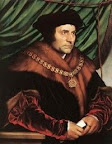
I've been reading a very good life of St. Thomas More, James Monti's The King's Good Servant, But God's First. It is a critical collection of previous biographies and manuscripts, with any number of citations to the writings of St. Thomas More, especially of his correspondence with Erasmus of Rotterdam, a longtime friend of More's. The book does an excellent job of contextualizing the life of St. Thomas More, and of drawing reasonable inferences about the saint's habits and thought based on known premises and the saint's own writings. It also delves considerably into the spiritual life of the saint, and his manners and the conduct of his household. A very good read.
It is relevant under this title because it seems to me that St. Thomas More was one who mourned. Dietrich von Hildrand, in his very excellent book, Transformation in Christ, lays out some of the principle significances of mourning. Essentially, they boil down to feeling a sort of gap. The world, though redeemed by Christ, is still in process. There is a rift between what creation once was and will eventually be again (on the one hand), and (on the other) what it is now. We travel from Eden to Eternity, not as mere wanderers, but as exiles. We feel this most acutely at times of tragedy. "Right, mom's gone on to heaven. We'll see her soon. But I miss her now!" The response is perfectly reasonable. Soul and flesh were not meant to be torn asunder, nor were families, nor were friendships - such ripping apart is the result of sin, and we are right to be pained by it. We are blessed to be pained by them, to mourn our present condition, to weep in this valley of tears because doing so means that we are awake. To feel the tear means that we are conscious to reality. It is in this state of consciousness that we can have a real relationship with the Living God. It is aware of, and pained by, our wounds and the wounds of the world that we can go to the Divine Physician for healing.
The alternative is that taken by bleary-eyed optimists and addicts of all stripes: escape from reality. Rather than deal with the pain of reality, rather than unite themselves consciously with Christ Crucified for a fallen world, such folks dodge the present condition of the world and attempt to create their own substitute, either by a false attitude or giving themselves to the glamor (the word originally means illusion) of sin.
St. Thomas More loved his family, his country, and his king. He had no ill will against any of them, despite how he was daily maligned for not going along with the crowd. At first commissioned by King Henry VIII to defend the Holy Faith and Holy Church, More gradually found his companions falling away. As the king's pleasure turned from the defense of the Church to hostility toward her, more and more laymen, government officials, and even bishops abandoned the cause. At last, St. Thomas More found himself almost alone. Even family members attempted to persuade him to acquiesce to the king's lusts. Months in the Tower of London, interrogations, and even betrayals left More saddened by life's bitter turns and weary with the world.
"I am, said I, the King's true faithful subject and daily beadsman and pray for his Highness and all his and all the realm. I do nobody harm, I say none harm, I think none harm, but wish everybody good. And if this be not enough to keep a man alive, in good faith, I long not to live and I am dying already, and have since I came here been divers times in the case that I thought to die within one hour, and I thank our Lord I was never sorry for it, but rather sorry when I saw the pang past. And therefore my poor body is at the King's pleasure; would God my death might do him good." [Click here for Paul Scofield's performance of the speech in "A Man for All Seasons."]
It is important to note that More did not seek martyrdom, much less did he desire to die. Rather, he took very seriously the spiritual destruction going on all around him, and ultimately became aware of his inability to check it. So God prepared him with special graces for a special exit.
We must fight and resist sin at every turn. Firstly, we must combat it in ourselves. Secondly, we must love our neighbors and our enemies - otherwise we will only increase sin in the world. This part is harder than it sounds. Loving our family means protecting them. Loving our enemies may mean warning them of their sins and possibly provoking their rage. Thirdly, if combating our own sins and loving our neighbors and enemies has not exhausted us, we are in a position to combat sin in the world - actually to go on the spiritual warpath against it, rather than simply trying to keep it in check or at bay within our natural sphere of influence.
It is relevant under this title because it seems to me that St. Thomas More was one who mourned. Dietrich von Hildrand, in his very excellent book, Transformation in Christ, lays out some of the principle significances of mourning. Essentially, they boil down to feeling a sort of gap. The world, though redeemed by Christ, is still in process. There is a rift between what creation once was and will eventually be again (on the one hand), and (on the other) what it is now. We travel from Eden to Eternity, not as mere wanderers, but as exiles. We feel this most acutely at times of tragedy. "Right, mom's gone on to heaven. We'll see her soon. But I miss her now!" The response is perfectly reasonable. Soul and flesh were not meant to be torn asunder, nor were families, nor were friendships - such ripping apart is the result of sin, and we are right to be pained by it. We are blessed to be pained by them, to mourn our present condition, to weep in this valley of tears because doing so means that we are awake. To feel the tear means that we are conscious to reality. It is in this state of consciousness that we can have a real relationship with the Living God. It is aware of, and pained by, our wounds and the wounds of the world that we can go to the Divine Physician for healing.
The alternative is that taken by bleary-eyed optimists and addicts of all stripes: escape from reality. Rather than deal with the pain of reality, rather than unite themselves consciously with Christ Crucified for a fallen world, such folks dodge the present condition of the world and attempt to create their own substitute, either by a false attitude or giving themselves to the glamor (the word originally means illusion) of sin.
St. Thomas More loved his family, his country, and his king. He had no ill will against any of them, despite how he was daily maligned for not going along with the crowd. At first commissioned by King Henry VIII to defend the Holy Faith and Holy Church, More gradually found his companions falling away. As the king's pleasure turned from the defense of the Church to hostility toward her, more and more laymen, government officials, and even bishops abandoned the cause. At last, St. Thomas More found himself almost alone. Even family members attempted to persuade him to acquiesce to the king's lusts. Months in the Tower of London, interrogations, and even betrayals left More saddened by life's bitter turns and weary with the world.
"I am, said I, the King's true faithful subject and daily beadsman and pray for his Highness and all his and all the realm. I do nobody harm, I say none harm, I think none harm, but wish everybody good. And if this be not enough to keep a man alive, in good faith, I long not to live and I am dying already, and have since I came here been divers times in the case that I thought to die within one hour, and I thank our Lord I was never sorry for it, but rather sorry when I saw the pang past. And therefore my poor body is at the King's pleasure; would God my death might do him good." [Click here for Paul Scofield's performance of the speech in "A Man for All Seasons."]
It is important to note that More did not seek martyrdom, much less did he desire to die. Rather, he took very seriously the spiritual destruction going on all around him, and ultimately became aware of his inability to check it. So God prepared him with special graces for a special exit.
We must fight and resist sin at every turn. Firstly, we must combat it in ourselves. Secondly, we must love our neighbors and our enemies - otherwise we will only increase sin in the world. This part is harder than it sounds. Loving our family means protecting them. Loving our enemies may mean warning them of their sins and possibly provoking their rage. Thirdly, if combating our own sins and loving our neighbors and enemies has not exhausted us, we are in a position to combat sin in the world - actually to go on the spiritual warpath against it, rather than simply trying to keep it in check or at bay within our natural sphere of influence.








 Posts
Posts


