Ecology and Justice. That governments may foster the protection of creation and the just distribution of natural resources. Hope for the Sick. That the Risen Lord may fill with hope the hearts of those who are being tested by pain and sickness.
I apologize for the erratic and infrequent posts of late. I am pretty excited about the cause of my recent unreliability in posting.
Without Having Seen is moving to a new home and a new platform.
My reasons are multiple, and I'll spare you. Suffice it to say that I believe the reading experience will be comparable or superior. At the same time that I am finalizing the blog's code at the new site, I am also recruiting some more writers to add to the base of perspectives offered on this blog. All these things - plus more stuff at home - have got me busy enough that my blogging has had to take a back seat for a bit.
Please do keep checking in, though. When the new site is ready, this one will announce the new home and automatically redirect the eager reader there. In the meantime, thanks for your patience.
Anyone who knows how my tentative affection for winter and snow has received a setback by recent events will appreciate my tongue in cheek presentation of the title piece below. Still, the music is beautiful and the accompanying performance is very interesting... impressive, really.
Vivaldi composed this set of four string concertos in 1723. You can also check out "Spring," "Summer," and "Autumn," with accompanying sand art in like manner. Sand art, coincidentally, seems to be big in Eastern Europe. There are a bunch of YouTube posts. A very good one that I have seen, that is really very moving, is embedded below. It tells a beautiful story by means of images that each surpass even a thousand words. The rhythm and grace with which Kseniya Simonova, a Ukrainian, performs her sand art adds an entire dimension to her work.
The same piece can be found in smaller segments with a somewhat better sound quality, but I wanted to provide the whole performance as a single piece to give a better feel. The same performer also has a sand art performance that tells the story of the Ukraine before, during, and after the calamities of World War II and Stalin. I do not know enough about the culture and sufferings of that people during the middle of the twentieth century to understand exactly what many of the images mean to them as they watch it, but watching it myself, I was moved, and further moved by how moved the audience was by Simonova's work.
Pro-Abortion America (NOW, NARAL, etc.) have fought like a bunch of linebackers to keep Tim Tebow's extremist advertisements off the air. Check 'em out; but brace yourself, they'll make even the most resolute pro-lifer grimace.
Lol. Now that you've watched the entirely innocuous ads with Tim Tebow and his mom, are you as perplexed as I am about why the abortionists would try to keep these off the air? Their whoopin' and hollerin' has caused more of a fuss than these ads could ever have done by themselves. It's awesome, really. Normally, we traditionally-minded Christians are the ones who drive up the ratings of our enemy's propaganda. We get all worked up about a nasty movie or play and make all sorts of otherwise unaware bystanders suddenly become very interested. This time, the shoe is on the other foot.
Now, of course the ads aren't exactly innocuous. In fact, even though they say so little, they are deadly poison to the abortion industry. The have two attractive people, who clearly love each other immensely, and one of whom is famous - now even outside of his professional reputation. (In fact, opposition to the ad has probably turned Tim Tebow, at least for now, into a household name.) So why are these ads poison to those people? Because the ads undermine the mentality that makes abortion possible. For decades and decades, America has slowly been buying the lie that most of us know from our own experience isn't true: babies are a burden and it's better not to have them if there's a real chance that its not gonna work out just right. These advertisements remind us of what we all know: not only that nothing in life is guaranteed, but that somehow, with a bit of grit, optimism, friendship, and faith - heck, with just a little of any of hose things - life has a way of turning out OK, unless by OK we mean two kids and a dog and a white picket fence and two nice cars with annual vacations overseas. In that case, our odds narrow somewhat. But if we can roll with the punches just a little, we don't typically have to resort to murder to get things to work out passably. Sometimes, oftentimes, if we have eyes to see, things will turn out far better than we could have planned (not dreamed, but planned) ourselves anyway.
Actually, scratch my metaphor about poison. These ads are ingenious little bits of warm sunlight casting in among fungus that had been hidden in shadows. Just like fungus avoids sunlight, the abortionists avoid truth:
Here's a little taste of G. K. Chesterton, whose writing style is somewhat ironic because as he writes, the reader has the constant sensation that he is being led somewhere and only the author knows. He is a master of paradoxical conclusions designed to blow his ideological opponents out of the water.
I hope it is not a secret arrogance to say that I do not think I am exceptionally arrogant; or if I were, my religion would prevent me from being proud of my pride. Nevertheless, for those of such a philosophy, there is a very terrible temptation to intellectual pride, in the welter of wordy and worthless philosophies that surround us today. Yet there are not many things that move me to anything like a personal contempt. I do not feel any contempt for an atheist, who is often a man limited and constrained by his own logic to a very sad simplification. I do not feel any contempt for a Bolshevist, who is a man driven to the same negative simplification by a revolt against very positive wrongs. But there is one type of person for whom I feel what I can only call contempt. And that is the popular propagandist of what he or she absurdly describes as Birth-Control.
I despise Birth-Control first because it is a weak and wobbly and cowardly word. It is also an entirely meaningless word; and is used so as to curry favour even with those who would at first recoil from its real meaning. The proceeding these quack doctors recommend does not control any birth. It only makes sure that there shall never be any birth to control. It cannot for instance, determine sex, or even make any selection in the style of the pseudo-science of Eugenics. Normal people can only act so as to produce birth; and these people can only act so as to prevent birth. But these people know perfectly well as I do that the very word Birth-Prevention would strike a chill into the public, the instant it was blazoned on headlines, or proclaimed on platforms, or scattered in advertisements like any other quack medicine. They dare not call it by its name, because its name is very bad advertising. Therefore they use a conventional and unmeaning word, which may make the quack medicine sound more innocuous.
Second, I despise Birth-Control because it is a weak and wobbly and cowardly thing. It is not even a step along the muddy road they call Eugenics; it is a flat refusal to take the first and most obvious step along the road of Eugenics. Once grant that their philosophy is right, and their course of action is obvious; and they dare not take it; they dare not even declare it. If there is no authority in things which Christendom has called moral, because their origins were mystical, then they are clearly free to ignore all the difference between animals and men; and treat men as we treat animals. They need not palter with the stale and timid compromise and convention called Birth-Control. Nobody applies it to the cat. The obvious course for Eugenists is to act towards babies as they act towards kittens. Let all the babies be born; and then let us drown those we do not like. I cannot see any objection to it; except the moral or mystical sort of objection that we advance against Birth-Prevention. And that would be real and even reasonable Eugenics; for we could then select the best, or at least the healthiest, and sacrifice what are called the unfit. By the weak compromise of Birth-Prevention, we are very probably sacrificing the fit and only producing the unfit. The births we prevent may be the births of the best and most beautiful children; those we allow, the weakest or worst. Indeed, it is probable; for the habit discourages the early parentage of young and vigorous people; and lets them put off the experience to later years, mostly from mercenary motives. Until I see a real pioneer and progressive leader coming out with a good, bold, scientific programme for drowning babies, I will not join the movement.
But there is a third reason for my contempt, much deeper and therefore more difficult to express; in which is rooted all my reasons for being anything I am or attempt to be; and above all, for being a Distributist. Perhaps the nearest to a description of it is to say this: that my contempt boils over into bad behaviour when I hear the common suggestion that a birth is avoided because people want to be "free" to go to the cinema or buy a gramophone or a loud-speaker. What makes me want to walk over such people like doormats is that they use the word "free." By every act of that sort they chain themselves to the most servile and mechanical system yet tolerated by men. The cinema is a machine for unrolling certain regular patterns called pictures; expressing the most vulgar millionaires' notion of the taste of the most vulgar millions. The gramophone is a machine for recording such tunes as certain shops and other organisations choose to sell. The wireless is better; but even that is marked by the modern mark of all three; the impotence of the receptive party. The amateur cannot challenge the actor; the householder will find it vain to go and shout into the gramophone; the mob cannot pelt the modern speaker, especially when he is a loud-speaker. It is all a central mechanism giving out to men exactly what their masters think they should have.
Now a child is the very sign and sacrament of personal freedom. He is a fresh free will added to the wills of the world; he is something that his parents have freely chosen to produce and which they freely agree to protect. They can feel that any amusement he gives (which is often considerable) really comes from him and from them and from nobody else. He has been born without the intervention of any master or lord. He is a creation and a contribution; he is their own creative contribution to creation. He is also a much more beautiful, wonderful, amusing and astonishing thing than any of the stale stories or jingling jazz tunes turned out by the machines. When men no longer feel that he is so, they have lost the appreciation of primary things, and therefore all sense of proportion about the world. People who prefer the mechanical pleasures, to such a miracle, are jaded and enslaved. They are preferring the very dregs of life to the first fountains of life. They are preferring the last, crooked, indirect, borrowed, repeated and exhausted things of our dying Capitalist civilisation, to the reality which is the only rejuvenation of all civilisation. It is they who are hugging the chains of their old slavery; it is the child who is ready for the new world.
G. K. Chesterton, "Babies and Distributism," from The Well and the Shallows
The priest to whom I made my confession today told me the coolest thing:
When you wake up in the morning, that is God saying to you, 'Get up! I've got something important for you to do today!' And you want to get in the habit of asking yourself and asking God throughout the day, 'OK, God, so what's the next thing I do today?'
I believe that he was bearing in mind that, being underemployed right now, I have more free time than normal. Such time is often squandered unintentionally on frivolities, and the long term effect of such leaking is demoralization.
Thanks to The American Catholic for displaying that clip from The Onion. The video is really a clever reminder about how silly are many of our affairs, and how soon they will be forgotten, in the grand scheme of things. Let's keep our eyes fixed on the things that we can bring with us into eternity: friends and family, faith, hope, and love.
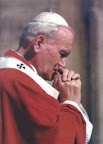
Here is an excerpt from a simple speech of the late Holy Father, John Paul II of venerable memory. I love this one:
Dear young people, many false teachers point out dangerous ways that lead to fleeting joys and satisfactions. Today expressions of our culture are mired in superficiality... Refuse to sell your dreams too cheaply! Dream, but in freedom! Plan, but in truth!
The Lord is also asking you: "Will you also go away?" Answer with the Apostle Peter: "Lord, to whom shall we go? You have the words of eternal life" (Jn 6,68). God alone is the infinite horizon of your life. The more you know him, the more you will find out that only he is love and an inexhaustible source of joy.
But to enter and remain in contact with God it is indispensable to establish a deep relationship with him in prayer. When it is genuine, prayer spreads divine energy in every context and at every moment of life. It makes us live in a new way. Is it not prayer that made Francis a new man and Clare a source of light?
I love that speech to the second international meeting of "Young People to Assisi". You can read the whole, brief thing by clicking here. The quotation from St. John's gospel is among my favorite. It's a great one for prayer when I am tired of following Jesus sometimes, or feel like giving him an ultimatum to do things my way. "Jesus, you better... or else I'll walk!" So many times the words of Peter have drifted back into my heart and mind at those points. "Fine. I guess I'm still yours, thick or thin."
At this time of the year, we do especially well to reinvest ourselves in Jesus, who is the source and summit of authentic human happiness, and to ask him with renewed fervor to reinvest Himself in us. Come, Lord Jesus!
I know lots of people who are having babies. Babies are beautiful. Now there is a documentary called "Babies," coming out, and it looks pretty... well, beautiful.
Here's the website. It seems to be about the first year in the life of four babies from different places around the globe. The people responsible have a few weird movies, but this one looks good. Thanks, Anchoress!
But always it is through an act of God, hidden or open, that faith, hope, and charity are possible. The theological virtues awaken and grow in human hearts bu the work and teaching of the Holy Spirit. That divine teaching is sometimes quite disconcerting. Let us look at the way the Holy Spirit acts within us.
There is no way to chart all the Spirit does in any life. We can't set rules for it or plan it. "The wind blows where it wills, and you hear the sound of it, but you do not know whence it comes or whither it goes," (Jn 3:8). Yet, certain constants can be traced. The mysteries of the Rosary can help us see that.
The Rosary is a very beautiful prayer through which we entrust ourselves to our Lady in order to enter into communion with the events of Christ's life. But it is also a kind of symbol of every human life. Just as the Rosary contains joyful, sorrowful, and finally glorious mysteries, it could be said of the work of the Holy Spirit in our lives that there are "outpourings" that are joyful, sorrowful, and glorious. (That is the order of their importance, but they occur in a cyclical way.)
Some outpourings of the Holy Spirit illuminate and reveal, some strip and impoverish, and some confirm and fortify. All three kinds are necessary: the first to give birth to faith, the second to teach us hope, and the third to give us the courage to love.
The author then proceeds to use details of the life of St. Peter that are recorded in the gospels as illustrations of his interpretation. When I read this tonight in adoration chapel, I literally jumped in my seat. "Holy crap!" I thought. I know, not terribly pious - my apologies. "That's my life."
There's a lot of brain food in Fr. Philippe's words. The book is simple to read, yet thick - one doesn't rush through such things. I hope my mind isn't doing cartwheels still when I lay me down in a little bit.
Here's the beginning of a paper that I recently wrote about the general approach of our bishops to overturning Roe v. Wade and creating a culture of life:
In January of 2008, Georgia Catholic Bishops Kevin Boland and Wilton Gregory announced that they would not lend their support to the Georgia state human life amendment that many pro-life leaders were pushing. Why would two Catholic bishops refuse to back a bill that sought to defend life from the moment of conception? In order to understand the pro-life position today and the various strategies that are promoted in the movement, it is first necessary to review the impact of Roe v. Wade. This paper will first review the Court’s decision in Roe and analyze the past pro-life strategies for overturning it. It will investigate the two predominant “camps”—those who seek state constitutional amendments and those who favor an “incrementalist” approach—and detail how each envisions bringing about a pro-life legal system and culture. Lastly, the brunt of this paper will evaluate the state human life amendment approach and show how it is fraught with theological, philosophical, legal, and political misunderstandings.
"It is Jesus who stirs in you the desire to do something great with your lives, the will to follow an ideal, the refusal to allow yourselves to be ground down by mediocrity, the courage to commit yourselves humbly and patiently to improving yourselves and society, making the world more human and more fraternal."
Those paying close attention will have noted that the subtitle of this blog recently changed from "Meanderings in Faith From One Hoping To Grow In Charity" to "A Pilgrimage Of Faith For Those Hoping To Grow In Charity." Why, you might ask.
Well there is an anterior reason and a proximal reason. Lol.
The anterior (earlier) reason is that I have had a growing desire to somehow draw this blog into my Christian apostolate. Huh? Every Christian is called to have an apostolate, a way or ways of presenting Christ to the world. Some apostolates are really the task of every Christian: virtuous living, for example. Other apostolates, like teaching religion, need a bit of specialized training. Some apostolates are apostolates-by-example: working in a soup kitchen, for example. Other apostolates are more apostolates-by-proclamation: writing books about the Faith, etc. One's personal apostolate is the way or collection of ways in which one presents the love of Jesus Christ to the world. Clearly, different seasons of our life will include different sorts of apostolate.
Changing the subtitle from "from one hoping to grow in charity," to "for those hoping to grow in charity," is intended to indicate the shift I am getting at here: this blog started as my personal ramblings that might or might not have been interesting to others. Now, I would like this blog to shift focus to be ramblings (perhaps from a variety of source) that may help people to understand the holy Catholic religion, and the way we think and see the world.
The proximal reason for the change in the subtitle is the homily that I recently posted on behalf of the Rev. Mr. David Wells. He made the point that life is a pilgrimage. That got me to thinking: pilgrimages have points. Meandering means wandering aimlessly, or something like it. I am a Christian, and while I get sidetracked and sometimes wander, I certainly am not wandering aimlessly. At least, I hope not. A pilgrimage, on the other hand, is "a journey, esp. a long one, made to some sacred place as an act of religious devotion." I am, please God, on a pilgrimage to heaven, as Deacon Wells pointed out. Thanks, Rev!
So I hope, dear reader, that you will stick with me, offer your contributions, and grow with us in faith, hope, and charity though clear thinking, experiencing beauty and goodness, and praising God.
In a breathtaking change of tack, Congressional Democratic leadership has decided to behave democratically. They are going to allow the House to vote on the overwhelmingly popular position to exclude federal funding from federal health care spending. Rep. Bart Stupak (R-Mich) and a group of a few dozen Democrats should be applauded for putting principle above party loyalty. The Democrat machine might try to grind them out of politics, but God will reward them.
Now the Washington Post reports that the Stupak amendment has been inserted to the House Democrats' catastrophe on a vote of 240-194. Whether the plan is stupid and ruinous for our nation, at least now we can be reasonably sure that it will not fund, either directly or surreptitiously, the murder of unborn children.
Thank you, Congressman Stupak!
The blogosphere is filled with rants of people who feel women are somehow being abused by the Stupak Amendment. In reality, their own logic is being turned against them, as is the tide of American thinking generally, and they are bitter and frustrated. The vote on the Stupak Amendment seems to more or less coincide with the majority of Americans, who believe they should not be compelled through taxation to pay for an act they believe to be morally ambiguous or worse. Abortion supporters continue to speak out of both sides of their mouth. On the one hand, as a normal medical/surgical treatment, they want abortion funded. On the other hand, as a private choice, they do not want it regulated by government authority. On the one hand, they say that abortion is a personal decision between a woman and her doctor. On the other hand, they want it funded - apparently by everyone BUT the woman or her doctor. The moral nonsense is compounded by legal nonsense.
It is heartening that Americans are starting to wake up.
A friend of mine just told me about this site called My Life Is Average. Open contributions from anyone who cares to contribute provide a steady stream of pleasant and cheerful anecdotes, like the ones quoted below:
Today, I was driving behind my boyfriend when he suddenly pulls over. I do the same and am utterly bewildered as he runs out of his car and pulls me out of mine. He then grabs my hand and we take off running.. and jumping into a giant pile of leaves he saw on the side of the road. I do believe I will be keeping him around. MLIA.
and:
Today, I was eating my dinosaur themed fruit snacks. There were only a few left, and poured them out into my hand. I find half of a red dinosaur, and a T-Rex with red on its teeth. Best bag of fruit snacks ever. MLIA.
I am convinced that even more than daily miracles, God offers us daily chuckles, if we will open our eyes to see them. C. S. Lewis wrote that he was confident that affection is responsible for nine tenths of basic human happiness. Being able to chuckle once or twice an hour probably goes a long way to basic happiness, too.










 Posts
Posts


