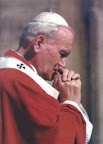
Intentions of the Holy Father for April

Ecology and Justice. That governments may foster the protection of creation and the just distribution of natural resources.
Hope for the Sick. That the Risen Lord may fill with hope the hearts of those who are being tested by pain and sickness.

Another New Man (in Another) Town

The Board of Directors of The Catholic University of America has elected the new Archbishop of Detroit to be its chairman. To see what kind of man man Archbishop Vigneron may be, check out this list that he wrote of Ten Rules for Handling Disagreement Like a Christian. The rules might as easily be called Ten Rules for Figuring Out What the Heck to Do.

CUA owes the outgoing chairman, Bishop William Lori of Bridgeport, a great debt of gratitude. I suspect that before long, it will owe Archbishop Vigneron at least as much.

If You Can Lend a Hand...

The IRS has decided to lay a heavy fine on Catholic Answers (www.catholic.com), an apologetics organization devoted to catechesis of Catholics and the presentation of our holy faith to non-Catholics. The reason for the fine?

Catholic Answers had the audacity to give Catholic answers. It's shocking that they should do such a thing, I know. What's not shocking is that the IRS is shocked. It seems that during the 2004 election cycle, Catholic Answers presented the Church's view as to why pro-choice Catholic politicians, specifically John Kerry, should not be admitted to the altar rail. At no point did the organization tell anybody how they should vote. Four years and more pass, and now (with a new Administration less friendly to Catholic teachings?) the IRS has decided that its regulations for tax exempt organizations were violated. Hmmm...

One immediately wonders if other tax-exempt organizations like NARAL, NOW, or various urban churches are being investigated under the new, more rigorous standards that seem to apply and (suddenly) to prohibit non-profits from even mentioning political figures.

Happily, Catholic Answers is not taking it lying down. They estimated they will need $100,000 for their lawsuit to fend off the Man in court. This lawsuit is an important opportunity to defy a government that has for a while become increasingly partisan and totalitarian in its behavior. Perhaps the courts will still defend the citizenry from the Administration and assert that we still have rule of law in America, and not merely rule of rulers. Instructions for donating to Catholic Answers are available on their website. I have already made a contribution to Catholic Answer's cause, and hope many others will as well.

A Bit Carried Away?

I think a lot of people have gotten carried away in their enthusiasm over Obama. Here is the editor of Newsweek Magazine.


Is there any question whether the magazine he edits will give the American people a balanced presentation of the acts of the man he calls, "sort of God?" The so-called Fourth Estate of our society, the press, is perhaps falling asleep at its job, providing the American public a final check on its leaders.

Old Loyalties Are Not All Forgotten

Today is the anniversary of the Normandy landings on 6 June 1944 that began the expulsion of Nazi armies from France. It is deeply gratifying to me that, despite political differences, our old friendship with the French is still on solid footing. We are perhaps like a married couple that bickers with each other, but nevertheless will protect each other tooth and nail.

Our friendship with the French goes back at least to the help of the Marquis de Lafayette's invaluable assistance during the Revolution. The Marquis' name is prominent in many places around the U.S., and here in the nation's capital it is especially prominent. He was the principal architect of the District of Columbia, and before that, he helped to train American soldiers to fight the British for independence. He was loved by our soldiers because, though of noble birth, he was humble, approachable, brave, and he helped to galvanize our army's resolve. While touring the U.S. after some twenty years back home in France, the Marquis told Americans in one speech that one day, we might with our idealism and willingness to sacrifice, very well save liberty in the world.

When General Pershing brought the American Expeditionary Force to France to help fight the Germans in World War I, he brought his armies to the grave of the Marquis de Lafayette. There he gave them a speech to remind them of our purpose there, and of our old friendship with France, and how they had come on behalf of America to honor that friendship once again. It is said that, while they were leaving, Pershing's attache placed a flower on the grave and said simple, "Monsieur Lafayette, we are here."

Twenty-seven years later, Americans would again return in arms, again to fight the same enemy, again on behalf of the same broken friend. France's armies had psyched themselves out and given up almost without a fight, betraying their countrymen who prayed German occupation would be brief and not so bad. Four years later, after that nation had been brutalized, its old friends west of the Atlantic returned again. As Lafayette had galvanized our nation's resolve to fight, our armies lifted France up to fight for her freedom as well. Especially in Normandy, that old friendship is not forgotten. We should be careful not to let the agendas and fads of political parties to override that friendship. It may not be too long before either they or we need once again to call upon it for assistance in peril.


Here is an article from the Washington Post.

My own experience travelling to France has been a very warm one. On four separate trips I have been treated uniformly well, despite my bad French accent and my out-of-place American clothes.

Guidelines for Fraternal Correction, pt 2

The last article discussed when to fraternally correct, and this second one will address how. As in all things, the Golden Rule (Mt 7:12; Lk 6:31) applies.

First, consider how we would react if someone, even someone we liked and who liked us, came to us arrogantly making demands and threats. It probably wouldn't go over well, and if we complied, it would be out of fear or guilt, and resentment would accompany our compliance. True?

So as a matter of sheer practicality, it is best to take the opposite approach once we've decided that someone must be fraternally corrected, and that we should be the one to do it. An attitude of humility and concern for the one corrected is key. The attitude must not be fake, nor should it be a ruse or a cover for other motivations. If we have more personal reasons for wanting a change, we should be honest with ourselves and the other about that.

To humble our heart, I have found a few reflections helpful. I try to think of ways I have contributed to the negative situation. I consider times when I have harmed the other, or done the same thing to another person that I want to challenge the correctee about. "He lives dirty dishes all over the house," should be balanced in our mind with, as applicable, "and I leave laundry in a big pile in the basement." This balanced recollection should be part of the discussion we have with our correctee. In such a situation, the correction is also a self-correction.

"Hey, dude. I've been thinking. Our house is trashed. I'm not blaming you at all - all those clothes piled in the basement are mine. I don't know how you feel about it, but I'd like to live in a tidier place. Maybe we could each resolve to straighten up our stuff in the next day or two. Would you be willing to clean up these dishes and put them away? I've definitely got to get those clothes to where they belong."

Another approach, rather than simply making a demand, "You have to stop doing X," is to show how the other's actions affect us. "Buddy, I don't think you know, but last night, I had a hard time falling asleep because of the music you were playing. I was useless at work today because I was so tired. Do you think you might be able to turn it down on weeknights, to help me out?" By temporarily abandoning the language of rights and justice, and simply sharing our heart and mind with our brother, we will often move him to compassion and sensitivity, building our community. If that doesn't work, then we may need to take stronger action, but usually easy does it, and a mild approach is more effective.

In cases where there are wrongs done in both directions, we must be willing to take responsibility and apologize for our share of the hurt. The killer thing about being a Christian, and the nature of a sincere apology, is that both are free. That is, we Christians make our apologies for our sins without regard to any sort of recompense. We apologize for our faults as they negatively impact others because that is the right thing to do, the thing that reflects our true role in the situation. It is not our concern whether the other accepts our apology or responds in kind. Often, he will not. He will feel he is righteous and that our apology has vindicated him and proven that aching spot in his conscience to be wrong. So be it. It may often be that, for the sake of doing the right thing, we must tolerate harm done to us or a justice left undone. I apologize to try to make amends, and he responds arrogantly. I cannot affect his response. I only know that I have at last done the right thing; any harm that comes to me as a result, even a mild one, is a harm that makes me more like Jesus. And that is a very good kind of harm to endure.

Guidelines for Fraternal Correction, pt 1

I learned about the concept of fraternal correction for the first time in the seminary. The concept is simple. When one has a complaint or problem with another, and neither has authority over the other, the one with the complaint shares it with the other in an attempt to correct him or the situation as a whole.

In another post I will babble on about how to do a fraternal correction. The spiritual director gave us guidelines for the how. For now, I will discuss briefly the why and when. These come from my own observation. Take them for what they are worth.

Fraternal correction is important in the life of a community because it prevents a grievance from festering. By providing a healthy outlet for problems, it reduces the temptation to the divisive and diabolic sin of gossip. Make no mistake about it: gossip destroys the life of a community and comes straight from hell. The Greek word for gossip, or slander, is diabolos. There is a good test for whether "sharing" is "healthy venting to a third party," "seeking outside advice," or whether it is actually vicious gossip. The test is to consider our willingness or eagerness to relate the events only to persons who know nothing of the situation or the individuals involved, and to leave out all identifying characteristics. If we are just itching to say someone's name, we are almost certainly about to engage in malignant gossip. Don't. Now, back on track.

Fraternal correction encourages proactivity and ownership on the part of the members of the community, rather than passively waiting around for someone else, someone in authority to solve every interpersonal tension. Fraternal correction should be a skill in the repertoire of every grown man and woman.

When should we fraternally correct? I mean, if we all run around venting all of our grievances all the time, without ever being judicious and careful in doing so, we will almost certainly tear everyone around us down, and ourselves too, and end up friendless. Sensing this possibility, I came up with these criteria for a correction. All three criteria being met fully, I proceed with my intended correction.

#1. I must like the person whom I am considering correcting. Love isn't good enough a criterion because we Christians are supposed to love everyone, and boy, do we. Lol. We fool ourselves too easily on this point. But if I actually like the person and feel warmth and affection toward him, then I can be confident that my motives are pure enough, that I am doing it at least partly for his own good and not my own weird, selfish motivations.

#2. My complaint must be graver than my ability to endure. If it is a petty thing that I can deal with on my own, then I do. The expression, "suck it up," comes to mind. If what the person is doing is an objective wrong against me and is making hard for me to avoid doing wrong to him, then I should bring it to him in correction. If my brother is doing something that will lead him or others to real harm, then I should bring it to him. If my brother chews with his mouth open and it disgusts me, but doesn't actually harm me or immediately lead me to sin against him seriously, then I should chill out a bit. At this point, I need to be careful there is nothing I can do to let go of the problem: work through my own issues, reprioritize my values (close friendship over mere table manners, etc).

#3. I should be reasonably confident that he will heed my concern. We listen most to peers whom we know to care about us and to like us. The more serious the matter, the more personal or painful, the more confident we must be that the person confronting us is doing so out of love. There are extremes, though. I cannot wait until I am absolutely sure that someone will listen to me, when I am concerned that he is suicidal, or that someone under his care is in harm's way. At times we must discharge our conscience and let the chips fall where they may. The more grave the concern, the less confident I need to be and the more willing I should be to go out on a limb.

These three criteria are those I came up with. It would be great to receive feedback and correction from a brother or sister on the matter. In part two I will outline the procedure for correction that the spiritual director laid out before us at the seminary.

No Bones About It

An infamous villain was murdered on Sunday in his church; and it is a horrible thing that was done to him. Whatever his crimes were, and whatever punishment he deserved and may now receive before God, it is always and everywhere wrong deliberately to harm or kill someone who does not pose an immanent threat to oneself or to those under one's God-given duty to protect. Murder is always wrong. All that said, because a cold-blooded profiteering murderer was killed by another murder, himself deranged and fanatical, it is entirely unfair to label the pro-Life movement as hateful or to say that it incites violence. Those who hate life have already begun to use the murder of Dr. Tiller as an excuse to smear the pro-Life movement and to cow people from rallying to its cause, because they rightly understand that good-hearted, sound-minded people don't want to be associated with murderers. But murderers aren't pro-Life, and pro-Lifers aren't murderers. We must take this opportunity to state unequivocally that murder is always wrong, against not only the unborn, but also against their murderers. We must refuse to back down or to be cowed, but instead take the opportunity to be counted and to repeat firmly that no matter what, still


I am pro-Life.

People Say That God Has a Plan

So right now I am going through a lot of uncertainty in life, some emotional turbulence, and some minor practical chaos. To specify a bit, just enough to give a feel, but not so much as to spill my guts inappropriately, the "minor practical chaos" of the last week has included our basement flooding three (3!) times, my car breaking down, and some hay fever (a day or two after the rains finished flooding our basement and all the watered plants went back to pollinating). So, yeah, things have been kinda rough.

A theme emerging in all this s...tuff is God's providence, that "God has a plan for everything." Other people have been relating to me, unsolicited, the stuff in their lives past and present, and sharing with me this confidence: God has a plan for everything, and everything is part of his plan.

Fine. Why did God make mosquitoes, then, I protested to a friend years ago, just rhetorically, when he told me that God has a plan for everything. The biologically minded conversation friend told me that the mosquito's role is to spread disease to cull herds. Fine. Where mosquitoes failed me, I now have a better challenge to God's providence. If God has a plan for everything, what's His bright idea about the shield bug? It doesn't bite or sting or carry disease as far as I know. It just smells kinda poopy, and they sneak into our house a lot when the screen door isn't shut all the way. They don't really bother us overly, not enough to make us (or, I suspect, other large mammals) migrate or anything. They don't get into our food, but they do gravitate toward light bulbs. But none of those observations gives a clear answer to the question. The "why?" remains.

So it is with the flooding that caused no damage, but just annoyance; and so it is with a lot of the other s...tuff in the last few weeks. Of course, the stuff I do to myself is explained by just that fact alone: I do it, and God permits it so I can learn and grow up finally. Fair enough. But still, what about the shield bugs of life?

I think, in the end, I am going to have to side with Job here. I am gonna have to just admit I don't know, and with out being too pushy, tell God I'd like an answer, and wait on Him to decide when it's best for me to know. Something in me really strongly rebels against not knowing everything about everything that affects my life, against not being in charge of everything around me. That's OK, too. That's the way it is. I just keep going to confession in those cases. Every time, the Son of David is merciful to me (Lk 18:38), a sinner. So until I have a better answer, that's what I'm gonna have to try to get through my thick skull - God's mercy. To paraphrase the Little Flower, everything is a mercy. Even the shield bug.

Signs of the Times

It is not terribly shocking to hear that Fr. Alberto Cutié has decided to defect from the Catholic Church, and go to one (the Episcopal - that is, Anglican-in-America) in which things will be more to his liking. For one, they don't mind his inability or lack of ongoing commitment to celibacy. Fair enough - they don't require or esteem celibacy in the first place. More intriguing is the fact that they don't mind that he is an oath-breaker. He made solemn promises of obedience and celibacy, and now has unilaterally dodged them both in one fell swoop. They don't suit him anymore. One would think that Fr. Cutié's new superior would at least want to be sure that he can stick to a vow, no?

Well, it's perhaps fitting, after all. After all, the Anglican Communion was founded when an oath-breaking king became tired of his promises regarding sexuality, and decided to put away his first wife for another. And another. And another. One wonders how many churches Fr. Cutié will put away to suit his evolving tastes before the whole thing is done. It's a little known fact that England and her kings were legal vassals (governmental subordinates) of the Pope until Henry VIII broke his forefathers' faith. In most of Europe, the Pope could take up special collections and so forth; in England, he could collect taxes and call for soldiers. Henry VIII would rather have things his own way, though, rather than honoring the promises of his fathers. Now that Fr. Cutié has broken with Rome, one must wonder if he will really let himself be governed by another master, or if he will be his own... if perhaps he is already his own master. That's the devil's motto, in Milton's Paradise Lost: "I will not serve." That and his television show frankly smack of a towering pride.

Meanwhile, our President has named an ambassador to the Holy See: Miguel Diaz. He is Catholic, in the way that the Sandinistas are. He is "pro-Life," in the way that Douglas Kmiec and the President are. He publishes on presses that call themselves Catholic but are either notorious for dissent, uncommitted to the teachings of the Church, or flat out deny the entirety of Christian revelation. Like Fr. Cutié and the President, he is young, good looking, smooth, and charismatic. He has a track record of supporting social justice issues for the poor and weak (except for, as one commentator has pointed out, the poorest and weakest, i.e., the unborn). He is suave and probably very convincing, and will probably be charged by the White House with getting the Vatican to believe that white is black and black is white, that good is evil, and evil good.

And against these slicksters, whom can Holy Church send forth, tattered and bruised by her own conduct as much as by that of her enemies? The likes of this man:

Now, don't get me wrong. Archbishop Favalora of Miami is likely a very competent administrator, strong shepherd, and loving father. He has enormous responsibilities of which, dear reader, you and I cannot even dream. I wouldn't criticize a bishop to save my life, I hope. I used to, but I'm done with that. It just helps out our enemies. And His Excellency's words regarding Fr. Cutié strike me as very well chosen. Still, looking at him and hearing his words will not be very convincing to most Americans - Catholic or otherwise - when the likes of Fr. Cutié or Prof. Diaz is sitting on the opposite side of the talk-show host. The Archbishop certainly has authority over both them (well, over Diaz only indirectly, since Diaz doesn't live in his diocese), and his reasoning is doubtless sounder than that of Cutié. All the same, I have a sickening feeling in my gut that many, many of the priest's fans, preferring to have their ears tickled, will choose him over Jesus' plump, wrinkly old vicar in Miami.

"For the time is coming when people will not endure sound teaching, but having itching ears they will accumulate for themselves teachers to suit their own likings, and will turn away from listening to the truth and wander into myths," 2 Tim 4:3-4.

A close friend of mine is being ordained a priest this weekend in Burlington, Vermont. Several more friends from my time in seminary will be ordained priests and (transitional) deacons in the next few weeks. They are young. Some are more charming and charismatic than others, but they are all very good men and that shines through. They believe in Jesus. They love and obey his Church. They defend life. I couldn't close without pointing out a few stars amid the dark night sky.

Seek to Know...

"Seek to know the path of spiritual childhood, without forcing yourself to follow this path. Leave works to the Holy Spirit," The Way #852, St. Josemaria Escriva.


Hadn't heard from him in a while, and I read this one at my desk when I got to work this morning. He is so excellent.

The People God Puts

I am from time to time amazed by the quality of the people that God puts into my life, and the timeliness with which our paths converge, and the fruit of the friendships that He gives us in each other. Today is St. Matthias day. St. Matthias was the disciple inducted by the Apostles into their little college to replace the fallen Judas Iscariot (Acts 1:23-26). Can you imagine how unnerving and humbling it must have been for him to be told, "Matthias, we feel that the Holy Spirit wants us to lay hands upon you and to share with you the ministry that Jesus gave to us before he ascended to his glory." "Me?" would be a reasonable, humble response.

I used very often to feel unworthy of my friends. Maybe I am - it's not for me to say. Now, I mostly just feel grateful for them, and that is all the difference in the world, and much better, I think. Reflecting on how much my friends tolerate in me helps motivate me to try to be tolerant with others. All this makes me think that it is probably a good thing to stretch ourselves a bit about who we are willing to be friends with.

Father, I pray You kindle in my heart love for those You bring into my life, so that in each other, we may encounter You, through Your Son Jesus Christ. Amen.


"Affection is responsible for nine-tenths of whatever solid and durable happiness there is in our lives," C. S. Lewis

More Coolness, Precious


Anyone else out there a fan of The Lord of the Rings? Ok, so I do not dress up as a hobbit, but I have read the trilogy a few times, and a couple of the accompanying novels written and/or edited by J. R. R. Tolkien or his son, Christopher. Someone, apparently inspired by the cinematographic version of the trilogy has decided to use the novel to fill in some of the blanks in the Peter L. Jackson production. Click here to see the just-released "The Hunt for Gollum."

Super Cool - Catacombs Come to Life

Check out this story about an archaeologist who is scanning the Catacombs of St. Domitilla, beneath the city of Rome, to make a 3D, real-color image of them.

http://news.bbc.co.uk/2/hi/europe/8027650.stm

If you click on the link, you'll get a cool sneak-peek at what the man is doing. Golly, what an age we live in!

Why Do They Care?

I am not immensely intrigued by Protestants who want the Eucharist, because their desire makes sense to me. I want the Eucharist, too. It is interesting to note that most mainline denominations in the U.S. celebrated "the Lord's Supper" regularly until about a hundred years ago, when fear of seeming "too Catholic" caused their ministers to reduce the frequency of communion services dramatically, from weekly to monthly, or even yearly. A friend of mine, a conservative Presbyterian, recently shared his frustration with me at hearing from his minister on Holy Thursday how the Eucharist is spiritual food. He summarized his frustration thus: "Then why doesn't [that minister] feed us more often than once a year?!"

What does impress me is how many Protestants seem to take it personally that we (Catholics) will not share Communion with them. They seem to take it as a sort of snootiness or arrogance on our part, as if we feel we are better than them. Feelings haven't anything to do with any of it, though. Nor does the status of their communion celebrations, or their beliefs and feelings regarding communion. While few Protestants have beliefs about the Eucharist the same as ours, most that I know do believe that is Jesus is somehow manifest in the Eucharist. That's great. It's a start. It also has nothing to do with why we will not share Communion with them. What is forming our stance is a matter of fact: in very substantial ways Protestants are not in communion with us and to share the Holy Communion with them would be to falsify communion.

When a Protestant is submits in matters of faith and morals to the authority of Church, who teaches on behalf of Christ, then the Protestant will have moral unity with the Church, and may share in our sacramental communion. Sharing sacramental communion before there is moral unity is like sharing sexual relations before there is sacramental marriage: it puts the cart before the horse, falsifies the nature of the relationship, and thereby cheapens the sacrament.

And the thing is that this teaching isn't personal. It's not like the Church has it out for Protestants or think we are better than them (although, sadly, there are many arrogant asses like myself among us). In fact, Catholics living in sin (I don't just mean sexually) aren't to go to communion either. Nor are Catholics who have eaten too recently. Of course, when the pews empty at communion time, a number of Catholics are going to communion who probably should not be - either for committing some sin, dissenting from some teaching, or from casually eating Cheetos before going to Mass. This careless communion gives cause for scandal to our Protestant brethren. "If all those flaky Catholics can go to Catholic communion, then why can't I?" The question is pretty legitimate. It would be easier to explain our doctrine about reception of the Eucharist if we as a community lived it out better ourselves.
If, at communion time, a significant number of Catholics-in-the-pew refrained from communion, as used to be the case, guests in our community would probably not feel so left out in the cold. For now, a good second best is probably to encourage friends that come with us to Mass to go up to receive a blessing - arms folded across chest, head bowed, mouth closed. And of course, there is the old multiknife of solutions - prayer.

I think there really is a reason, though, that they want our Eucharist. As previously noted, they have been starved by their own denominations from the spiritual blessing of reenacting the Lord's Supper. But there's more. Because we have priests successively ordained from generation to generation back to the apostles and our Lord himself, we offer the sacrifice that He taught us, and in that we sacrifice have Him for Whom we were made, in what merely appears to be bread and wine. We haven't just got mere symbols, or memorials, or spiritual presences. We have Him. He's attracted such a magnetic relationship upon the world for two thousand years so that one must, after reflection, either love Him or hate Him. Our hearts were made for Him, and as He predicted, the more Holy Church lifts Him up, the more He draws all men to himself (Jn 12:32).

Whoa

Kathleen Parker of the Washington Post just printed online this article concerning the Obama-Notre Dame fiasco. What strikes me is that this (by her own admission, unemphatic) pro-choice writer sorts through the issue very evenhandedly and in a way sympathetic to Holy Church. She applauds Prof. Glendon's recent decision to refuse the Laetare Medal from Notre Dame, so as not to share a platform with Obama, and so as not to legitimate the honors to be given him. She works through the question of why this issue is so important to us (Catholics), and what the President might do in order to display goodwill, tact, and poise.

Let's hope he does it, because the administration of Notre Dame hasn't the sense anymore. An alternative scenario would be a large-scale boycott of the commencement exercises by the graduating class. That would send an excellent and powerful message to both the President and to Notre Dame's administration.